


















The Barents Sea is a shallow part of the Arctic Ocean squeezed between the coastline of northern Russia, Scandinavia, and several islands to the north. Microscopic forms of phytoplankton thrive in its nutrient-rich waters, feeding invertebrates and small crustaceans that sustain an abundance of fish, seabirds, and mammals.
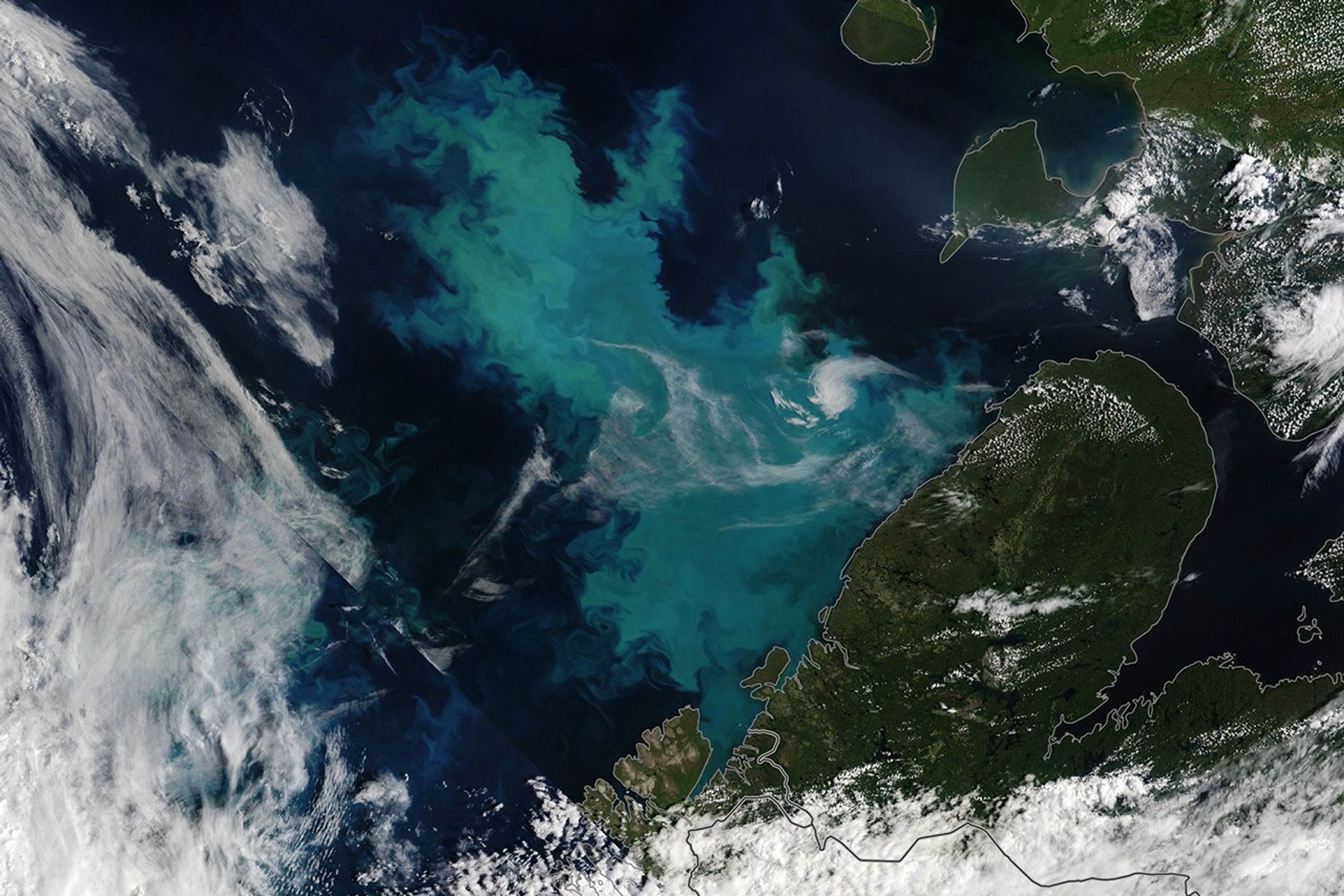
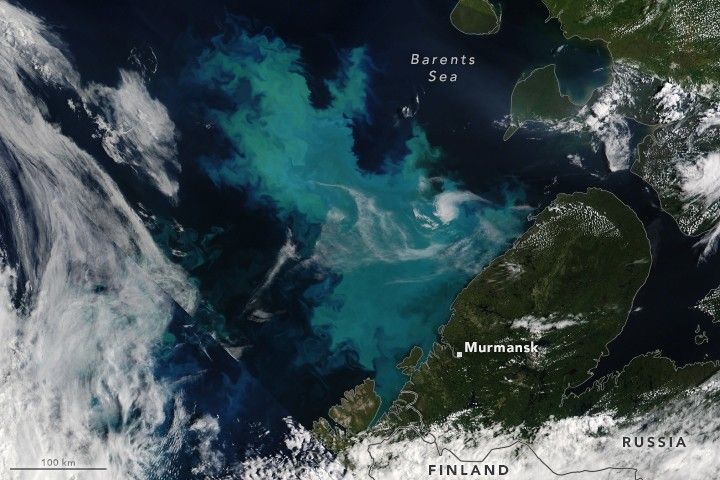
Individual phytoplankton are too small to be visible to the naked eye, but huge numbers of them together can change the color of the ocean over hundreds—or even thousands—of kilometers. These “blooms” in the Barents Sea can be hard to observe with optical imagers because it is among the cloudiest places in the world. However, on August 3, 2023, a break in the clouds offered a spectacular view of a bloom in the waters north of the Scandinavian and Kola peninsulas. The image above was acquired by the Moderate Resolution Imaging Spectroradiometer (MODIS) on NASA’s Terra satellite.
Many phytoplankton species live in the cool waters of the Barents Sea, but the milky blue color in this image suggests that the bloom contains coccolithophores, microscopic plankton plated with white calcium carbonate. In this case, the species is likely Emiliana huxleyi, whose blooms tend to be triggered by high light levels during the around-the-clock daylight of Arctic summers. Other colors in the scene may come from sediment or other species of phytoplankton, particularly diatoms.
The Barents Sea usually has two major bloom seasons each year, with diatoms peaking in May and June, then giving way to coccolithophores by August as certain nutrients run out and waters grow warmer and more layered. As the climate changes, increasing amounts of warm water from the Atlantic Ocean are flowing into the Barents Sea and reducing the amount of sea ice. As these changes play out, scientists are using satellites to track how phytoplankton populations are responding.
One group of researchers observed large shifts in the location of summer coccolithophore blooms to the northeast between 2002 and 2018. They also identified an increasing presence of Phaeocystis pouchetii, a type of phytoplankton normally found in warmer waters that can form gelatinous colonies millimeters in diameter. The effect that such changes might have on the ecosystem is a topic of ongoing research.
References & Resources
- Chernokulsky, A. et al. (2017) Climatology and Interannual Variability of Cloudiness in the Atlantic Arctic from Surface Observations since the Late Nineteenth Century. Journal of Climate, 30 (6), 2103-2120.
- Dalpadado, P. et al. (2020) Climate effects on temporal and spatial dynamics of phytoplankton and zooplankton in the Barents Sea. Progress in Oceanography, 185, 102320.
- The Barents Observer (2016, July 13) Spectacular Barents Sea plankton bloom. Accessed August 4, 2023.
- NASA Earth Data Ocean Color. Accessed August 4, 2023.
- NASA Earth Observatory (2010, July 13) What are Phytoplankton? Accessed August 4, 2023.
- Neukermans, G. et al. (2018) Increased intrusion of warming Atlantic water leads to rapid expansion of temperate phytoplankton in the Arctic. Global Change Biology, 24(6), 2543-2553.
- Orkney, A. et al. (2020) Bio-optical evidence for increasing Phaeocystis dominance in the Barents Sea. Philosophical Transactions of the Royal Society, 378(2181).
NASA Earth Observatory image by Michala Garrison, using MODIS data from NASA EOSDIS LANCE and GIBS/Worldview . Story by Adam Voiland .