




















In early November 2023, sky watchers across North America and Europe posted photos on social media of dazzling displays of the northern lights, also known as the aurora borealis. Colorful ribbons of light filled night skies, incited by a strong geomagnetic storm in Earth’s magnetosphere.
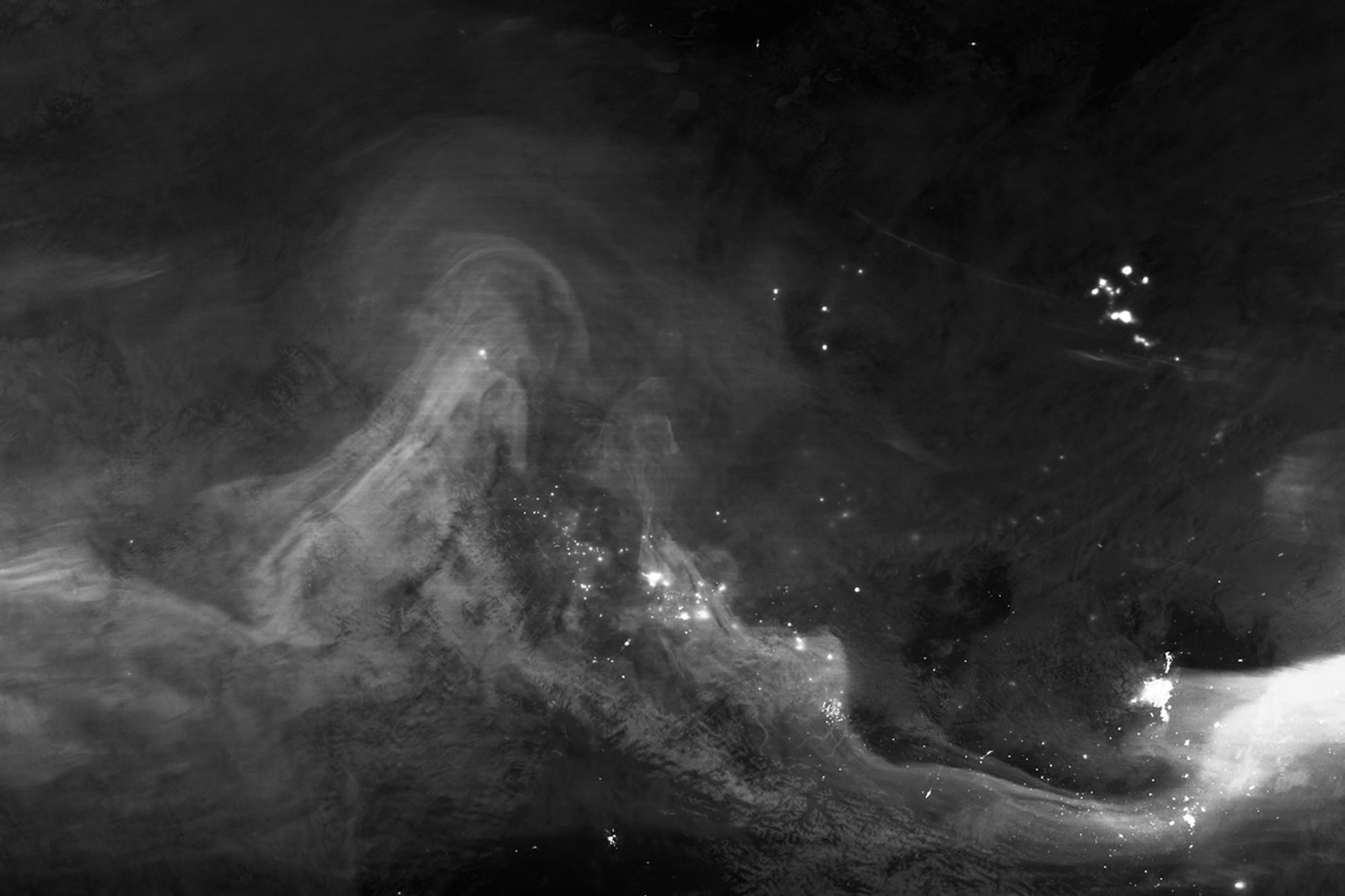
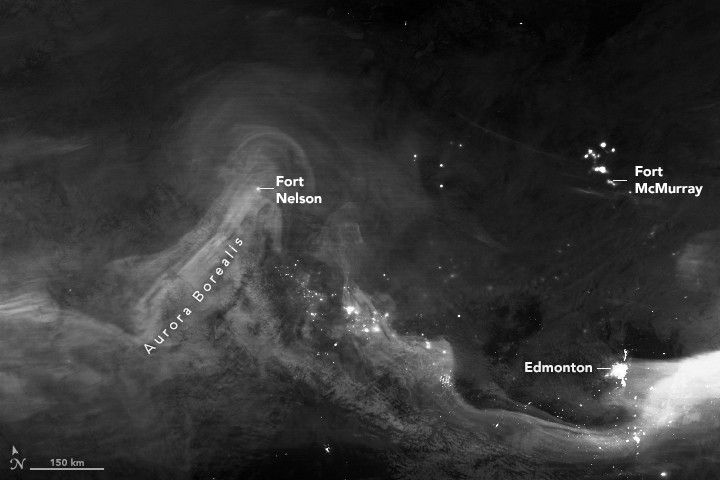
The VIIRS (Visible Infrared Imaging Radiometer Suite) sensor on the NOAA-NASA Suomi NPP satellite captured this image of the aurora over western Canada at 3:23 a.m. Mountain Time (10:23 Universal Time) on November 5, 2023. The aurora was so bright near Edmonton, Canada, it nearly saturated the satellite sensor. The event continued into the next evening, when skies in Glasgow, Montana, danced with pink and green light. The lights were especially bright near the U.S.-Canada border and in Alaska, but they were also faintly visible as far south as Texas.
The creation of an aurora typically starts when the Sun sends a surge of charged particles—through solar flares, coronal mass ejections, or an active solar wind—toward Earth. The solar particles collide with the magnetosphere and compress it, changing the configuration of Earth’s magnetic field. Some particles trapped in the magnetic field are accelerated into Earth’s upper atmosphere where they excite nitrogen and oxygen molecules and release photons of light, known as the aurora.
The aurora on November 5–6 was the product of multiple coronal mass ejections, large expulsions of magnetized plasma from the Sun’s corona, according to NOAA’s Space Weather Prediction Center. These bursts of plasma and energetic waves from the Sun crashed into Earth’s upper atmosphere, causing a strong geomagnetic storm.
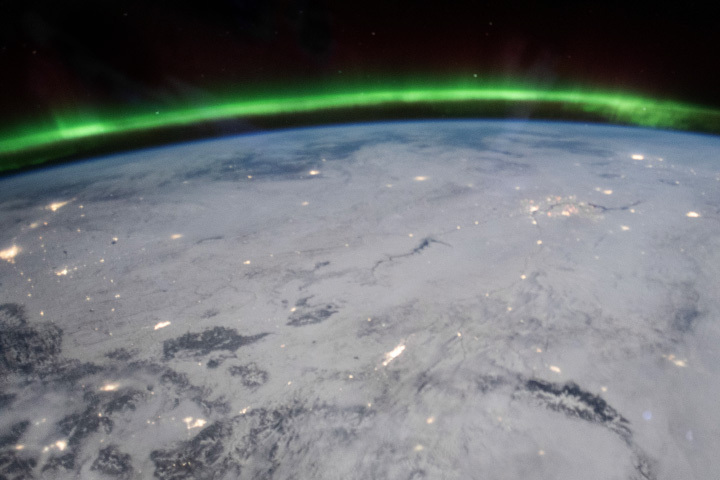
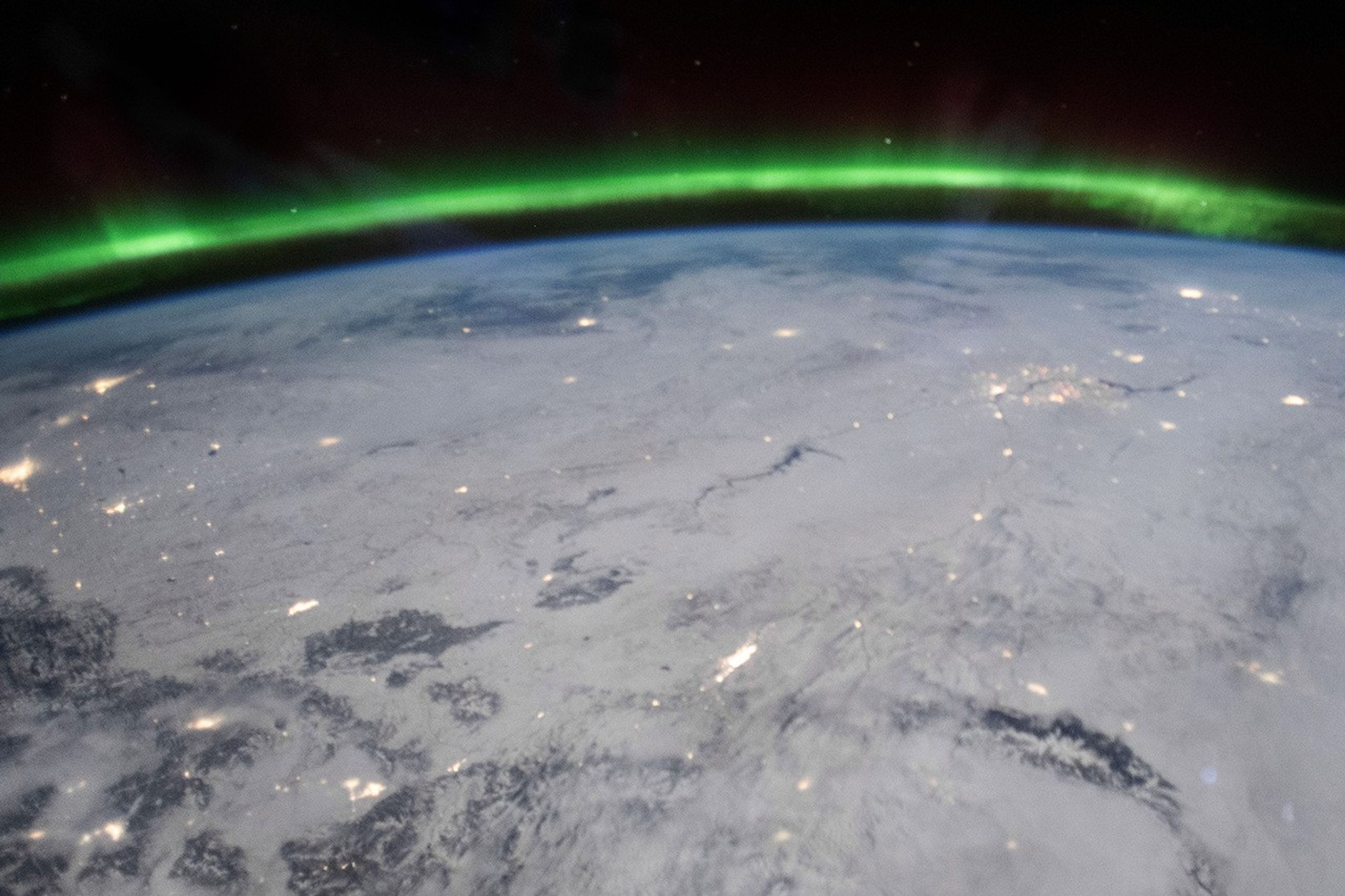
A week before the storm, an astronaut on the International Space Station captured a photo (above) of another aurora while orbiting 260 miles (418 kilometers) above Utah on October 28, 2023. This aurora was likely caused by a coronal hole that rotated towards Earth, according to the Space Weather Prediction Center. A coronal hole is an area of relatively cooler material in the solar atmosphere that is open to interplanetary space. These dark regions on the Sun’s surface emit material in a high-speed stream.
If you like watching aurora displays such as these, you can participate in aurora citizen science through a project called Aurorasaurus. The project tracks auroras around the world via reports to its website and on social media, then generates a real-time global map of those reports. Citizen scientists verify reports, and each verified sighting serves as a valuable data point for scientists to analyze and incorporate into space weather models. The project is a public-private partnership with the New Mexico Consortium and is supported by the National Science Foundation and NASA.
References & Resources
- Aurorasaurus Reporting auroras from the ground up. Accessed November 9, 2023.
- NASA Earth Observatory (2023, March 3) A Dazzling Aurora Borealis. Accessed November 9, 2023.
- NOAA Space Weather Prediction Center News Archive. Accessed November 9, 2023.
- NOAA Space Weather Prediction Center (2023, November 6) Weekly Highlights and 27-Day Forecast. Accessed November 9, 2023.
- The Washington Post (2023, November 6) Northern lights unleash outburst of color in skies over U.S., Europe. Accessed November 9, 2023.
NASA Earth Observatory image by Lauren Dauphin and Wanmei Liang, using VIIRS day-night band data from the Suomi National Polar-orbiting Partnership . Astronaut photograph ISS070-E-14996 was acquired on October 28, 2023, with a Nikon D5 digital camera using a 24 millimeter lens and is provided by the ISS Crew Earth Observations Facility and the Earth Science and Remote Sensing Unit, Johnson Space Center. The image was taken by a member of the Expedition 70 crew . The image has been cropped and enhanced to improve contrast, and lens artifacts have been removed. The International Space Station Program supports the laboratory as part of the ISS National Lab to help astronauts take pictures of Earth that will be of the greatest value to scientists and the public, and to make those images freely available on the Internet. Additional images taken by astronauts and cosmonauts can be viewed at the NASA/JSC Gateway to Astronaut Photography of Earth . Story by Emily Cassidy .