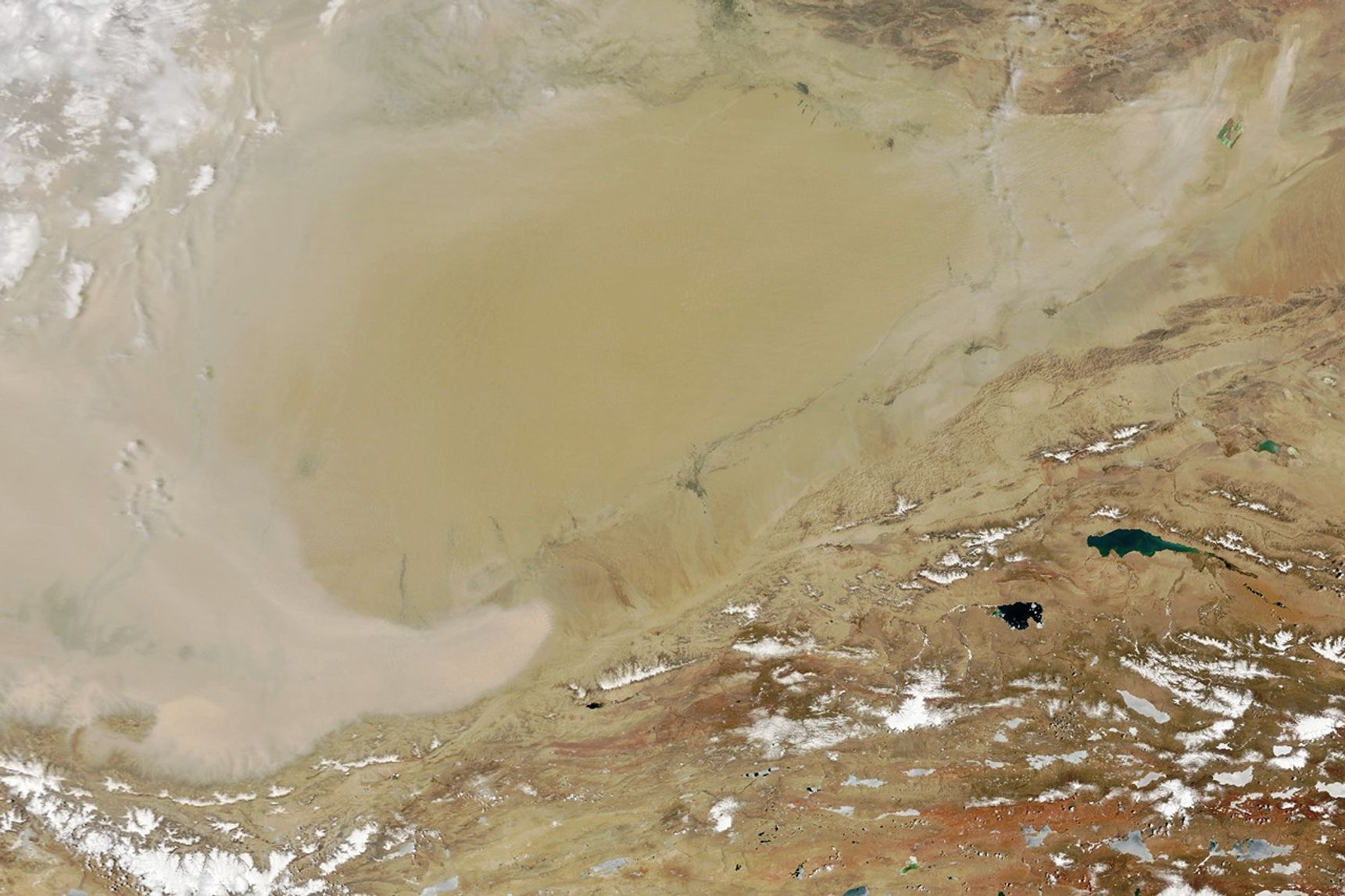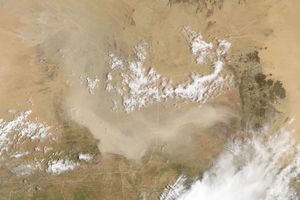



















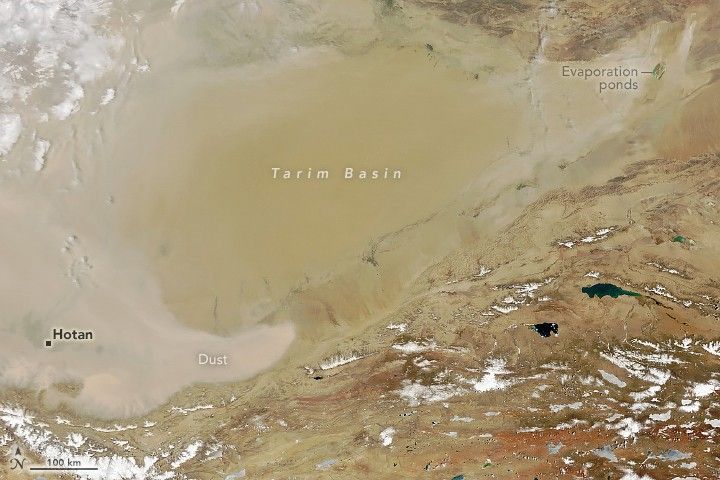
A thick plume of sand and dust hung in the air over China’s Tarim Basin in May 2024. While spring dust storms in the basin look remarkable from above, they carry implications for air quality and the health of people on the ground.
The MODIS (Moderate Resolution Imaging Spectroradiometer) on NASA’s Terra satellite acquired this image on May 19, 2024. Most of the Tarim Basin is visible within this scene, except for areas around the basin’s southwest perimeter that are obscured by airborne dust.
The Tarim Basin is hemmed in on three sides by the Tianshan, Kunlun, and Altun mountains. With very little rainfall and high rates of evaporation, the basin’s Taklimakan Desert has become one of the driest, most barren expanses on Earth. This desert accounts for more than a quarter of China’s desert area and is the largest single source of dust aerosols from East Asia.
Dust storms in the basin are most common in the spring and summer. In spring, strong cyclonic winds from the northeast easily pick up particles from the dry, loose surface. Warming of the ground in springtime drives turbulence in the atmosphere that can loft particles to higher altitudes than at other times of the year. Dust generally stays within the basin unless it reaches altitudes high enough to be blown over the surrounding mountains.
Dust from the Taklimakan Desert can affect the air quality in urban areas that lie downwind. Researchers showed that in 2015, dust reached numerous cities in Northwest China and was correlated with increased concentrations of fine particulate matter (PM2.5).
Other research found that between 1989 and 2021, the Tarim Basin saw an average of 60 dust days per year. Some areas, including southern parts of the basin around Hotan, were dustier than others, especially in spring. However, the frequency of dust weather during that period was declining across the basin.
References & Resources
- MODIS Image of the Day (2024, May 17) Heavy Dust across China. Accessed May 20, 2024.
- NASA Earth Observatory (2016, May 3) The Taklimakan Desert: A Factory for Dust Storms. Accessed May 20, 2024.
- Xiaoyu, L., et al. (2018)The Impacts of Taklimakan Dust Events on Chinese Urban Air Quality in 2015. Atmosphere, 9 (7), 281.
- Zhou, Y., et al. (2023)Characteristics of Dust Weather in the Tarim Basin from 1989 to 2021 and Its Impact on the Atmospheric Environment. Remote Sensing, 15 (7), 1804.
NASA Earth Observatory image by Michala Garrison, using MODIS data from NASA EOSDIS LANCE and GIBS/Worldview . Story by Kathryn Hansen.