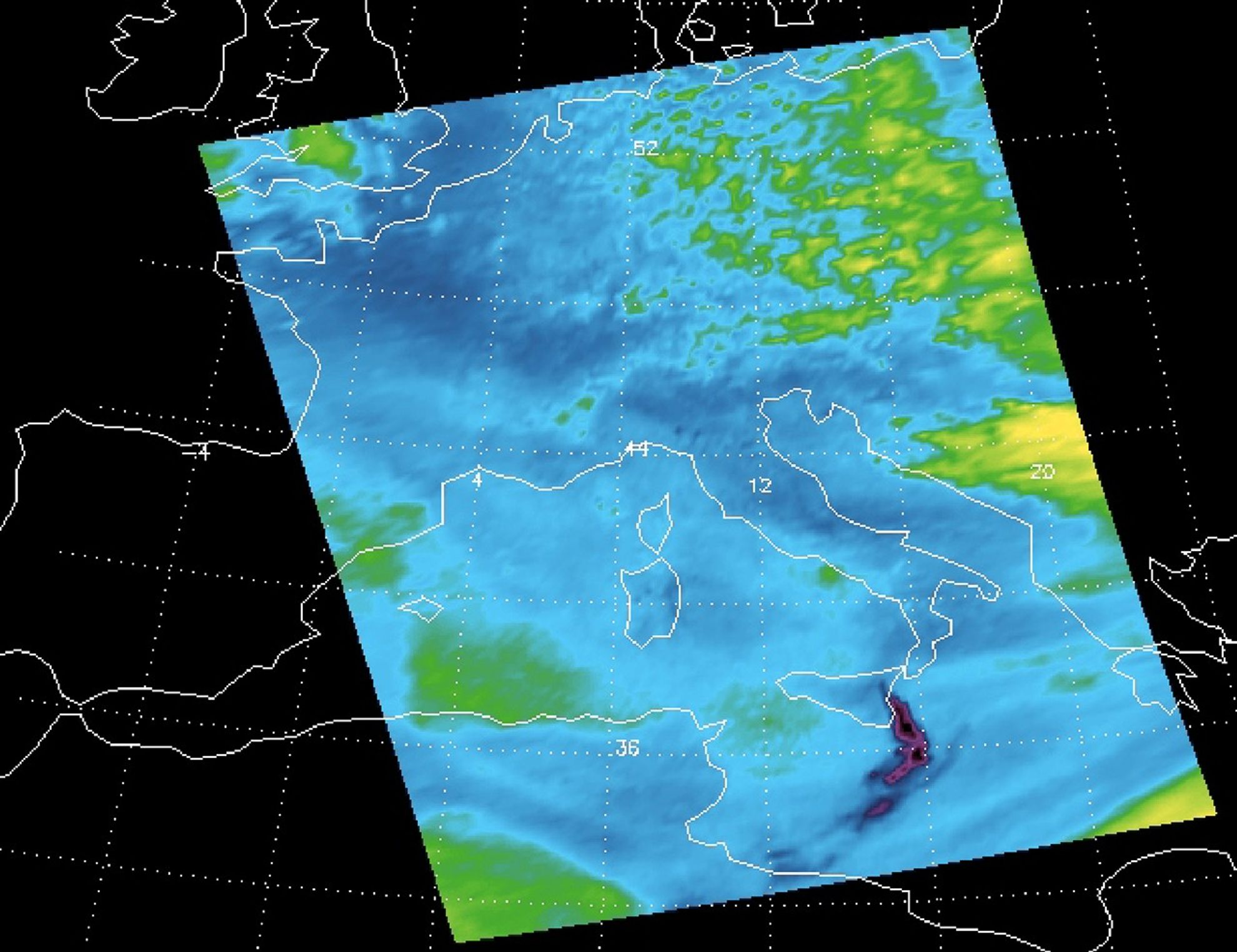




















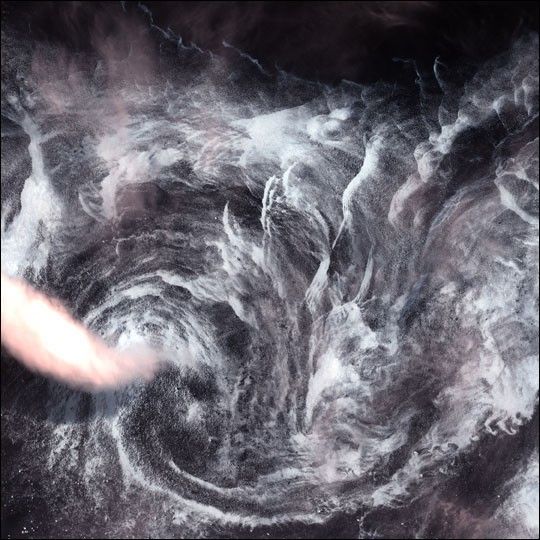
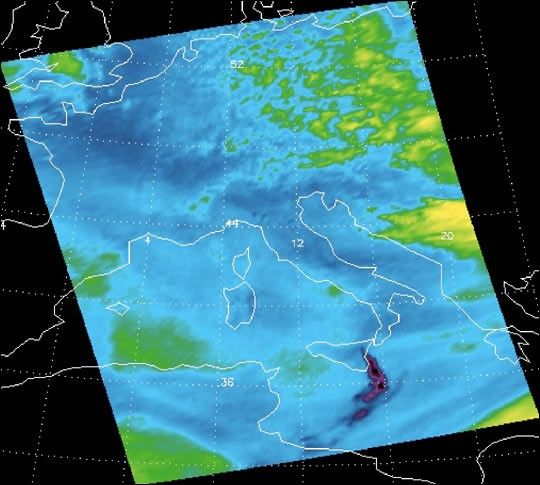
Mt. Etna, a volcano on the island of Sicily, erupted on October 26,2002. Preliminary analysis of data taken by the Atmospheric InfraredSounder (AIRS) on NASA’s Aqua satellite on October 28 shows theinstrument can provide an excellent means to study the evolution andstructure of the sulfur dioxide (SO2) plume emitted from volcanoes.These data also demonstrate that AIRS can be used to obtain the totalmass of SO2 injected into the atmosphere during a volcanic event,information that may help us to better understand these dangerousnatural occurrences in the future.
The image above clearly shows the SO2 plume in shades of purple and black.This image was created by comparing data taken at two different frequencies, or channels, andcreating one image that highlights the differences between these twochannels. Both channels are sensitive to water vapor, but one of thechannels is also sensitive to SO2. By subtracting out the common watervapor signal in both channels, the SO2 feature remains and shows up asan enhancement in the difference image.
References & Resources
Image courtesy AIRS team, NASA JPL