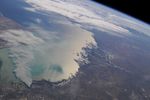








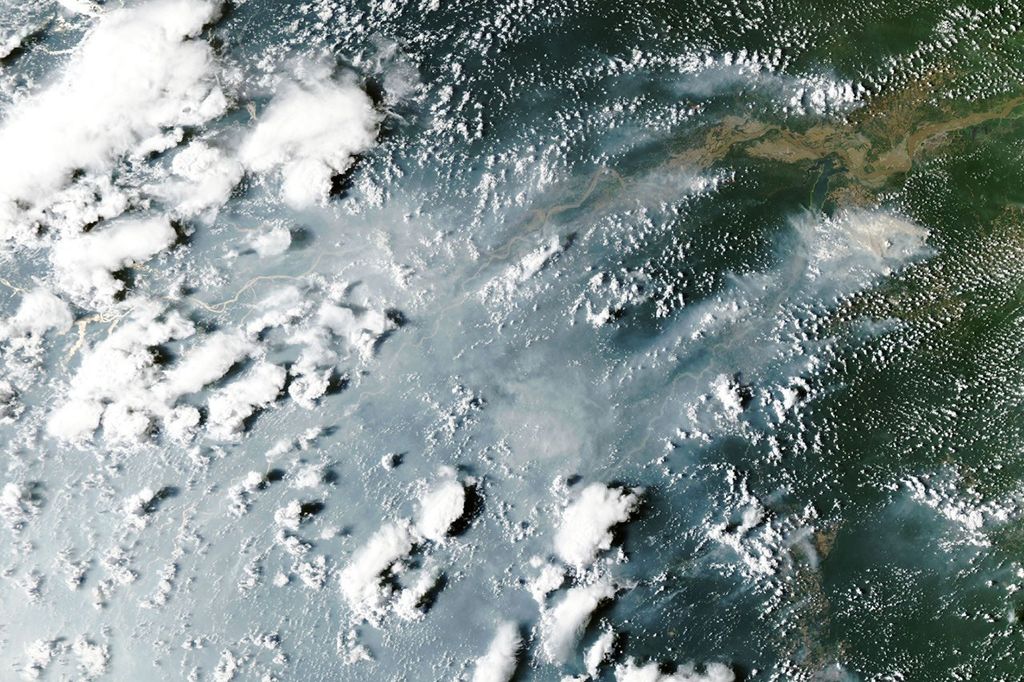









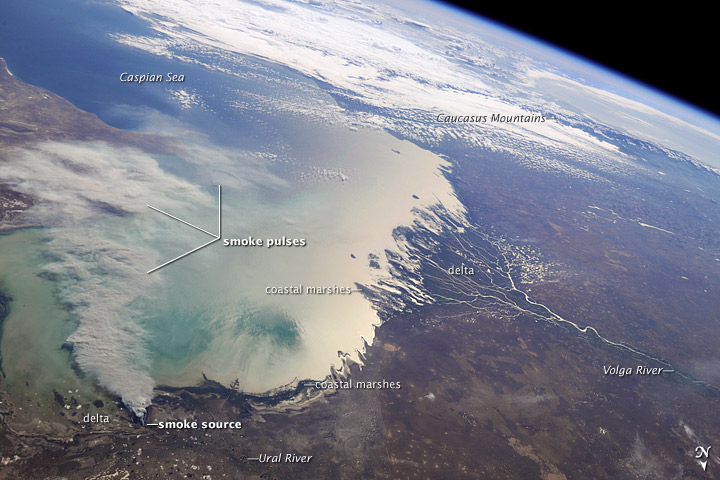
Astronauts on the International Space Station took in this view of the north coast of the Caspian Sea and two river deltas in Kazakhstan and Russia on September 11, 2010. The larger delta (image middle) is that of the Volga River, which appears prominently in sunglint—light reflected off a water surface back towards the observer—and the smaller, less prominent delta is the Ural River (lower left).
The smoke plume appears to rise out of coastal marsh vegetation in the Ural River delta, rather than a city or oil storage facility. Although even small fires produce plumes that are long, bright, and easily visible from space, the density of the smoke in this plume—which stretches 350 kilometers (217 miles)—suggests it was a significant fire. The smoke was thick enough near the source to cast shadows on the Caspian Sea surface below. Lines mark three separate pulses of smoke: the most recent, nearest the source, extends directly south from the coastline. With time, plumes become progressively more diffuse. The oldest pulse appears thinnest, casting no obvious shadows.
Wide-angle, oblique views such as this—taken looking outward at an angle, rather than straight down towards the Earth—give an excellent impression of how ISS astronauts view the Earth. For a sense of scale, the Caucasus Mountains, across the Caspian, are approximately 1,100 kilometers (680 miles) to the southwest of the space station’s nadir point—the location on Earth directly underneath the spacecraft—at the time this image was taken.
References & Resources
Astronaut photograph ISS024-E-14233 was acquired on September 11, 2010, with a Nikon D3X digital camera using a 50 mm lens, and is provided by the ISS Crew Earth Observations experiment and the Image Science & Analysis Laboratory, Johnson Space Center. The image was taken by the Expedition 24 crew. The image has been cropped and enhanced to improve contrast. Lens artifacts have been removed. The International Space Station Program supports the laboratory as part of the ISS National Lab to help astronauts take pictures of Earth that will be of the greatest value to scientists and the public, and to make those images freely available on the Internet. Additional images taken by astronauts and cosmonauts can be viewed at the NASA/JSC Gateway to Astronaut Photography of Earth . Caption by M. Justin Wilkinson, NASA-JSC.