
















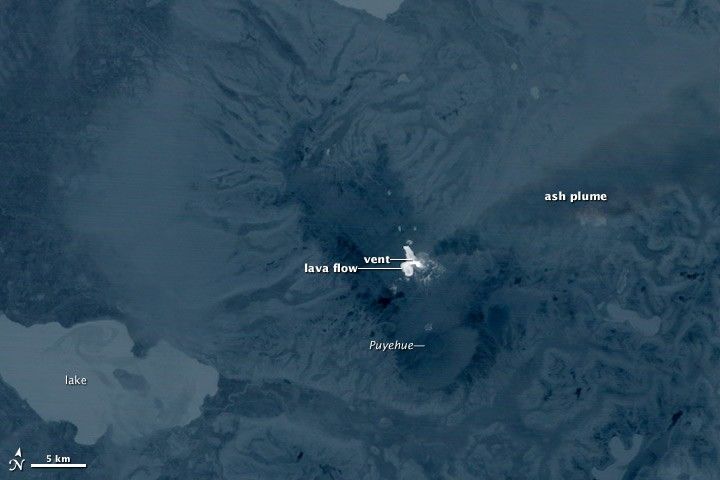
The eruption at Chile’s Puyehue-Cordón Caulle Volcanic Complex continued in late June 2011, with lava and ash still pouring out 23 days after the eruption began.
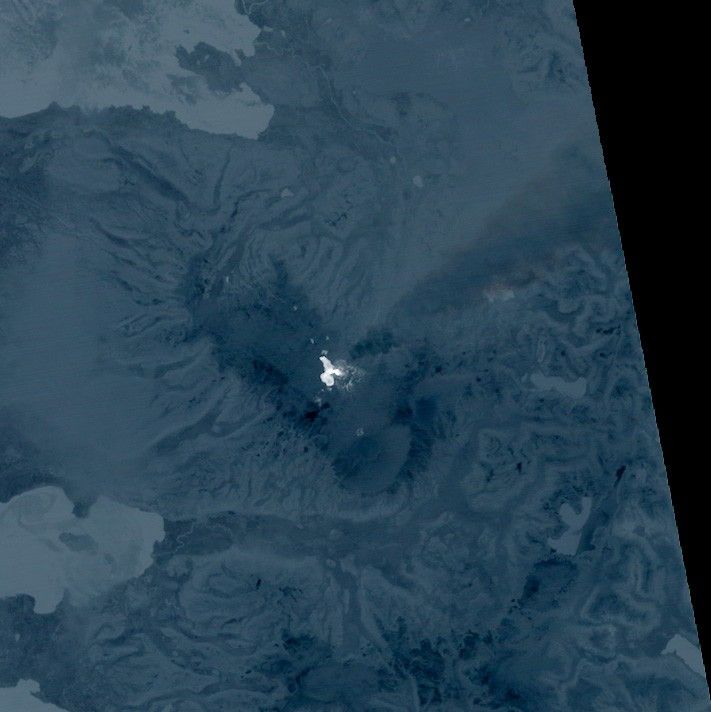
The Advanced Spaceborne Thermal Emission and Reflection Radiometer (ASTER) on the Terra satellite captured this nighttime view of the volcanic complex on June 27, 2011. In this thermal infrared image, hot areas are bright and cold areas are dark. The white feature in the center of the image is an active lava flow.
According to SERNAGEOMIN, Chile’s ministry of mining and geology, the eruption has been subsiding a bit, with fewer and lower intensity tremors and earthquakes. Ashfalls, lahars, and landslides are the primary threat at the moment.
NASA Earth Observatory image by Robert Simmon, using data from the NASA/GSFC/METI/ERSDAC/JAROS, and U.S./Japan ASTER Science Team