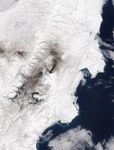




















Eruptions at the Klyuchevskaya volcano on Russia’s Kamchatka Peninsula became more violent on March 24, 2005. The Kamchatkan Volcanic Eruptions Response Team boosted the alert level on the volcano to red, the highest alert reserved for major explosive eruptions, after Klyuchevskaya began to eject clouds of ash and steam as high as 10 kilometers (32,800 feet) above sea level. Seismic activity around the volcano has increased to match Klyuchevskaya’s continuous eruptions.
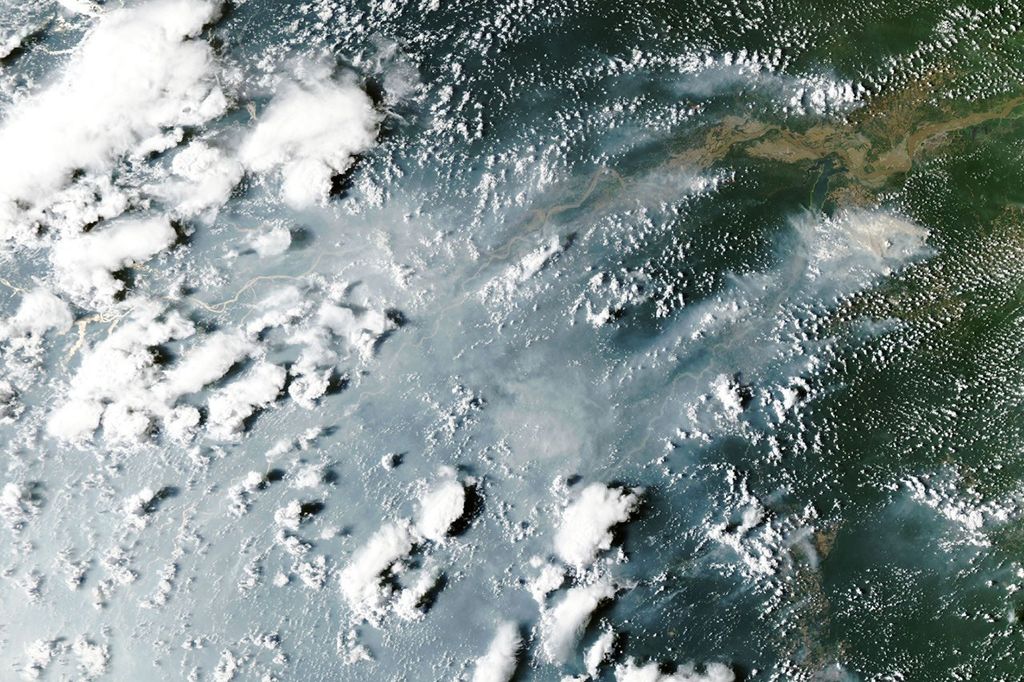
This image, acquired by the Moderate Resolution Imaging Spectroradiometer (MODIS) on NASA’s Terra satellite on March 24, 2005, reflects the sudden violence of the eruptions. An ash-darkened plume of steam rises from the volcano and drifts northeast away from the summit. The light-colored plume is hard to spot against the snow, but its shadow is starkly visible. While the ash plume seen here is not particularly large, fresh ash spread over the snow to the northwest of Klyuchevskaya reveals that eruptions have been larger in the recent past. The ash was not present on March 23. On top of both Klyuchevskaya and Sheveluch, its northern neighbor, MODIS detected a thermal hotspot over the crater, an indicator that molten rock is near or on the crater’s surface.
References & Resources
NASA image courtesy the MODIS Rapid Response Team at NASA GSFC. The image is available in additional resolutions .