

















With an average of just 258 millimeters (10.2 inches) of rain per year, Namibia is Africa’s driest country south of the Sahara. Desert runs the length of the Namibian coast, and almost all of that desert is now protected land. The creation of Dorob National Park around Swakopmund and Walvis Bay in December 2010 completed a nearly unbroken chain of coastal parks.
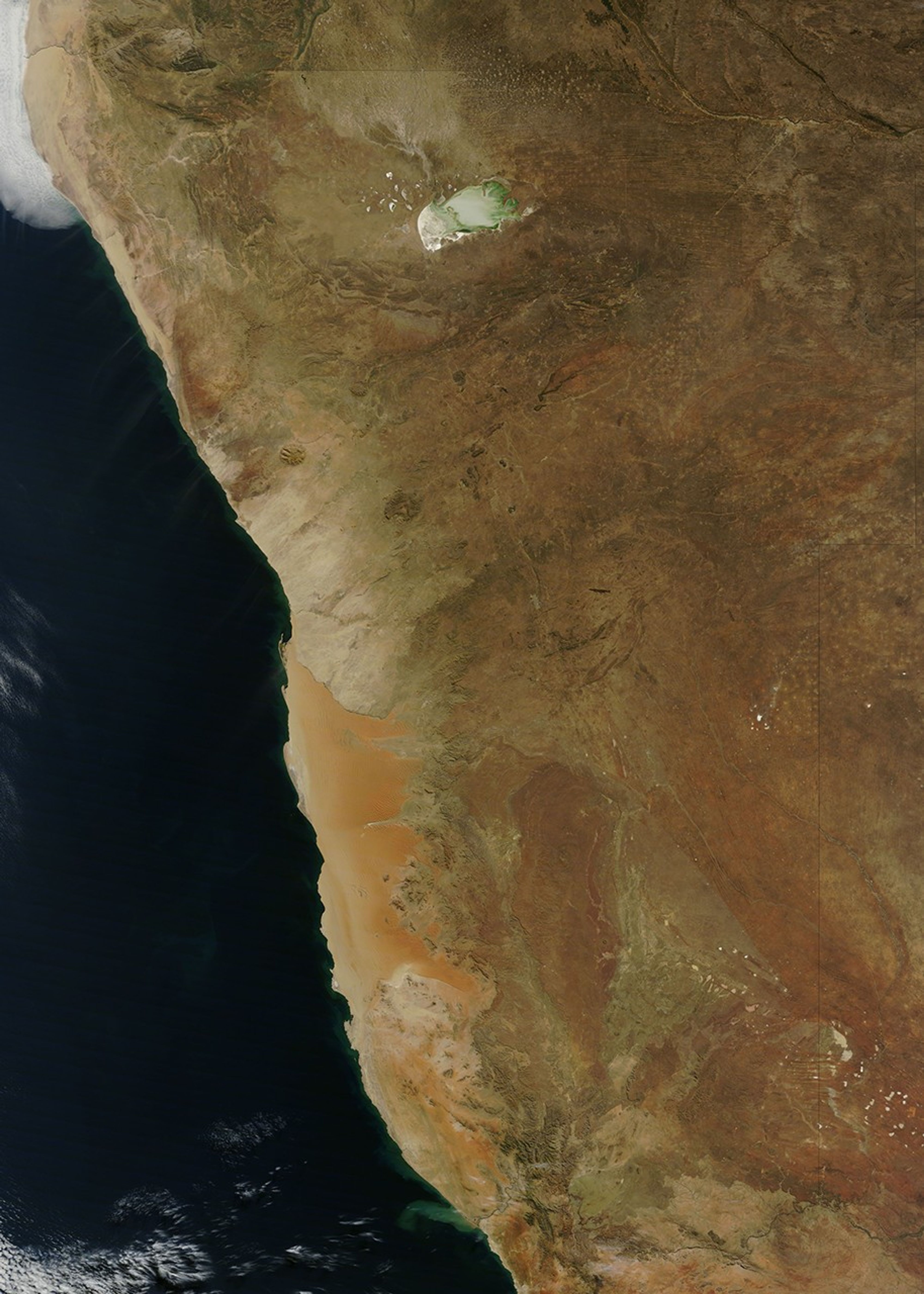
The Moderate Resolution Imaging Spectroradiometer (MODIS) on the Terra satellite captured this natural-color image of the Namibian coast on June 26, 2011. This image is rotated so that north is to the right. With the exception of a cloud bank hugging the coast near the Kunene (or Cunene) River, skies are cloud-free.
Namibia’s deserts are by no means uniform. The Kuiseb River, flowing toward the Atlantic Ocean about midway down the coast, marks a dramatic difference in landscape. Rocky plains lie north of the river; to the south lies a sea of sand dunes, which appear orange-brown in this image.
In fact, sand dunes often march northward past the Kuiseb River, as this linked satellite image shows. The river is impermanent, and when it lacks enough water to wash out accumulated sand, dunes can continue their northward trip, shifting over older dunes. The rainy season of 2010–2011 brought sufficient rains to the region to send the Kuiseb all the way to the coast for the first time since the early 1960s. Even though dunes can be spotted north of the Kuiseb in early 2011, they end more definitely near Swakopmund.
Estimated to be 55 million years old, the Namib Desert, which spans much of the Namibian coast, may be the oldest desert in the world, according to the United Nations Environment Programme. The desert owes much of its continued aridity to wind. National Geographic describes two winds: a hot, dry wind from the east that can raise local temperatures to 100 degrees Fahrenheit (38 degrees Celsius) or higher, and a cool, moist wind from the Atlantic Ocean that occasionally brings much-needed moisture.
Rain is rare along the Namibian coast, but it does arrive spectacularly sometimes.
References & Resources
- Fuller, A. (2011). Namibia’s coastal parks. National Geographic, 219(6), 60–69.
- United Nations Environment Programme. (2008). Africa: Atlas of Our Changing Environment. Division of Early Warning and Assessment, United Nations Environment Programme, Nairobi, Kenya.
NASA image courtesy MODIS Rapid Response Team, Goddard Space Flight Center. Caption by Michon Scott.