


















Two of the world’s most earthquake prone regions—Turkey and Indonesia—experienced damaging quakes in the first week of June 2000.
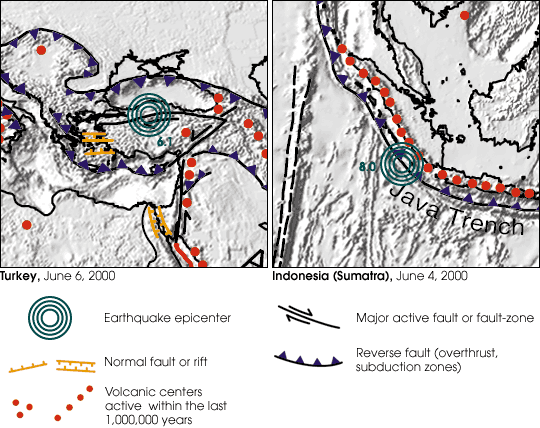
The maps above show the location of the two quakes plotted on the Digital Tectonic Activity Map, a comprehensive database of fault lines, earthquake zones, and volcanism derived from geological and satellite data.
Turkey, site of a magnitude 7.4 earthquake in 1999 that killed 18,000 people, is sandwiched between the colliding Arabian and Eurasian plates. The continental crust underneath Turkey is being compressed by the colliding plates, forcing the bedrock to shear along fault lines. Rocks on the opposite sides of the faults are moving relative to each other. Earthquakes occur when the rocks along the fault move suddenly, releasing shockwaves through the ground.
The quake of June 6, 2000, (above left) occured in Cerkes, 100km (60 miles) north of Ankara, Turkey's capital. With a magnitude of 6.1, it killed 2 people and damaged more than 100 buildings.
A much more serious quake (above right) struck the Indonesian island of Sumatra two days earlier. That quake was powered by a different geological mechanism. Southeast of Sumatra the oceanic crust of the Australian plate is being forced under the Indonesian islands in a process called subduction. As the oceanic plate is driven deeper underneath the surface of the Earth it generates earthquakes far beneath the ocean floor.
Bengkulu, Indonesia, was hardest hit by the magnitude 8.0 quake. More than 100 people were killed in the remote region, and almost a week later the full extent of the catastrophe was not known.
For more information about the Digital Tectonic Activity Map, see Putting Earthquakes in their Place.
References & Resources
Images provided by Jacob Yates, NASA GSFC Laboratory for Terrestrial Physics.
None