






















The goal of the Skylab mission was to prove that humans could live and work in space for extended periods of time. But like every other human venture into the skies, somehow the view always turns back to Earth.
The first American space station was launched into orbit on a Saturn V rocket on May 14, 1973. In the nine months that followed, three separate crews made progressively longer stays on Skylab. The astronauts made observations of the Sun—including the first images of solar flares from space—conducted biomedical and microgravity experiments on themselves, and did a lot of maintenance and handy work to keep the converted rocket shell working as a laboratory. They also took photographs and observations of home.
“Between 8 and 10 at night, we had free time,” said astronaut Gerald Carr, who commanded the third crewed mission on Skylab for 84 days. “For the most part, the most fun was looking out the window.”
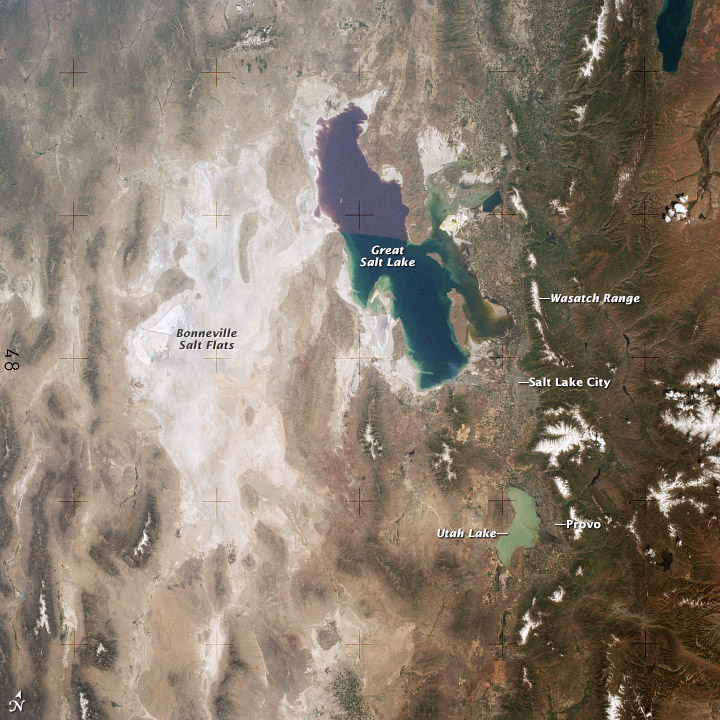
Astronauts on the Skylab 2 mission (May 25 to June 22, 1973) took this photograph of north central Utah with a Hasselblad camera, using an 80 millimeter lens and Kodak Etkachrome MS film. Note the different colors in the north and south sections of the Great Salt Lake, which are separated by a railroad causeway that restricts the mixing of the waters. The north section is much more salty, and different species of algae give the two sections different hues.
Skylab included several handheld cameras and the Earth Resources Experiment Package (EREP), a series of sensors and cameras that observed the Earth in visible, microwave, and infrared light. In 171 days of Skylab operation, EREP collected more than 350,000 photos and 72,725 meters (238,599 feet) of magnetic data tape, observing Earth’s surface between roughly 50 degrees north and south latitude. The astronauts even observed category 5 Hurricane Ava near Acapulco, Mexico.
Further Reading
- NASA (2013) Skylab: America’s First Space Station. Accessed May 13, 2013.
- NASA History Office (1978) Skylab EREP Investigations Summary. Accessed May 13, 2013.
- NASA Earth Observatory (2013, May 13) Elegant Figures: Skylab (with tips for searching the NASA Earth Observations photo database).
- NASA Earth Observatory (2007, July 16) Algae in Great Salt Lake.
References & Resources
Astronaut photograph SL2-6-478 was acquired in the spring of 1973 with a Hasselblad camera using an 80 millimeter lens, and is provided by the ISS Crew Earth Observations experiment and Image Science & Analysis Laboratory, Johnson Space Center. The image was taken by the Skylab 2 crew. It has been cropped and enhanced to improve contrast, and lens artifacts have been removed. Additional images taken by astronauts and cosmonauts can be viewed at the NASA/JSC Gateway to Astronaut Photography of Earth. Caption by Mike Carlowicz.