

















Springtime brings increased sunlight, bursts of nutrients, and changing water conditions to the Gulf of Alaska. The combination promotes massive blooms of phytoplankton—microscopic, plant-like organisms that turn sunlight into food and then become fodder for some of the richest fisheries on the planet.
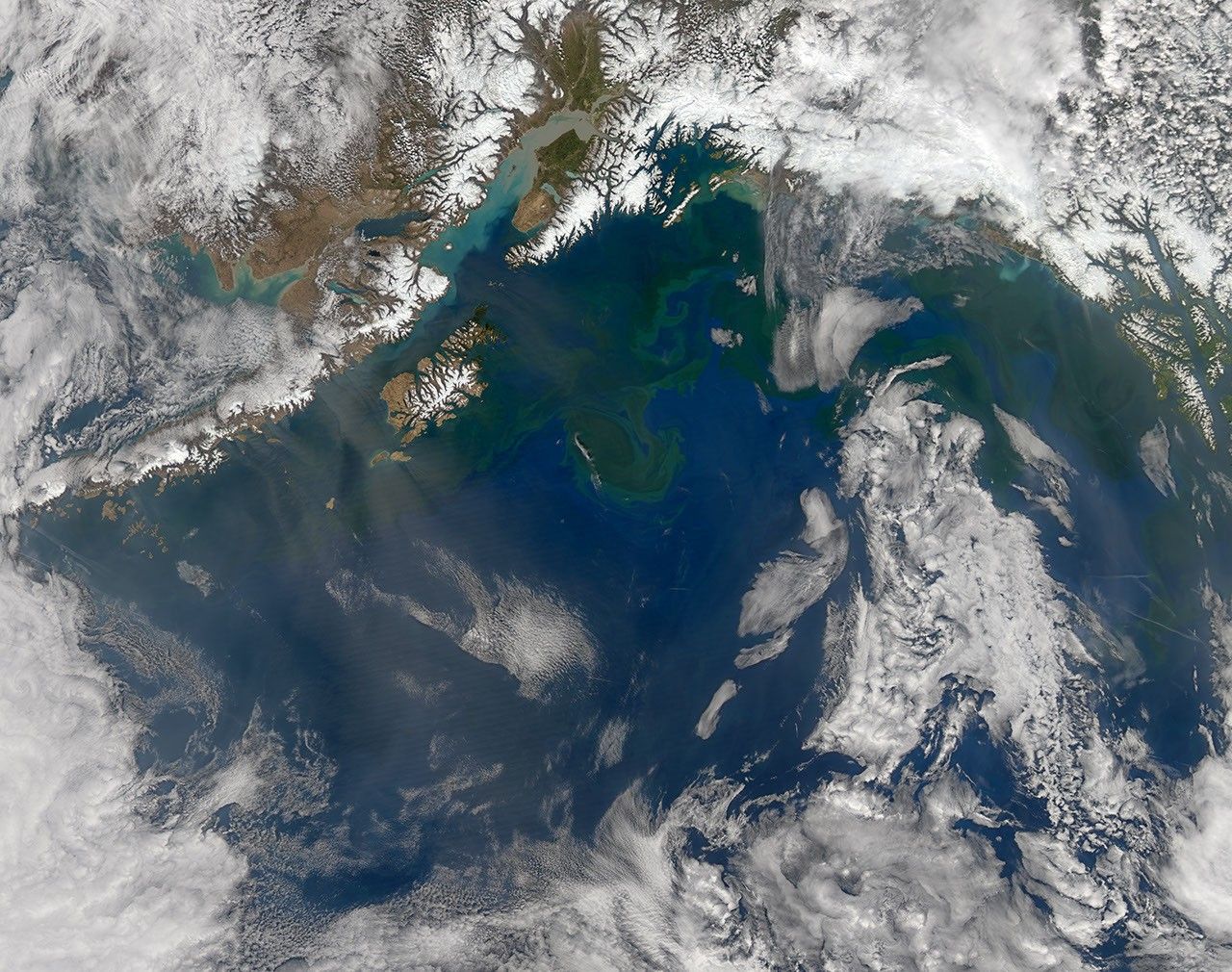
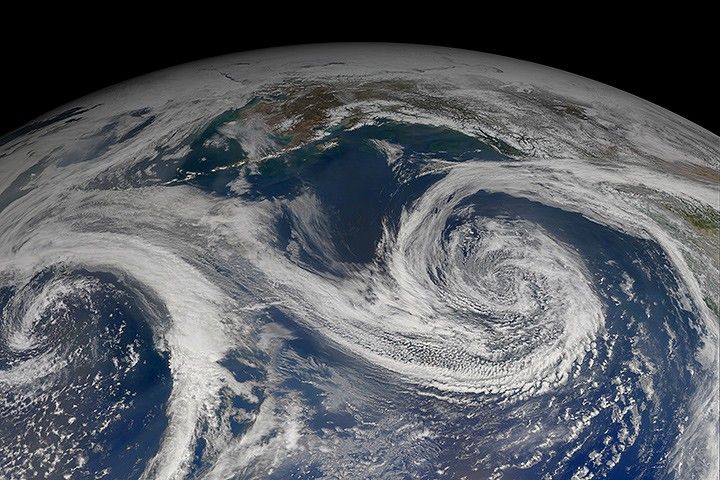
The top image shows the southern Alaska coast and the Gulf of Alaska on May 2, 2014. It is a composite knitted together from several orbits of the Aqua satellite and its Moderate Resolution Imaging Spectroradiometer (MODIS). Two comma-shaped cloud formations (image center and far left) dominate the skies over the North Pacific Ocean. These clouds were likely moving around and ahead of a low-pressure system, showing some cyclonic circulation. Dark green traces of a phytoplankton bloom are just visible off of the Alaska coast at top center.
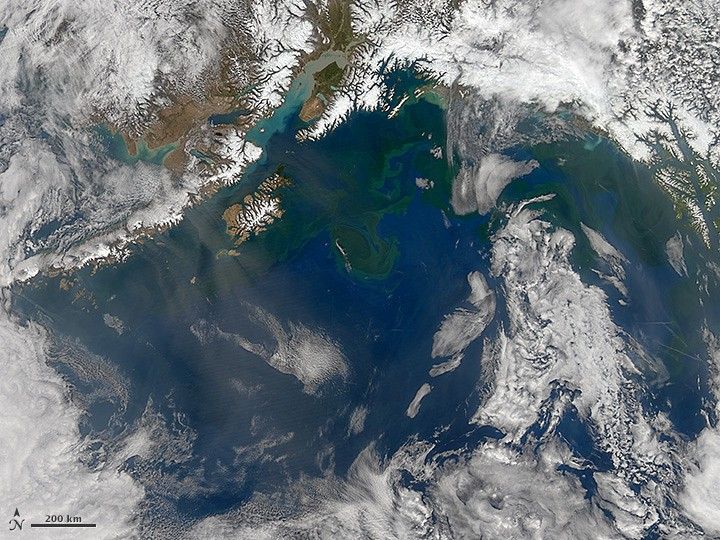
The second image shows a tighter MODIS view of the Gulf on May 9, 2014, when a substantial bloom of phytoplankton colored the waters south of Prince William Sound with green, chlorophyll-rich life. Closer to the coast, the water has a tan tint, a sign of sediment in the water—likely runoff from snowmelt-swollen rivers dumping their excess into the sea.
The waters around Alaska are among the most biologically productive in the world. Ash from the many volcanoes and wind-blown glacial powder occasionally seed the seas with the nutrients necessary for phytoplankton growth. The rivers carry their share of rich sediments, and the stormy, turbulent waters offshore sweep up a fair bit from the seafloor. So when spring and summer bring more sunlight, the waters are primed for explosive blooms of aquatic plants and phytoplankton—and then the many crabs, fish, and whales that feed on them.
References & Resources
- Integrated Ocean Observing Systems (2014) Alaska Ocean Observing System. Accessed May 24, 2014.
- NASA Earth Observatory (2013, January 31) Volcanic Fertilizer.
- NASA Earth Observatory (2010, July 13) What Are Phytoplankton?
- NASA Earth Observatory (2005, April 11) Spring Bloom in the Gulf of Alaska.
NASA images by Norman Kuring, NASA’s Ocean Color web. Caption by Mike Carlowicz.