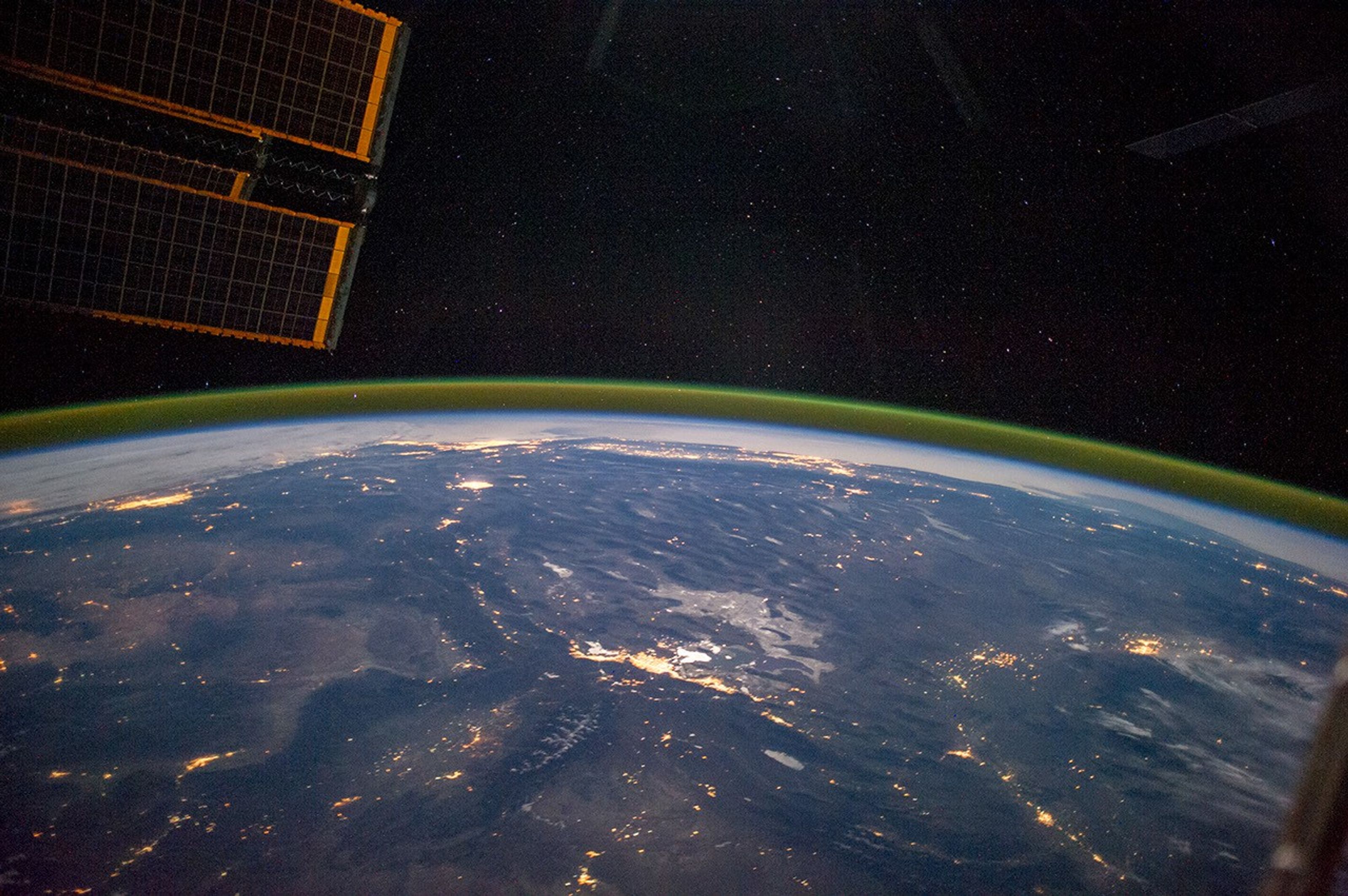





















This moonlit panorama was shot in early October 2014 by astronauts on the International Space Station (ISS) as they looked west from a point over Nebraska. The wide-angle lens shows a huge swath of the western United States from Phoenix, Arizona, to Portland, Oregon. The largest string of lights in the foreground is the Ogden-Salt Lake City-Provo area of Utah. The Los Angeles and San Francisco metropolitan regions, as well as the cities of the central valley of California (Bakersfield to Redding) stretch across the horizon. A green airglow layer appears over the horizon in night images.
Moonlight shows the red tinge of the ISS solar arrays. It also emphasizes the broader-scale geological zones on the ground. Nevada’s short, dark, parallel mountain ranges of the Basin and Range geological province (image center) contrast with the expanses of flat Colorado Plateau (image left) in Colorado, Arizona, Utah, and New Mexico. The near-full Moon even reveals the vast, dry lake bed known as the Bonneville Salt Flats. The black line of the Sierra Nevada marks the eastern edge of California’s well-lit Central Valley (directly below the San Francisco Bay area).
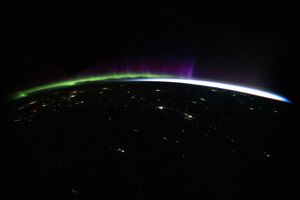
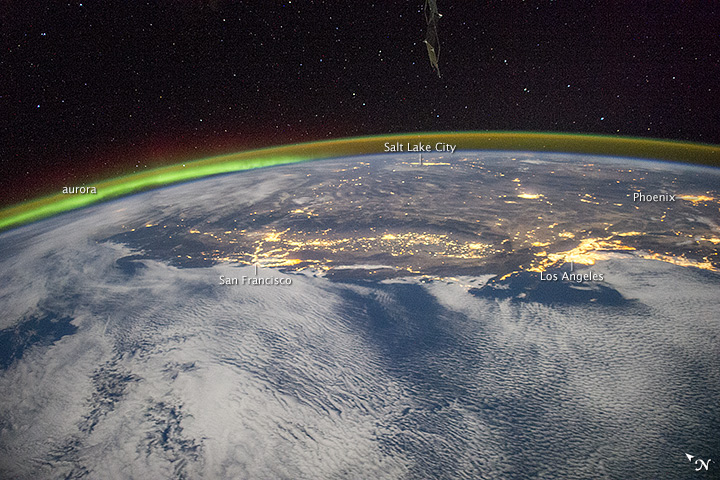
Five days after that westward-looking photo was taken, the astronauts observed roughly the same scene in the opposite direction. The night panorama below shows Los Angeles, the Central Valley, and the Sierra Nevada in the foreground, with Salt Lake City and a display of green aurora (left) on the horizon.
Click here for an image of the Central Valley and the Basin and Range in daylight.
References & Resources
Astronaut photograph ISS041-E-67595 was acquired on October 6, 2014, with a Nikon D3S digital camera using a 24 millimeter lens. Astronaut photograph ISS041-E-75835 was acquired on October 6, 2014, with a Nikon D3S digital camera using a 24 millimeter lens, and is provided by the ISS Crew Earth Observations Facility and the Earth Science and Remote Sensing Unit, Johnson Space Center. The image was taken by the Expedition 41 crew. It has been cropped and enhanced to improve contrast, and lens artifacts have been removed. The International Space Station Program supports the laboratory as part of the ISS National Lab to help astronauts take pictures of Earth that will be of the greatest value to scientists and the public, and to make those images freely available on the Internet. Additional images taken by astronauts and cosmonauts can be viewed at the NASA/JSC Gateway to Astronaut Photography of Earth. Caption by M. Justin Wilkinson, Jacobs at NASA-JSC.