

















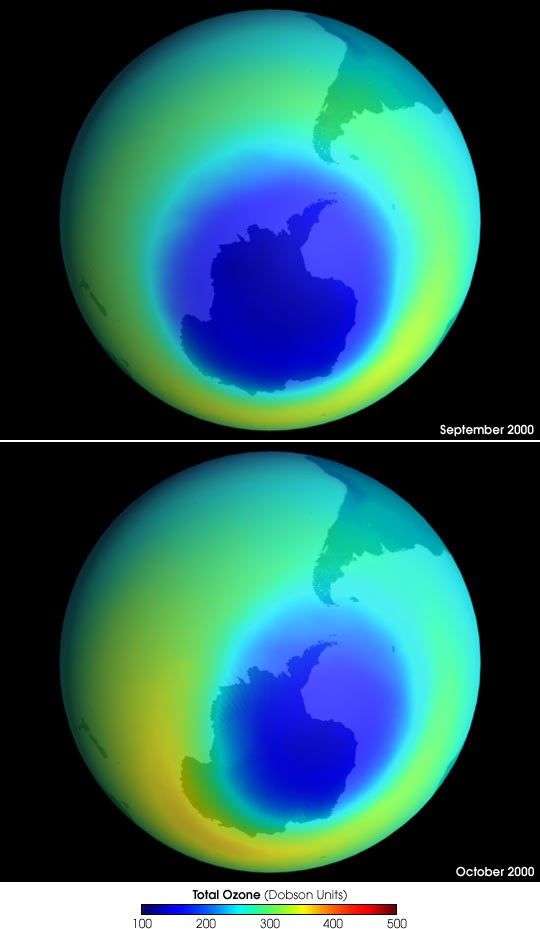
Each spring the ozone layer over Antarctica nearly disappears,forming a “hole” over the entire continent. The hole is createdby the interaction of some man-made chemicals—freon, for example—withAntarctica’s unique weather patterns and extremely cold temperatures.Ozone in the stratosphere absorbs ultraviolet radiation from the sun,thereby protecting living things. Since the ozone hole was discovered manyof the chemicals that destroy ozone have been banned, but they will remain inthe atmosphere for decades.
In 2000, the ozone hole grew quicker than usual and exceptionally large.By the first week in September the hole was the largest ever—11.4 millionsquare miles. The top image shows the average total column ozone values overAntarctica for September 2000. (Total column ozone is the amount of ozone fromthe ground to the top of the atmosphere. A relatively typical measurement of 300Dobson Units is equivalent to a layer of ozone 0.12 inches thick on theEarth’s surface. Levels below 220 Dobson Units are considered to besignificant ozone depletion.) The record-breaking hole is likely the result oflower than average ozone levels during the Antarctic fall and winter, and exceptionally coldtemperatures. In October, however (bottom image), the hole shrankdramatically, much more quickly than usual. By the end of October, the hole wasonly one-third of it’s previous size. In a typical year, the ozone hole does notcollapse until the end of November. NASA scientists were surprised by this early shrinkingand speculate it is related to the region’s weather.
Global ozone levels are measured by the Total Ozone Mapping Spectrometer (TOMS).
For more information about ozone, read the EarthObservatory’s ozone fact sheet and see these ozoneimages.
References & Resources
Images by Greg Shirah, NASA GSFC Scientific Visualization Studio.
None