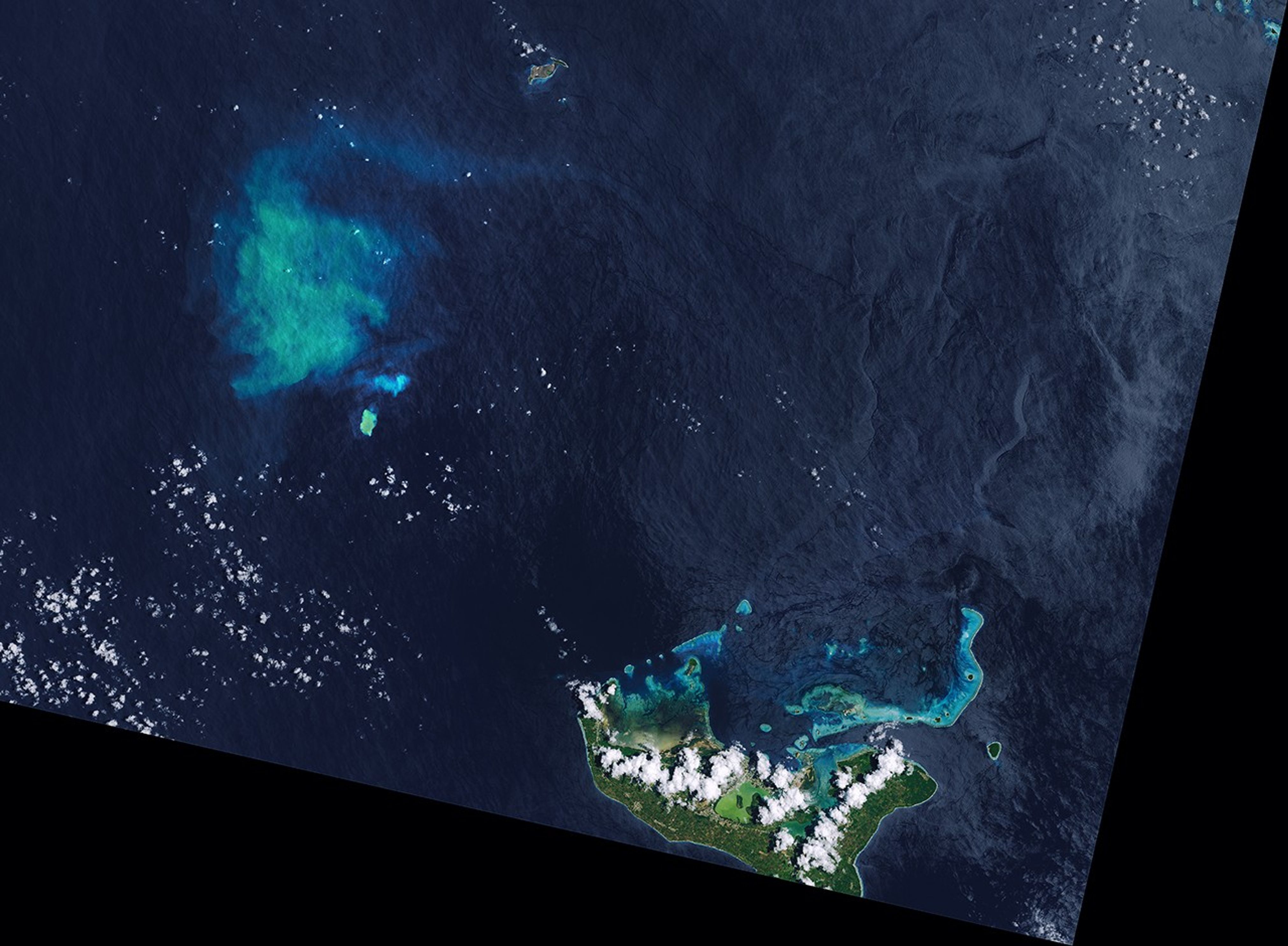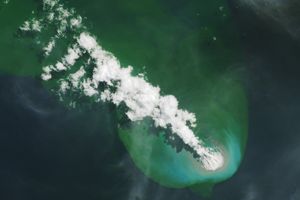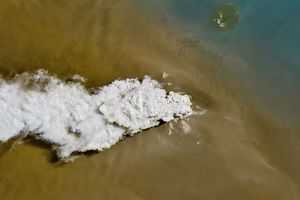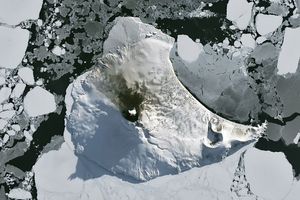





















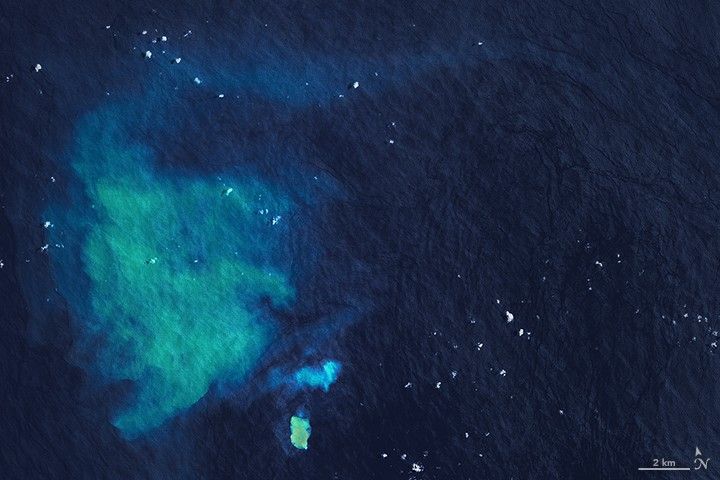
Murray Ford was scanning satellite imagery of a young island in Tonga called Hunga Tonga-Hunga Ha’apai when he noticed something odd—a turquoise plume of water—in the corner of an image. The coastal geologist from the University of Auckland had stumbled across an underwater volcano in the midst of an eruption.
That plume is coming from a seamount located 33 kilometers (20 miles) from Tonga’s main island of Tongatapu. The images above were captured on January 27, 2017, by the Operational Land Imager (OLI) on Landsat 8. The discolored water was likely caused by the underwater release of gases, rocks, and volcanic fluids. The eruption also may have disturbed sediment on the seamount. Other images collected by the Moderate Resolution Imaging Spectroradiometer (MODIS) and Visible Infrared Imaging Radiometer Suite (VIIRS) on NASA and NOAA satellites suggest that the eruption began on January 23, 2017.
“It may continue for some days or weeks, and an island may form temporarily,” said Martin Jutzeler, a University of Tasmania geologist who studies underwater eruptions. “However, new volcanic islands are easily eroded by wave action.”
Underwater eruptions are relatively common in this area, which is part of the Tonga-Kermadec volcanic arc and the Pacific Ring of Fire. This plume appears to have originated from a seamount that geologists call “Submarine Volcano III.” It has shown signs of activity in 1911, 1923, 1970, 1990, and 2007.
Ash from volcanic eruptions on land are a well-known threat to airplanes, and underwater eruptions can likewise pose a hazard to ships. Some underwater eruptions produce rafts of light, porous rock called pumice that float on the sea surface and can clog ship engines.
References & Resources
- GNS Science Trenches and Volcanic Arcs Accessed February 1, 2017.
- NASA Earth Observatory (2015, May 3) Connecting Islands in the Pacific. Accessed February 1, 2017.
- Oregon State University Floating Pumice — an Oceanic Hazard? Accessed February 1, 2017.
- The New Zealand Herald (2017, January 31) NZ scientist discovers huge undersea eruption. Accessed February 1, 2017.
- Scott, B. via Geonet (2017, January 31) Submarine eruption in progress in Tonga. Accessed February 1, 2017.
NASA Earth Observatory images by Joshua Stevens, using Landsat data from the U.S. Geological Survey . Caption by Adam Voiland, with information from Murray Ford (University of Auckland), Martin Jutzeler (University of Tasmania), and Bradley Scott (GNS Sciences).