





















April 2, 2018
Demise of a Quake Lake
On May 12, 2008, the mountainous landscape of south-central China was profoundly changed. On that day, a magnitude 7.9 temblor—known as the Great Sichuan or Wenchuan earthquake—caused destruction to areas near and far from the epicenter, about 80 kilometers west-northwest of Chengdu.
The quake triggered deadly landslides, some of which blocked the flow of rivers. The earthen dams caused water levels to rise and spawned more than 20 “quake lakes.” A series of satellite images published in 2008 showed the growth of one such lake in Beichuan County, one of the most severely affected quake regions.
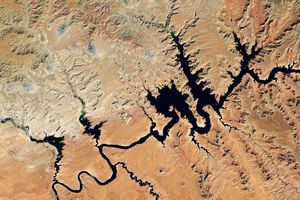
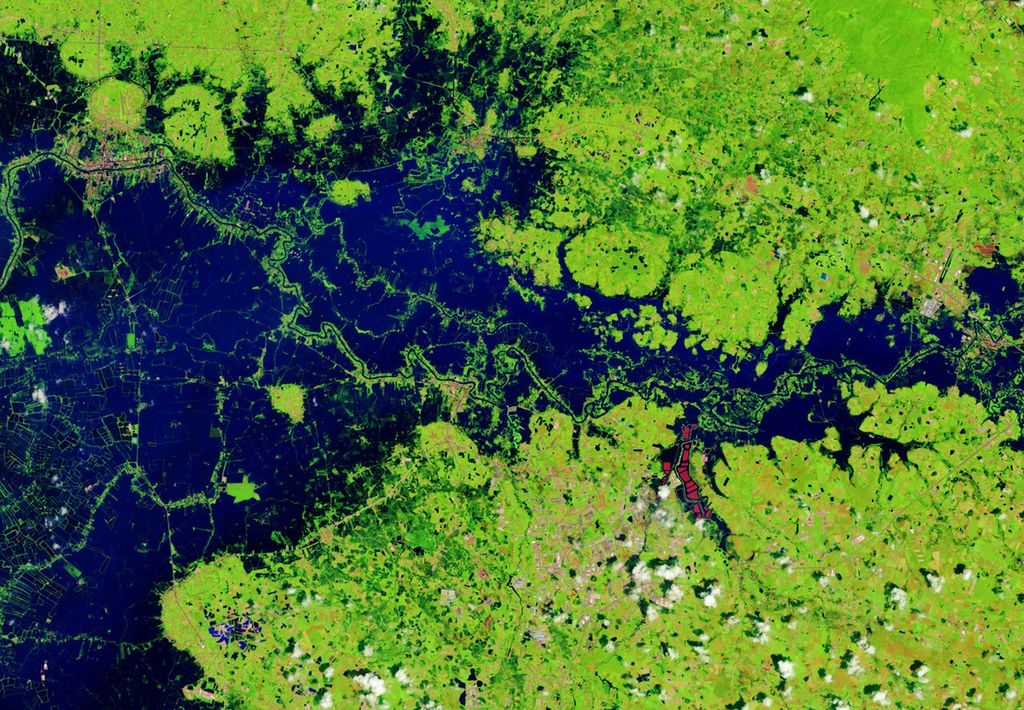
Ten years later, the lake’s water level has dropped. The change is visible in this image pair, acquired with the Operational Land Imager (OLI) on Landsat 8. The first image shows the lake on April 28, 2016, when water levels were still relatively high. The second image shows the same area on April 2, 2018, after water levels have lowered.
Water levels can fluctuate over the course of a year, especially after large rainfall events. These images were acquired before the start of the rainy season, so the image sequence likely represents the longer-term effects of an earthquake on the landscape.
The earthquake caused the kinds of changes to slopes and channels that can last for years or decades, according to Dave Petley of the University of Sheffield. New lakes were formed. Hillsides became less stable. And huge amounts of sediment were mobilized.
“The people have to deal with these effects, and they are profound and dangerous,” Petley said. “This is the frequently forgotten effect of an earthquake. It is not just that buildings and infrastructure are damaged. The whole way that the environment is operating has changed.”
In the vicinity of this particular lake, erosion of the earthen dam is slowly lowering the lake level. “This is the best-case scenario for this type of situation, releasing the water slowly and progressively with time,” Petley said. Also, sediments that have eroded from the hills and channels are filling the lake. “Again, this is quite normal,” he said. “The two effects together mean that the lake will disappear over time.”
References & Resources
- AGU Blogosphere (2018) The Landslide Blog. Accessed September 5, 2018.
- Chen, Y. and Booth, D. (2011) The Wenchuan Earthquake of 2008: Anatomy of a Disaster. Springer.
- NASA Earth Observatory (2008, June 11) Dam Breach Swells Jianjiang River.
- NASA Earth Observatory (2008, May 21) Lake Formation in the Aftermath of Magnitude 7.9 Earthquake.
- USGS Earthquake Hazards Program (2008, May 12) M 7.9 - eastern Sichuan, China. Accessed September 5, 2018.
NASA Earth Observatory images by Lauren Dauphin, using Landsat data from the U.S. Geological Survey . Story by Kathryn Hansen.