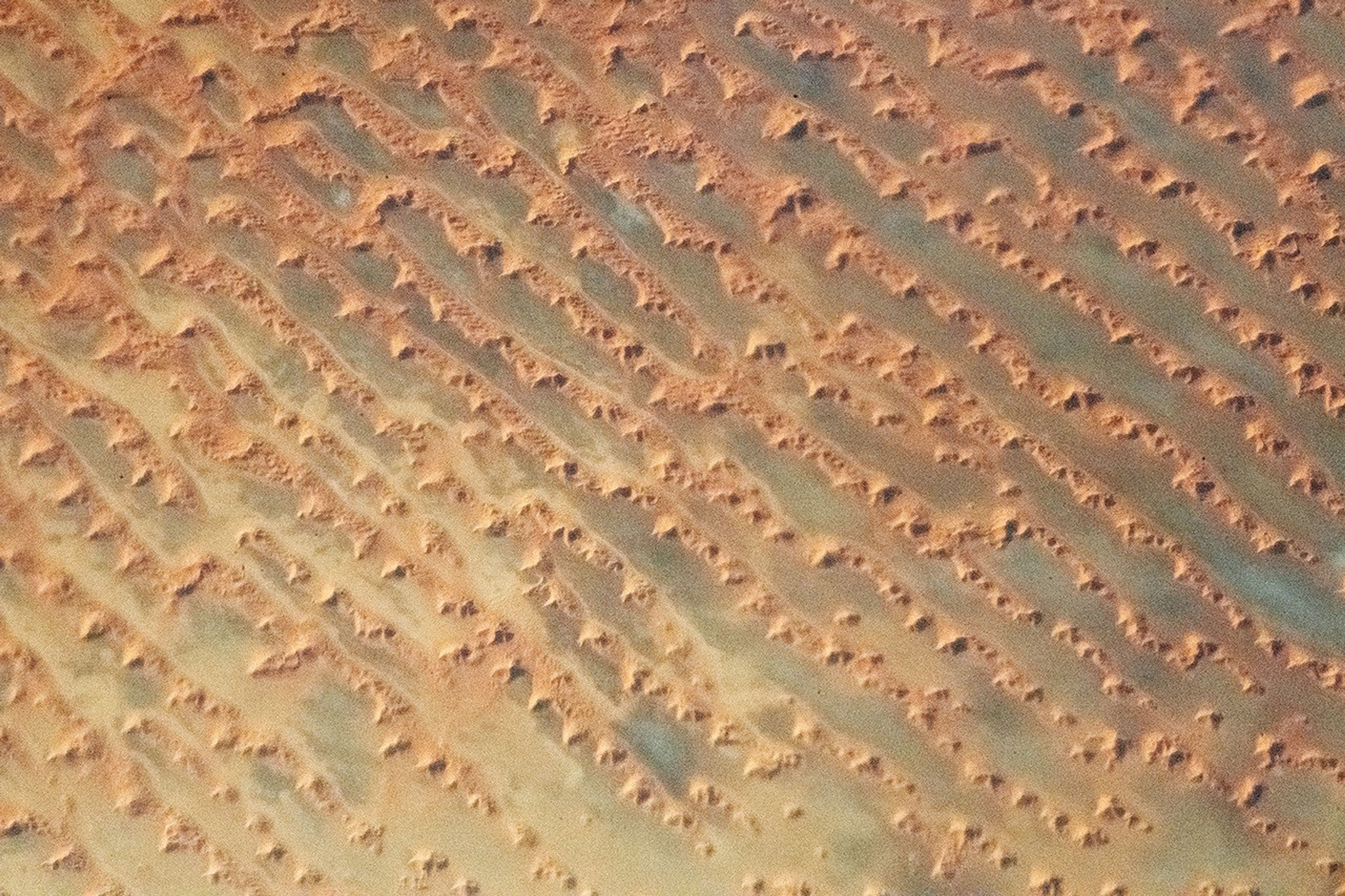














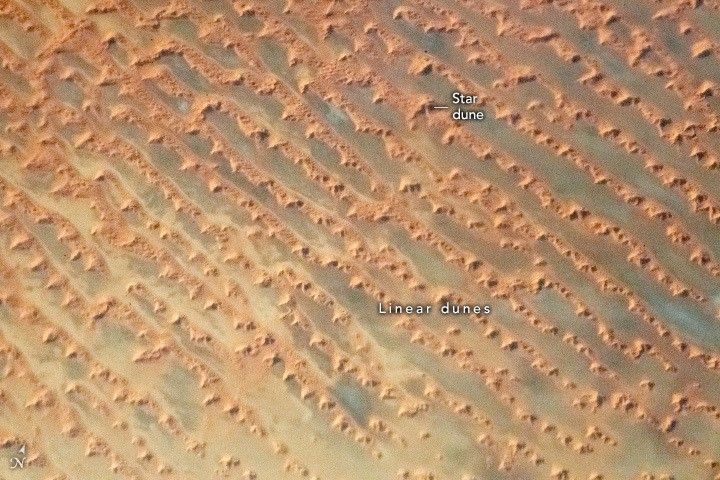
This photograph was taken by an astronaut aboard the International Space Station as it orbited over the remote dune fields of southeastern Saudi Arabia during the late afternoon (local time) on April 13, 2023. These linear dunes are part of the Rub’ al Khali erg, or sand sea, located within the Arabian desert.
The roughly parallel dune patterns are generated by strong prevailing winds. Here, dunes are evenly spaced in relatively straight lines trending northwest-southeast. The linear dunes in the photograph are continuous over a distance of 34 kilometers (21 miles), but elsewhere in the Rub’ al Khali dunes can grow up to 75 kilometers (47 miles) in length.
In large sand seas, complex dune systems are common due to the abundance of sand available for transport. Complex dune systems contain a combination of dune types, as seen here with star dunes that have formed atop the linear dunes.
Star dunes are roughly conic accumulations of sand that display three or more “arms.” Star dunes appear here as numerous high points built on top of the linear dunes. Rising higher with steeper slopes than the linear dune masses, many star dunes cast dark shadows on their southeastern flanks as seen in this late afternoon photograph.
References & Resources
Astronaut photograph ISS069-E-3278 was acquired on April 13, 2023, with a Nikon D5 digital camera using a focal length of 460 millimeters. It is provided by the ISS Crew Earth Observations Facility and the Earth Science and Remote Sensing Unit, Johnson Space Center. The image was taken by members of the Expedition 69 crew . The image has been cropped and enhanced to improve contrast, and lens artifacts have been removed. The International Space Station Program supports the laboratory as part of the ISS National Lab to help astronauts take pictures of Earth that will be of the greatest value to scientists and the public, and to make those images freely available on the Internet. Additional images taken by astronauts and cosmonauts can be viewed at the NASA/JSC Gateway to Astronaut Photography of Earth . Caption by Justin Wilkinson, Texas State University, JETS Contract at NASA-JSC, and Susan Runco (NASA retired).