





















Artemis II Lunar Targeting Plan
| Language |
|
|---|
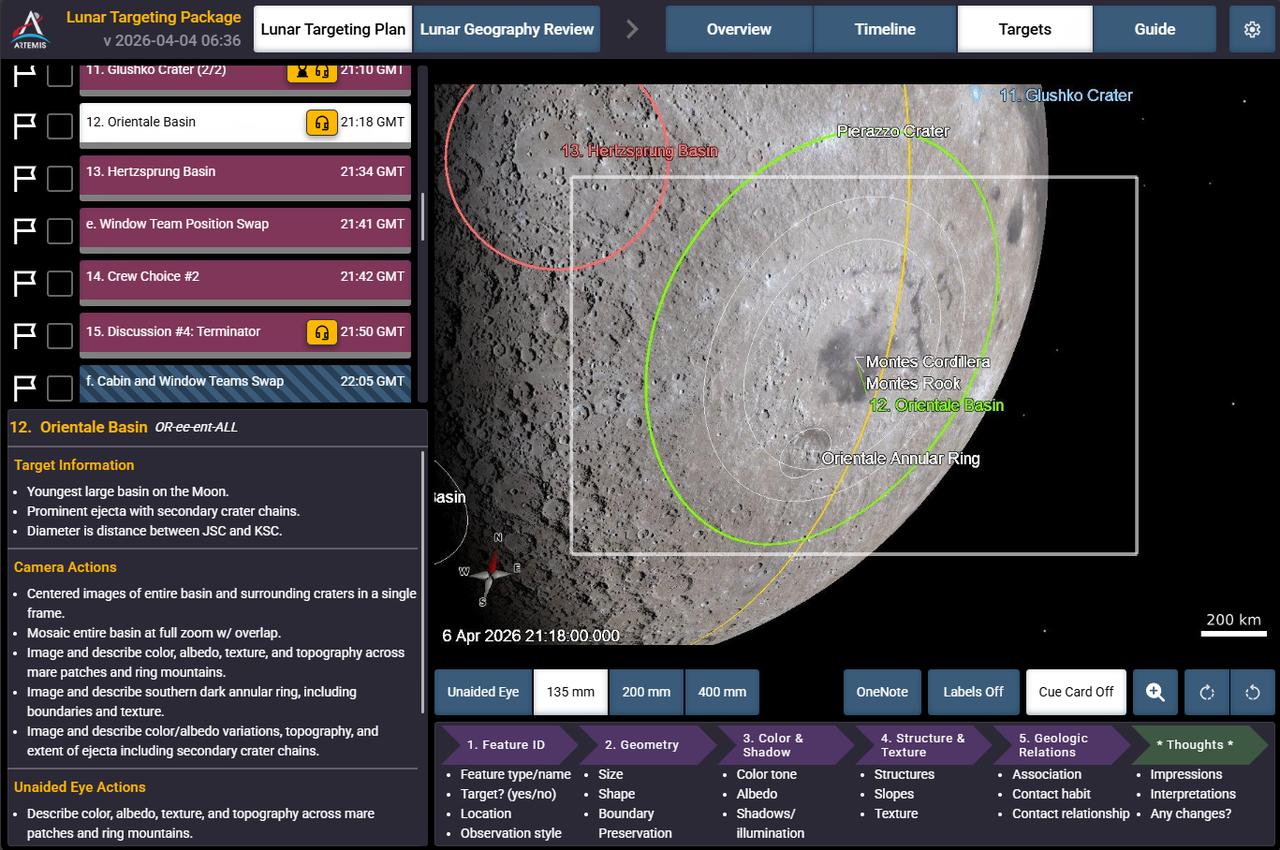
The Lunar Targeting Plan is the Artemis II crew's Moon observing assignment. It is fine-tuned to the exact lighting conditions on the Moon’s surface during the astronauts' lunar flyby, and for their viewing angle as they’re hurtling through space. Like a spacewalk plan, it provides strong, detailed guidance, plus flexibility for the crew to make decisions based on what they’re seeing and experiencing in real time. Targets are prioritized based on both their science value and their visibility at the time of observation.
As the Artemis II astronauts approached the Moon on April 6, 2026, most of the lunar near side was illuminated – a shared view with observers on Earth. When they were all the way on the other side of the Moon, they saw a waxing crescent: about 20% of the lunar far side was sunlit, and about 80% was in darkness.
This Lunar Targeting Plan is focused on the parts of the lunar surface that were sunlit during the Artemis II flyby, but the night side of the Moon offers unique science opportunities, too. The astronauts looked for bursts of light created when space debris slams into the Moon’s surface, also called “impact flashes”. They kept their eyes out for dust lofted above the lunar horizon and backlit by the Sun. And on top of all that, they experienced a total solar eclipse lasting almost an hour.