


















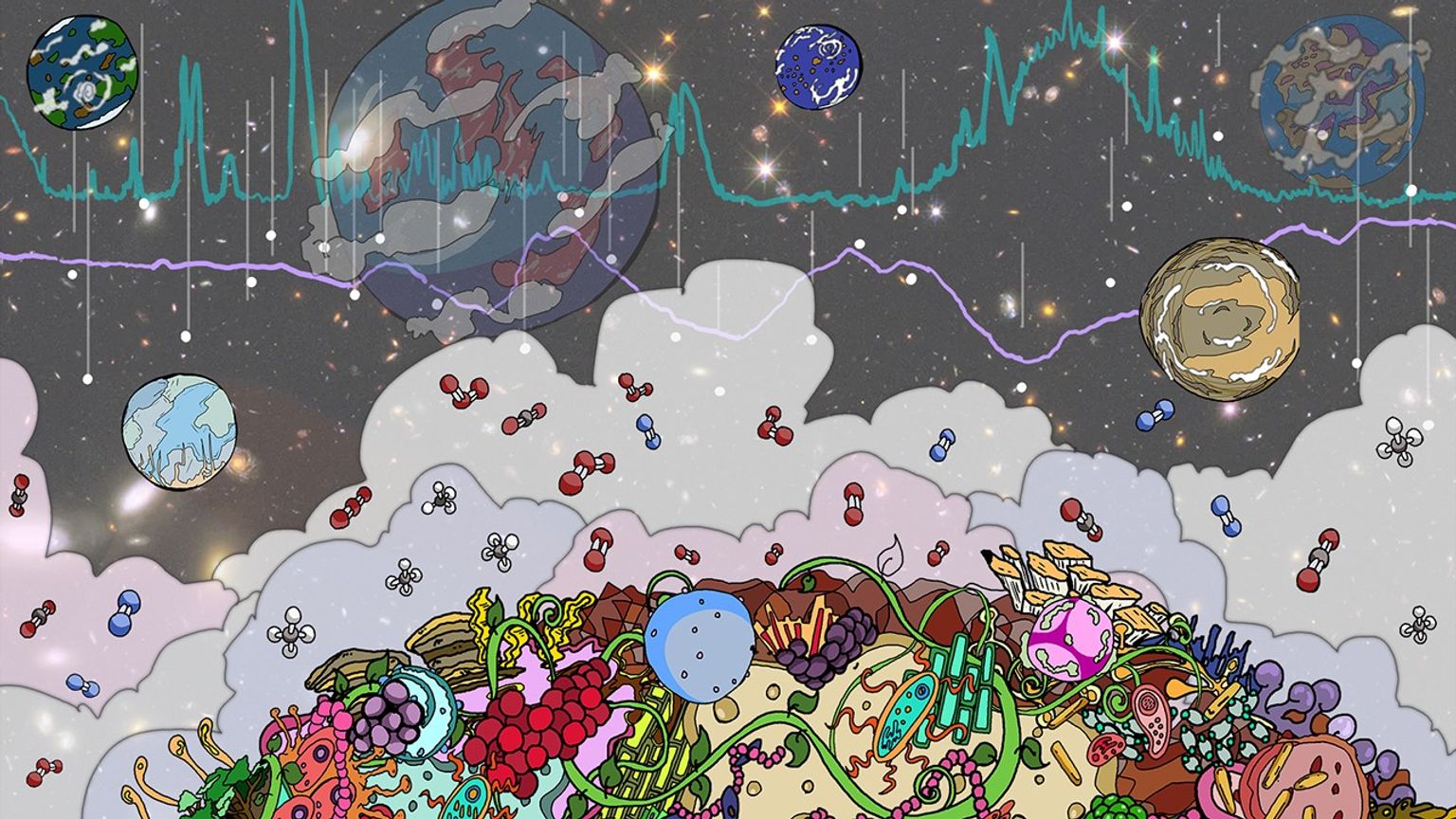
7.4. How can we identify worlds around other stars that could have life?
A core learning question from the Astrobiology Learning Progressions
Astrobiology Learning Progressions Navigation

Previous
7.3. How do we discover worlds around other stars?
Grades K-2 or Adult Naive Learner
Have you ever noticed that when you get closer or further away from something hot that it really changes the temperature that you feel? For example, if you get too close to a fireplace, a heater, or a campfire, you can actually feel way too warm. But, if you move away, it starts to get cooler. The same thing happens with our Sun. It’s really warm for a planet that’s close to the Sun, but as we move further and further from the Sun, there’s less warmth from the Sun reaching the planets. This might be important when it comes to looking for alien life in the universe. When planets are really close to their stars, it’s actually too hot for liquid water on those planets. Their oceans would just boil away. But, if it’s really far from a star, then it’s so cold that liquid water freezes and makes ice. So planets that might have liquid water on their surface (like lakes and rivers and oceans), might only be in an area around their stars that “just right” for liquid water.
Disciplinary Core Ideas
PS3.B: Conservation of Energy and Energy Transfer: Energy is present whenever there are moving objects, sound, light, or heat. When objects collide, energy can be transferred from one object to another, thereby changing their motion. In such collisions, some energy is typically also transferred to the surrounding air; as a result, the air gets heated and sound is produced. (4-PS3-2, 4-PS3-3) Light also transfers energy from place to place. (4-PS3-2)
PS3.D: Energy in Chemical Processes and Everyday Life: The energy released [from] food was once energy from the Sun that was captured by plants in the chemical process that forms plant matter (from air and water). (5-PS3-1)
LS4.C: Adaptation: For any particular environment, some kinds of organisms survive well, some survive less well, and some cannot survive at all. (3-LS4-3)
LS4.D: Biodiversity and Humans: Populations live in a variety of habitats, and change in those habitats affects the organisms living there. (3-LS4-4)
ESS1.A: The Universe and its Stars: The Sun is a star that appears larger and brighter than other stars because it is closer. Stars range greatly in their distance from Earth. (5-ESS1-1)
ESS2.A: Earth Materials and Systems: Rainfall helps to shape the land and affects the types of living things found in a region. (4-ESS2-1)
Crosscutting Concepts
Systems and System Models: A system can be described in terms of its components and their interactions. (3-LS4-4) Patterns- Similarities and differences in patterns can be used to sort, classify, communicate and analyze simple rates of change for natural phenomena. (5-ESS1-2)
Big Ideas: Heat varies by the distance an object is from the heat source. The Earth has a temperature that is just right for people and other life. If Earth were closer to the Sun, liquid water would boil and evaporate. If it were too far from the Sun, liquid water would freeze. Earth’s distance from the Sun permits the liquid water necessary for life. Scientists are looking for other places that also have a temperature that is just right.
Boundaries: At this level, learners focus on how the distance between a planet and its Sun affects its temperature and other characteristics.
No appropriate content for this grade level. Please use the navigation arrows to switch levels.

Grades 3-5 or Adult Emerging Learner
Have you ever noticed that when you get closer or further away from something hot that it really changes the temperature that you feel? For example, if you get too close to a fireplace, a heater, or a campfire, you can actually feel way too warm. But, if you move away, it starts to get cooler. The same thing happens with our Sun. It’s really warm for a planet that’s close to the Sun, but as we move further and further from the Sun, there’s less warmth from the Sun reaching the planets. This might be important when it comes to looking for alien life in the universe. When planets are really close to their stars, it’s actually too hot for liquid water on those planets. Their oceans would just boil away. But, if it’s really far from a star, then it’s so cold that liquid water freezes and makes ice. So planets that might have liquid water on their surface (like lakes and rivers and oceans), might only be in an area around their stars that “just right” for liquid water.
It’s just like the story of Goldilocks and the Three Bears. In this story, young Goldilocks goes to eat some porridge left in the kitchen by a family of three bears. Papa Bear’s porridge was too hot and Mama Bear’s porridge was too cold, but Baby Bear’s porridge was “just right” for eating. Since this is kind of like how we think about liquid water on planets, we call that place around stars where it’s “just right” for liquid water the “Goldilocks Zone.” There might be many other places where aliens could live, but planets with liquid water on the surface are an important place to look.
Disciplinary Core Ideas
PS3.B: Conservation of Energy and Energy Transfer: Energy is present whenever there are moving objects, sound, light, or heat. When objects collide, energy can be transferred from one object to another, thereby changing their motion. In such collisions, some energy is typically also transferred to the surrounding air; as a result, the air gets heated and sound is produced. (4-PS3-2, 4-PS3-3) Light also transfers energy from place to place. (4-PS3-2)
PS3.D: Energy in Chemical Processes and Everyday Life: The energy released [from] food was once energy from the Sun that was captured by plants in the chemical process that forms plant matter (from air and water). (5-PS3-1)
LS4.C: Adaptation: For any particular environment, some kinds of organisms survive well, some survive less well, and some cannot survive at all. (3-LS4-3)
LS4.D: Biodiversity and Humans: Populations live in a variety of habitats, and change in those habitats affects the organisms living there. (3-LS4-4)
ESS1.A: The Universe and its Stars: The Sun is a star that appears larger and brighter than other stars because it is closer. Stars range greatly in their distance from Earth. (5-ESS1-1)
ESS2.A: Earth Materials and Systems: Rainfall helps to shape the land and affects the types of living things found in a region. (4-ESS2-1)
Crosscutting Concepts
Systems and System Models: A system can be described in terms of its components and their interactions. (3-LS4-4)
Patterns: Similarities and differences in patterns can be used to sort, classify, communicate and analyze simple rates of change for natural phenomena. (5-ESS1-2)
Big Ideas: Heat varies by the distance an object is from the heat source. The Earth has a temperature that is just right for people and other life. If Earth were closer to the Sun, liquid water would boil and evaporate. If it were too far from the Sun, liquid water would freeze. Earth’s distance from the Sun permits the liquid water necessary for life. Scientists are looking for other places that also have a temperature that is just right.
Boundaries: At this level, learners focus on how the distance between a planet and its Sun affects its temperature and other characteristics.
3-5 SpaceMath Problem 376: The Earth-like Planet Gliese 518g. Students use data for the Gliese 581 planetary system to draw a scaled model of the locations and sizes of the discovered planets. They also identify the location and span of the Habitable Zone for this planetary system. [Topics: scale models; measurement] https://spacemath.gsfc.nasa.gov/astrob/7Page40.pdf
4-6 SpaceMath Problem 325: Kepler Spies Five New Planets. Students count squares on a Bizarro Star to study the transit of a planet, and determine the diameter of the planet. This demonstrates the basic principle used by NASA ’s Kepler satellite to search for Earth-sized planets orbiting distant stars. [Topics: counting; graphing; area of a square] https://spacemath.gsfc.nasa.gov/astrob/6Page113.pdf
Grades 6-8 or Adult Building Learner
We’ve now discovered several thousand planets that orbit around other stars! What’s more, based on the number of exoplanets that we’ve detected by looking at just a small fraction of the total number of stars that are in our galaxy, we’ve estimated that there are probably way more than 100 billion planets within the galaxy. That’s a whole lot of worlds. If you were to try counting one of those planets each second, it would take over 3,000 years to count them all! With all of those worlds out there, do you think it’s possible that any of them are home to other living things? If there are any alien biospheres out there, then we need to consider how to find them and how we can learn more about them.
Our Earth is the only place we know of so far that has life, so it might be important for alien worlds to be a bit like Earth in order to have life. For instance, our Earth lies within the “Goldilocks Zone” of our solar system. The Goldilocks Zone is a region around a star where the starlight warming the surface of a planet might allow the planet to have liquid water on its surface. Just like in the story of Goldilocks and the Three Bears, where Papa Bear’s porridge was too hot and Mama Bear’s porridge was too cold, but Baby Bear’s porridge was “just right” for eating, some planets are either so close to their star that it’s too hot for liquid water on the surface and others are so far from their star that it’s too cold for liquid water on the surface, but some planets are in the area where it’s “just right” to have rivers and lakes and oceans on their surfaces. If having liquid water on a surface is important for life, then looking for worlds in the Goldilocks Zones around stars might be one good place to look.
There’s also the chance that worlds that have subsurface oceans could be important places for life. We have places like Europa and Enceladus here in our solar system. However, these are moons of larger planets. It turns out that, while finding exoplanets is hard enough, finding exomoons is even harder. And, on top of that, if there are biospheres within those subsurface oceans, we might not be able to see any evidence of them using our telescopes. What about life in atmospheres? Could you imagine a world like Jupiter or Saturn having a biosphere floating around in all of those clouds? We don’t know yet if this such worlds exist, but some people have wondered if looking for signs of life in the atmospheres of giant planets could also be one way to find alien life. There are definitely lots of worlds out there and that means that there are lots of possible places to look for life. As our telescopes and our technology get better and better, we’re even more likely to be able to find signs of life if there are alien biospheres out there!
Disciplinary Core Ideas
ESS1.A: The Universe and Its Stars: Patterns of the apparent motion of the Sun, the Moon, and stars in the sky can be observed, described, predicted, and explained with models. (MS-ESS1-1) ▪ Earth and its solar system are part of the Milky Way galaxy, which is one of many galaxies in the universe. (MS-ESS1-2)
ESS1.B: Earth and the Solar System: The solar system consists of the Sun and a collection of objects, including planets, their moons, and asteroids that are held in orbit around the Sun by its gravitational pull on them. (MS-ESS1-2, MS-ESS1-3) ▪ This model of the solar system can explain eclipses of the Sun and the moon. Earth’s spin axis is fixed in direction over the short-term but tilted relative to its orbit around the Sun. (MS-ESS1-1)
PS2.B: Types of Interactions Electric and magnetic (electromagnetic) forces can be attractive or repulsive, and their sizes depend on the magnitudes of the charges, currents, or magnetic strengths involved and on the distances between the interacting objects. (MS-PS2-3) ▪ Gravitational forces are always attractive. There is a gravitational force between any two masses, but it is very small except when one or both of the objects have large mass — e.g., Earth and the Sun. (MS-PS2-4) ▪ Forces that act at a distance (electric, magnetic, and gravitational) can be explained by fields that extend through space and can be mapped by their effect on a test object (a charged object, or a ball, respectively). (MS-PS2-5)
Crosscutting Concepts
Patterns: Patterns can be used to identify cause and effect relationships. (MS-ESS1-1)
Scale, Proportion, and Quantity: Time, space, and energy phenomena can be observed at various scales using models to study systems that are too large or too small. (MS-ESS1-3)
Systems and System Models: Models can be used to represent systems and their interactions. (MS-ESS1-2)
Big Ideas: Estimates suggest there are 100 billion exoplanets within the galaxy. Since Earth is the only place known to have life at this time, the search for alien life focuses on worlds that are similar to Earth in one way or another. Earth is within the Goldilocks Zone of the solar system. The Goldilocks Zone is a region around a star where the starlight warming the surface of a planet might allow the planet to have liquid water on its surface. Places with subsurface oceans could also be home to alien life. Enceladus and Europa both have subsurface oceans and are moons of larger planets. Exomoons are even more challenging to find and study than exoplanets. Technological advances continue to aid in the search for life beyond the solar system.
Boundaries: Students in this grade band use data to determine the scale properties of objects in the solar system. Data from Earth-based instruments, space-based telescopes, and spacecraft are used to determine similarities and differences among solar system objects. Assessment does not include recalling facts about properties of the planets and other solar system bodies. (MS-ESS1-3)
4-6 SpaceMath Problem 325: Kepler Spies Five New Planets. Students count squares on a Bizarro Star to study the transit of a planet, and determine the diameter of the planet. This demonstrates the basic principle used by NASA ’s Kepler satellite to search for Earth-sized planets orbiting distant stars. [Topics: counting; graphing; area of a square] https://spacemath.gsfc.nasa.gov/astrob/6Page113.pdf
6-8 SpaceMath Problem 213: Kepler: The hunt for Earth-like planets. Students compare the area of a star with the area of a planet to determine how the star’s light is dimmed when the planet passes across the star as viewed from Earth. This is the basis for the ‘transit’ method used by NASA ’s Kepler satellite to detect new planets. [Topics: area of circle; ratios; percents] https://spacemath.gsfc.nasa.gov/astrob/5Page87.pdf
6-8 SpaceMath Problem 360: Kepler’s First Look at 700 Transiting Planets. A statistical study of the 700 transits seen during the first 43 days of the mission. [Topics: percentages; area of circle] https://spacemath.gsfc.nasa.gov/astrob/7Page7.pdf
6-8 SpaceMath Problem 405: Discovering Earth-like Worlds by their Color. Students use recent measurements of the reflected light from solar system bodies to graph their colors and to use this in classifying new planets as Earth-like, moon-like or Jupiter-like [Topics: graphing tabular data; interpreting graphical data] https://spacemath.gsfc.nasa.gov/astrob/7Page68.pdf
6-9 Planet Hunters Education Guide. Lesson 6: Using Planet hunters. (page 75) This lesson acquaints students with the Planet Hunters (www.planethunters.org) citizen science project by researching its goals, learning about the project’s science, and participating in the search for exoplanets. This lesson is part of a nine lesson unit that takes learners through engaging activities that feature habitability, identifying and characterizing exoplanets, and citizen science. NASA . https://s3.amazonaws.com/zooniverse-resources/zoo-teach/production/uploads/resource/attachment/122/Planet_Hunters_Educator_Guide.pdf
6-9 Planet Hunters Education Guide. Lesson 7: Creating and Interpreting light curves (page 81). In this activity, students interpret light curves to determine exoplanets’ characteristics, including size, period, and distance from a star. Students calculate the orbital period and use it to identify the distance between the detected planet and the host star using graphs displaying calculations based on Kepler’s Third Law. This lesson is part of a nine lesson unit that takes learners through engaging activities that feature habitability, identifying and characterizing exoplanets, and citizen science. NASA . https://s3.amazonaws.com/zooniverse-resources/zoo-teach/production/uploads/resource/attachment/122/Planet_Hunters_Educator_Guide.pdf
6-9 Planet Hunters Education Guide. Lesson 9: Planetary Possibilities (page 102.) In this activity, students apply information they have learned about the solar system, star types, habitable zones, and exoplanet systems in previous activities to design and draw a planetary system model of a candidate planet. Students base their designs on exoplanet data from a list of confirmed exoplanets. This lesson is part of a nine lesson unit that takes learners through engaging activities that feature habitability, identifying and characterizing exoplanets, and citizen science. NASA . https://s3.amazonaws.com/zooniverse-resources/zoo-teach/production/uploads/resource/attachment/122/Planet_Hunters_Educator_Guide.pdf
6-10 SpaceMath Problem 197: Hubble Sees a Distant Planet. Students study an image of the dust disk around the star Fomalhaut and determine the orbit period and distance of a newly-discoveblack planet orbiting this young star. [Topics: calculating image scales; circle circumferences; unit conversions; distance-speed-time] https://spacemath.gsfc.nasa.gov/astrob/5Page62.pdf
6-12 Astrobiology Math. This collection of math problems provides an authentic glimpse of modern astrobiology science and engineering issues, often involving actual research data. Students explore concepts in astrobiology through calculations. Relevant topics include Kepler-The hunt for Earth-like planets (page 63), The Earth-like planet Gliese 581g (page 85), and Kepler’s First Look at Transiting Planets (page 67). NASA . https://www.nasa.gov/pdf/637832main_Astrobiology_Math.pdf
6-12 A Needle in Countless Haystacks. Out of billions of galaxies and billions of stars, how do we find Earth-like habitable worlds? What is essential to support life as we know it? In this TEDE d five-minute video, astrobiologist Ariel Anbar provides a checklist for finding life on other planets. TED -ed. https://ed.ted.com/lessons/a-needle-in-countless-haystacks-finding-habitable-planets-ariel-anbar
7-12 Cosmic Questions: Is There Life on Other Worlds? The Drake Equation (page 59). In this lesson, students estimate the number of worlds in the Milky Way Galaxy that have life. Students think about the size and composition of the galaxy and how it affects the possibility of extraterrestrial life. This collection of eight 30-45 minute lessons was developed to support the information in the informal education exhibit Cosmic Questions. Harvard-Smithsonian/NSF/NASA. https://www.cfa.harvard.edu/seuforum/exhibit/resources/CQEdGuide.pdf#page=18
8-10 SpaceMath Problem 396: Kepler 10b – A matter of gravity. Students use the measured properties of the Earth-like planet Kepler 10b to estimate the weight of a human on its surface. [Topics: evaluating formulas; mass = density x volume; volume of a sphere; scientific notation] https://spacemath.gsfc.nasa.gov/astrob/7Page58.pdf
Grades 9-12 or Adult Sophisticated Learner
We’ve now discovered several thousand planets that orbit around other stars! What’s more, based on the number of exoplanets that we’ve detected by looking at just a small fraction of the total number of stars that are in our galaxy, we’ve estimated that there are probably way more than 100 billion planets within the galaxy. That’s a whole lot of worlds. If you were to try counting one of those planets each second, it would take over 3,000 years to count them all! With all of those worlds out there, do you think it’s possible that any of them are home to other living things? If there are any alien biospheres out there, then we need to consider how to find them and how we can learn more about them. Our Earth is the only place we know of so far that has life, so it might be important for alien worlds to be a bit like Earth in order to have life. For instance, our Earth lies within the Goldilocks Zone of our solar system. The “Goldilocks Zone” is a region around a star where the starlight warming the surface of a planet might allow the planet to have liquid water on its surface. Just like in the story of Goldilocks and the Three Bears, where Papa Bear’s porridge was too hot and Mama Bear’s porridge was too cold, but Baby Bear’s porridge was “just right” for eating, some planets are either so close to their star that it’s too hot for liquid water on the surface and others are so far from their star that it’s too cold for liquid water on the surface, but some planets are in the area where it’s “just right” to have rivers and lakes and oceans on their surfaces. If having liquid water on a surface is important for life, then looking for worlds in the Goldilocks Zones around stars might be one good place to look.
When it comes to looking for Earth-like planets, another important thing to consider is the type of star (or stars) that a planet orbits. For instance, stars will change in how much radiation they emit over time, so the Goldilocks Zone changes over time as well. And not only that, but some stars might just be dangerous for life altogether. Larger stars have much wider Goldilocks Zones and therefore might have a greater potential for more planets to lie within that zone. However, large stars also burn through their hydrogen fuel quickly and have shorter lives because of it. The largest stars may only be in their main sequence phase for 10 million years before they move to supergiant and then supernova phases. That might not be enough time for life to evolve to a point where we could detect it in the atmosphere of an exoplanet. We might then say that we should look for planets around stars that live for a long time, but that could also be a problem. The smallest stars, the red dwarf stars, will be in their main sequence phase for 100s of billions to trillions of years. That should be plenty of time for life to develop. However, since those stars are a lot smaller, their Goldilocks Zones are much smaller and much closer to the star, and this can present a variety of problems. For instance, since the Goldilocks Zone is much closer to the star, some scientists have hypothesized that exoplanets around red dwarf stars are more likely to be “tidally locked”. Tidal locking is when a celestial object rotates in the same period that it revolves, such that one side of it is always facing in. Our moon is almost tidally locked, which is why we can only see one side of the Moon from Earth. A planet that is tidally locked would have one side facing its star all the time. This could be problematic for the evolution of life, but we don’t know for sure yet. Another concern for planets around red dwarf stars is that they might experience a lot of solar flares that could kill living things (red dwarf stars tend to be more variable, meaning that they go through times where they release lots of radiation and times when they release little). So maybe the biggest stars and the smallest stars aren’t the best for finding alien life.
It seems like looking for Earth-like worlds is the right way to go about looking for alien biospheres, but there are also other possible places where alien life might exist. For instance, there’s a chance that worlds that have subsurface oceans could be important places for life. We have places like Europa and Enceladus, moons with subsurface oceans, here in our solar system. However, these are moons of very large planets. It turns out that, while finding exoplanets is hard, finding exomoons around big planets is going to be even harder. And, on top of that, if there are biospheres within those subsurface oceans, we might not be able to see any evidence of them using our telescopes. So, even if these worlds might be good places for life to originate and develop, maybe they aren’t great places to look for life until we have better technology. What about life in atmospheres? Could you imagine a world like Jupiter or Saturn having a biosphere floating around in all of those clouds? We don’t know yet if such worlds exist, but some people have wondered if looking for signs of life in the atmospheres of giant planets could also be one way to find alien life. There are definitely lots of worlds out there and that means that there are lots of possible places to look for life. As our telescopes and our technology get better and better, we’re even more likely to be able to find signs of life if there are alien biospheres out there!
Disciplinary Core Ideas
ESS1.A: The Universe and Its Stars: Patterns of the apparent motion of the Sun, the Moon, and stars in the sky can be observed, described, predicted, and explained with models. (MS-ESS1-1) ▪ Earth and its solar system are part of the Milky Way galaxy, which is one of many galaxies in the universe. (MS-ESS1-2)
ESS1.B: Earth and the Solar System: The solar system consists of the Sun and a collection of objects, including planets, their moons, and asteroids that are held in orbit around the Sun by its gravitational pull on them. (MS-ESS1-2, MS-ESS1-3)
ESS1.C: The History of Planet Earth: The geologic time scale interpreted from rock strata provides a way to organize Earth’s history. Analyses of rock strata and the fossil record provide only relative dates, not an absolute scale. (MS-ESS1-4)
PS1.A: Structure and Properties of Matter: Substances are made from different types of atoms, which combine with one another in various ways. Atoms form molecules that range in size from two to thousands of atoms. (MS-PS1-1)
ETS1.A: Defining and Delimiting an Engineering Problem: The more precisely a design task’s criteria and constraints can be defined, the more likely it is that the designed solution will be successful. Specification of constraints includes consideration of scientific principles and other relevant knowledge that is likely to limit possible solutions.
ETS1.B: Developing Possible Solutions: There are systematic processes for evaluating solutions with respect to how well they meet the criteria and constraints of a problem.
ETS1.C: Optimizing the Design Solution: Although one design may not perform the best across all tests, identifying the characteristics of the design that performed the best in each test can provide useful information for the redesign process — that is, some of the characteristics may be incorporated into the new design. (MS-PS1-6) ▪ The iterative process of testing the most promising solutions and modifying what is proposed on the basis of the test results leads to greater refinement and ultimately to an optimal solution.
PS2.B: Types of Interactions: Electric and magnetic (electromagnetic) forces can be attractive or repulsive, and their sizes depend on the magnitudes of the charges, currents, or magnetic strengths involved and on the distances between the interacting objects. (MS-PS2-3) ▪ Gravitational forces are always attractive. There is a gravitational force between any two masses, but it is very small except when one or both of the objects have large mass — e.g., Earth and the Sun. (MS-PS2-4) ▪ Forces that act at a distance (electric, magnetic, and gravitational) can be explained by fields that extend through space and can be mapped by their effect on a test object (a charged object, or a ball, respectively). (MS-PS2-5)
PS4.C: Information Technologies and Instrumentation: Digitized signals (sent as wave pulses) are a more reliable way to encode and transmit information. (MS-PS4-3)
Crosscutting Concepts
Systems and System Models: When investigating or describing a system, the boundaries and initial conditions of the system need to be defined and their inputs and outputs analyzed and described using models. (HS-PS3-4) Models can be used to predict the behavior of a system, but these predictions have limited precision and reliability due to the assumptions and approximations inherent in models. (HS-PS3-1)
Big Ideas: Current estimates suggests there are over 100 billion exoplanets within the galaxy. Since Earth is the only place known to have life at this time, the search for alien life focuses on worlds that are similar to Earth in one way or another. Earth is within the Goldilocks Zone of the solar system. The Goldilocks Zone is a region around a star where the starlight warming the surface of a planet might allow the planet to have liquid water on its surface. The type of star(s) a planet orbits also can help assessing a planets habitability. Places with subsurface oceans could also be home to alien life. Enceladus and Europa both have subsurface oceans and are moons of larger planets. Exomoons are even more challenging to find and study than exoplanets. Technological advances continue to aid in the search for life beyond our solar system.
Boundaries: At this level, students can begin to discuss the pros and cons of the ways we try to identify worlds around other stars that could have life.
6-9 Planet Hunters Education Guide. Lesson 6: Using Planet hunters. (page 75) This lesson acquaints students with the Planet Hunters (www.planethunters.org) citizen science project by researching its goals, learning about the project’s science, and participating in the search for exoplanets. This lesson is part of a nine lesson unit that takes learners through engaging activities that feature habitability, identifying and characterizing exoplanets, and citizen science. NASA . https://s3.amazonaws.com/zooniverse-resources/zoo-teach/production/uploads/resource/attachment/122/Planet_Hunters_Educator_Guide.pdf
6-9 Planet Hunters Education Guide. Lesson 7: Creating and Interpreting light curves (page 81). In this activity, students interpret light curves to determine exoplanets’ characteristics, including size, period, and distance from a star. Students calculate the orbital period and use it to identify the distance between the detected planet and the host star using graphs displaying calculations based on Kepler’s Third Law. This lesson is part of a nine lesson unit that takes learners through engaging activities that feature habitability, identifying and characterizing exoplanets, and citizen science. NASA . https://s3.amazonaws.com/zooniverse-resources/zoo-teach/production/uploads/resource/attachment/122/Planet_Hunters_Educator_Guide.pdf
6-9 Planet Hunters Education Guide. Lesson 9: Planetary Possibilities (page 102.) In this activity, students apply information they have learned about the solar system, star types, habitable zones, and exoplanet systems in previous activities to design and draw a planetary system model of a candidate planet. Students base their designs on exoplanet data from a list of confirmed exoplanets. This lesson is part of a nine lesson unit that takes learners through engaging activities that feature habitability, identifying and characterizing exoplanets, and citizen science. NASA . https://s3.amazonaws.com/zooniverse-resources/zoo-teach/production/uploads/resource/attachment/122/Planet_Hunters_Educator_Guide.pdf
6-10 SpaceMath Problem 197: Hubble Sees a Distant Planet. Students study an image of the dust disk around the star Fomalhaut and determine the orbit period and distance of a newly-discoveblack planet orbiting this young star. [Topics: calculating image scales; circle circumferences; unit conversions; distance-speed-time] https://spacemath.gsfc.nasa.gov/astrob/5Page62.pdf
6-12 Astrobiology Math. This collection of math problems provides an authentic glimpse of modern astrobiology science and engineering issues, often involving actual research data. Students explore concepts in astrobiology through calculations. Relevant topics include Kepler-The hunt for Earth-like planets (page 63), The Earth-like planet Gliese 581g (page 85), and Kepler’s First Look at Transiting Planets (page 67). NASA . https://www.nasa.gov/pdf/637832main_Astrobiology_Math.pdf
6-12 A Needle in Countless Haystacks. Out of billions of galaxies and billions of stars, how do we find Earth-like habitable worlds? What is essential to support life as we know it? In this TEDE d five-minute video, astrobiologist Ariel Anbar provides a checklist for finding life on other planets. TED -ed. https://ed.ted.com/lessons/a-needle-in-countless-haystacks-finding-habitable-planets-ariel-anbar
7-12 Cosmic Questions: Is There Life on Other Worlds? The Drake Equation (page 59). In this lesson, students estimate the number of worlds in the Milky Way Galaxy that have life. Students think about the size and composition of the galaxy and how it affects the possibility of extraterrestrial life. This collection of eight 30-45 minute lessons was developed to support the information in the informal education exhibit Cosmic Questions. Harvard-Smithsonian/NSF/NASA. https://www.cfa.harvard.edu/seuforum/exhibit/resources/CQEdGuide.pdf#page=18
8-10 SpaceMath Problem 396: Kepler 10b – A matter of gravity. Students use the measured properties of the Earth-like planet Kepler 10b to estimate the weight of a human on its surface. [Topics: evaluating formulas; mass = density x volume; volume of a sphere; scientific notation] https://spacemath.gsfc.nasa.gov/astrob/7Page58.pdf
9-12 SpaceMath Problem 331: Webb Space Telescope: Detecting dwarf planets. The ‘JWST ’ will be launched some time in 2014. One of its research goals is to detect new dwarf planets beyond the orbit of Pluto. In this problem, students use three functions to predict how far from the sun a body such as Pluto could be detected, by calculating its temperature and the amount of infrared light it emits. [Topics: evaluating square-roots and base-e exponentials] https://spacemath.gsfc.nasa.gov/astrob/6Page146.pdf
9-12 Mission: Find Life. Finding Life in the Universe. These brief video clips are from The Mission: Find Life! exhibit at the Pacific Science Center in Seattle, WA. They show how astrobiologists search for life elsewhere in the Universe, studying extreme environments to understand the potential habitability of extraterrestrial environments, and examining how life might arise on planets orbiting stars different from our Sun. The exhibit features research at the Virtual Planetary Laboratory and ran March 18-September 4, 2017. VPL . https://www.youtube.com/watch?v=bJMp9Whqu7A&list=PLaKWGoQCqpVDiJl9NBwJ4E7Nwf3tn-yzB&index=2
9-12 Planet Hunters Education Guide. Lesson 8: Calculating Exoplanet Characteristics. (page 91). In this activity, students calculate the orbital period, semi-major axis, radius, mass, density and surface temperature of a candidate exoplanet transiting a star. Students use light curves from the Planet Hunters website to perform these functions, by gathering data about the planet candidates and using it to determine what types of planet they may be. Students also discuss whether the exoplanet may be habitable. This lesson is part of a nine lesson unit that takes learners through engaging activities that feature habitability, identifying and characterizing exoplanets, and citizen science. NASA . https://s3.amazonaws.com/zooniverse-resources/zoo-teach/production/uploads/resource/attachment/122/Planet_Hunters_Educator_Guide.pdf