





















APOD
Astronomy Picture of the Day
Discover the cosmos! Each day a different image or photograph of our fascinating universe is featured, along with a brief explanation written by a professional astronomer.
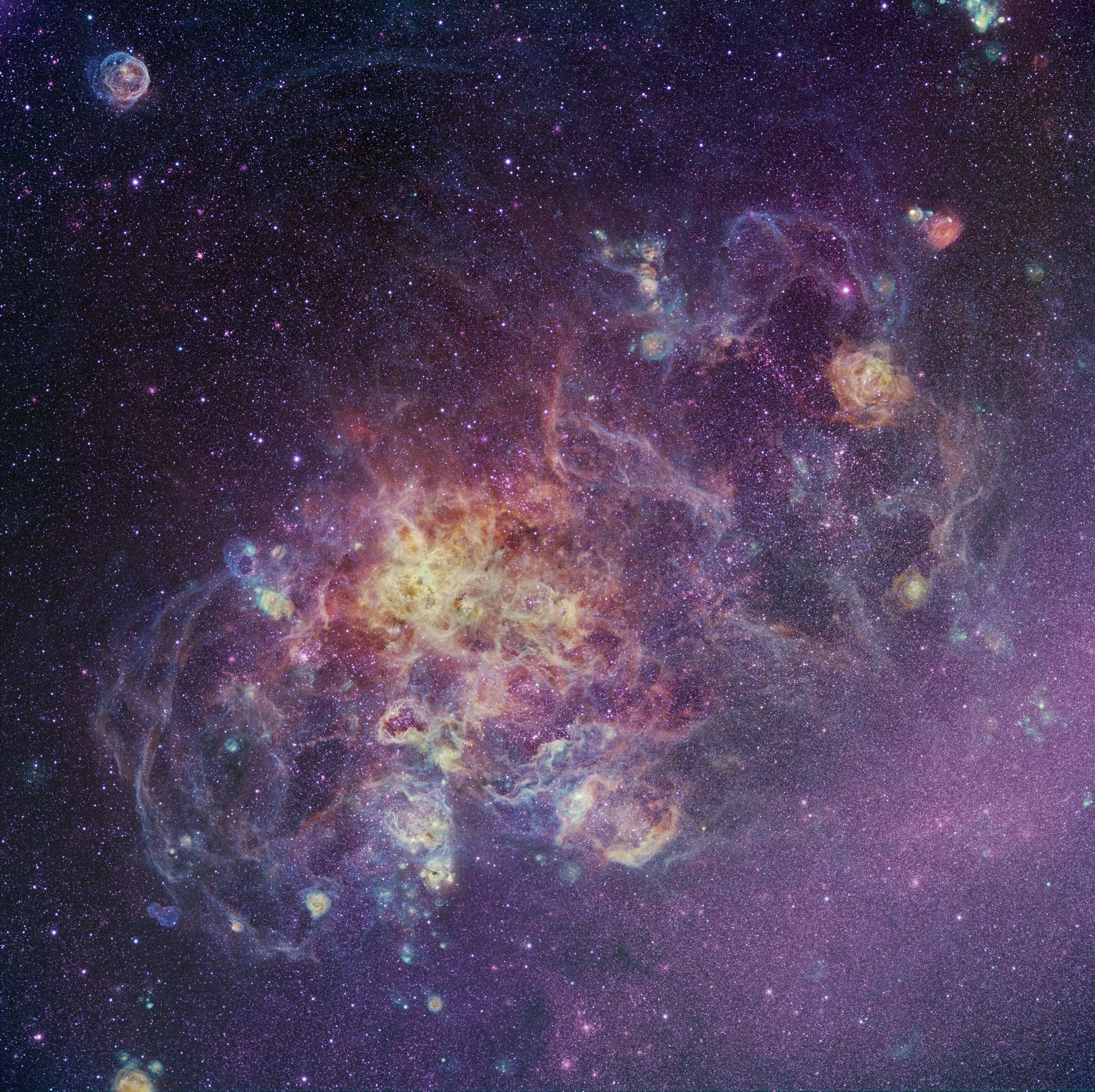
The Tarantula Zone
Explanation: The Tarantula Nebula is more than 1,000 light-years in diameter -- a giant star forming region within our neighboring galaxy the Large Magellanic Cloud (LMC). That cosmic arachnid lies left of center in this sharp, colorful telescopic image taken through narrow-band filters . It covers a part of the LMC over 2,000 light-years across. Within the Tarantula ( NGC 2070 ), intense radiation, stellar winds and supernova shocks from the central young cluster of massive stars, cataloged as R136 , energize the nebular glow and shape the spidery filaments. Around the Tarantula are other violent star-forming regions with young star clusters, filaments and bubble-shaped clouds. The rich field is about as wide as the full Moon on the sky, located in the southern constellation Dorado .
| Date | September 16, 2009 |
|---|---|
| Credit | Credit & Copyright: John P. Gleason |
| Authors & editors: | Robert Nemiroff (MTU) & Jerry Bonnell (UMCP) |
| A service of: |
ASD at NASA / GSFC, NASA Science Activation & Michigan Tech. U. |