




















APOD
Astronomy Picture of the Day
Discover the cosmos! Each day a different image or photograph of our fascinating universe is featured, along with a brief explanation written by a professional astronomer.
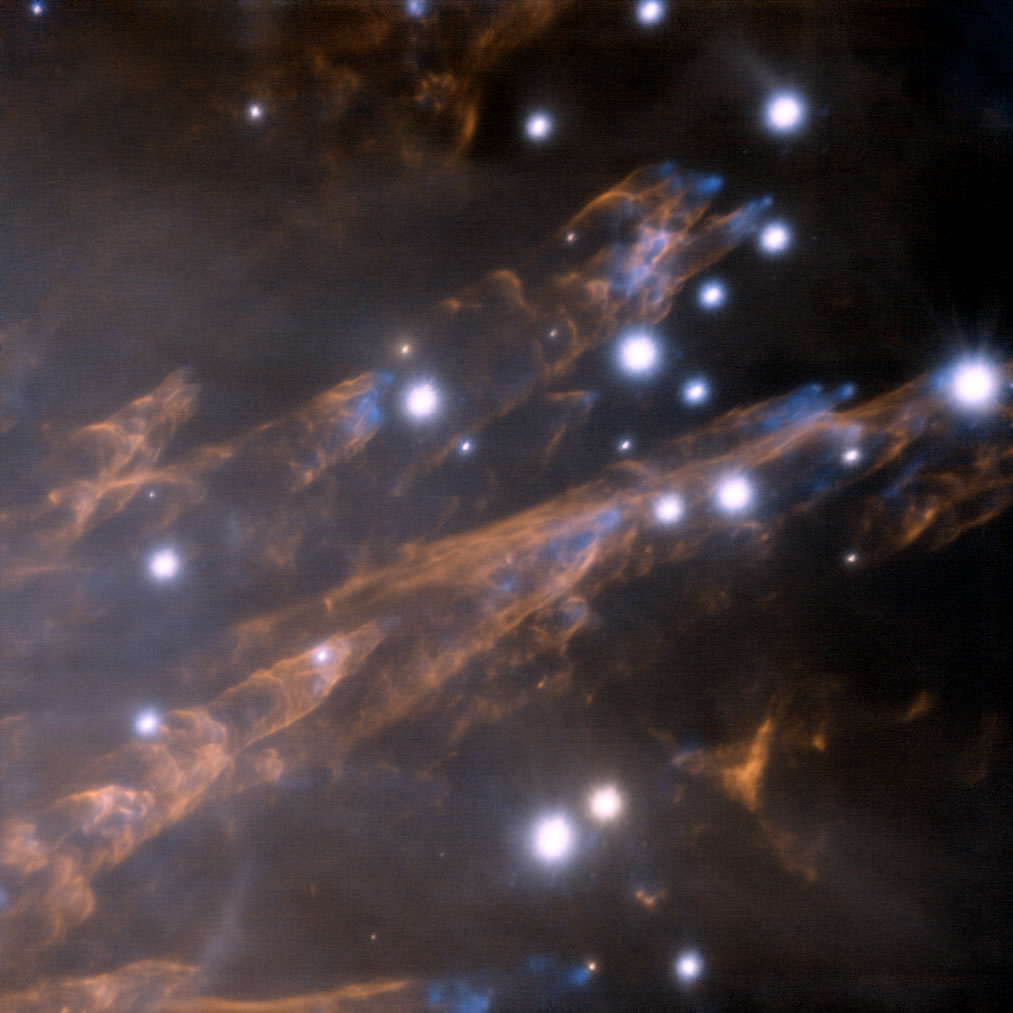
Bullet Pillars in Orion
Explanation: Why are bullets of gas shooting out of the Orion Nebula? Nobody is yet sure. First discovered in 1983, each bullet is actually about the size of our Solar System , and moving at about 400 km/sec from a central source dubbed IRc2. The age of the bullets, which can be found from their speed and distance from IRc2 , is very young -- typically less than 1,000 years. As the bullets rip through the interior of the Orion Nebula , a small percentage of iron gas causes the tip of each bullet to glow blue, while each bullet leaves a tubular pillar that glows by the light of heated hydrogen gas. Pictured above , the Orion bullets were captured in unprecedented detail by the adaptive optics technology of the Gemini North telescope. M42 , the Orion Nebula, is the closest major star forming region to us and filled with changing dust, gas, and bright stars . The Orion Nebula, is located about 1,500 light years away and can be seen with the unaided eye toward the constellation of Orion .
| Date | March 26, 2007 |
|---|---|
| Credit | Credit & Copyright: Gemini Observatory , AURA , NSF |
| Authors & editors: | Robert Nemiroff (MTU) & Jerry Bonnell (UMCP) |
| A service of: |
ASD at NASA / GSFC, NASA Science Activation & Michigan Tech. U. |