
























APOD
Astronomy Picture of the Day
Discover the cosmos! Each day a different image or photograph of our fascinating universe is featured, along with a brief explanation written by a professional astronomer.
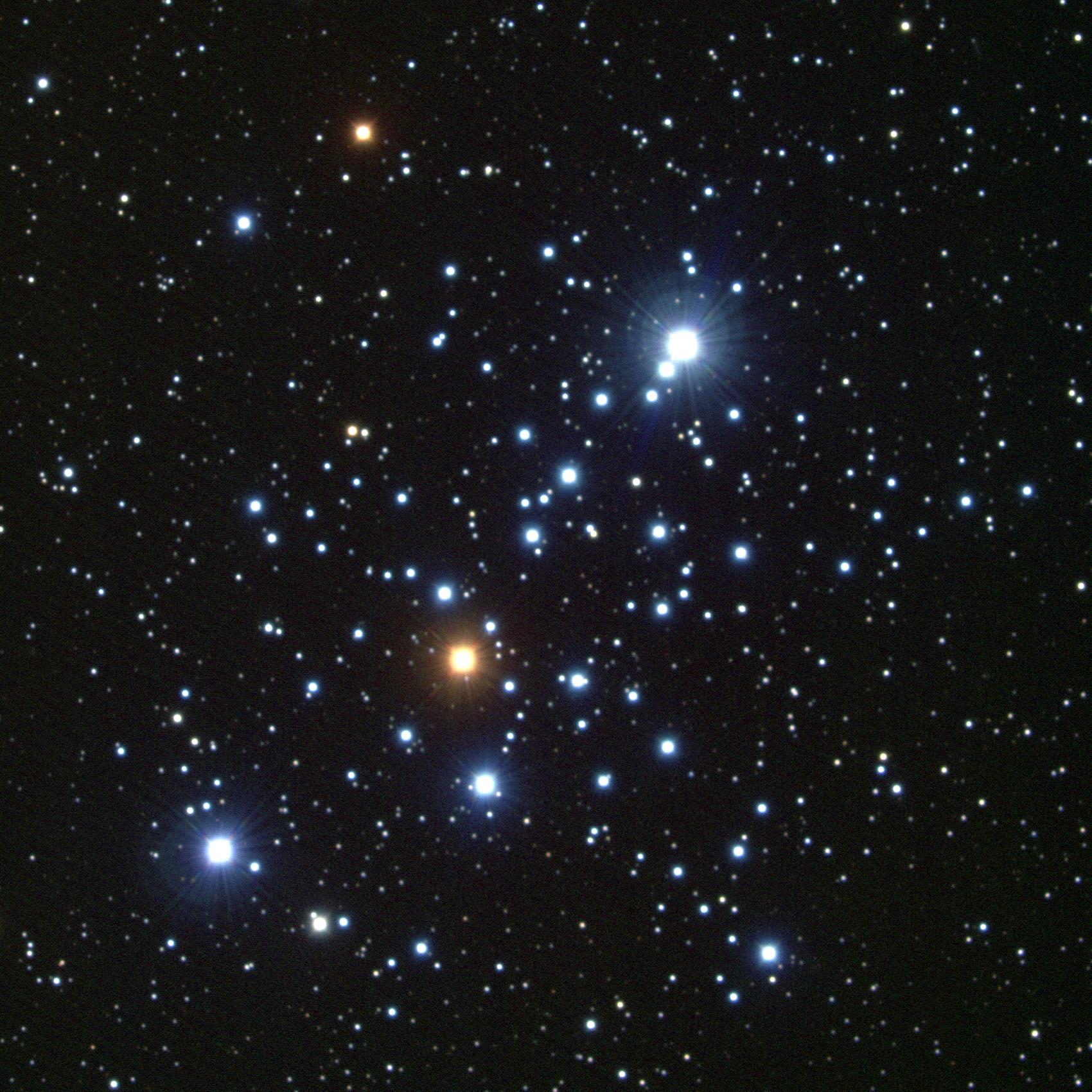
Distant Open Cluster M103
Explanation: Bright blue stars highlight the open cluster known as M103 . The gas clouds from which these stars condensed has long dispersed. Of the stars that were formed, the brightest, bluest, and most massive have already used up their nuclear fuel and self-destructed in supernova explosions . A 20 million-year age for M103 was estimated by finding the brightest main-sequence stars that still survive and theoretically computing their lifetimes. In fact, a formerly blue star has recently evolved off the main sequence and is visible above as the red giant star near the cluster center. In general, yellow stars like our Sun are usually less bright and hence less prominent in open clusters than their massive blue cousins. Light takes about 14 years to cross M103 . Although visible with binoculars toward the constellation of Cassiopeia , M103 's great distance of 8000 light years makes it appear four times smaller than a full moon .
| Date | February 7, 2001 |
|---|---|
| Credit | Credit & Copyright: Hillary Mathis & N. A. Sharp , KPNO 2.1-m Tel. , AURA , NOAO , NSF |
| Authors & editors: | Robert Nemiroff (MTU) & Jerry Bonnell (UMCP) |
| A service of: |
ASD at NASA / GSFC, NASA Science Activation & Michigan Tech. U. |