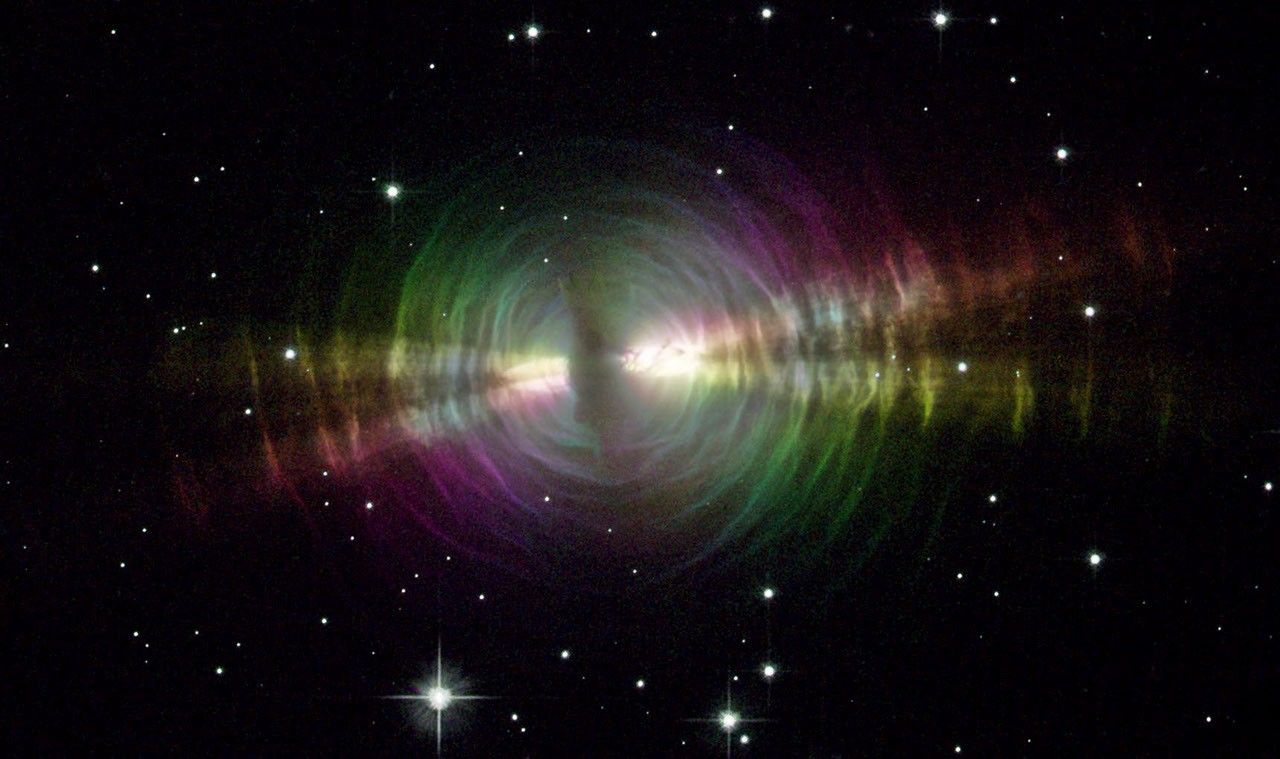



















Egg Nebula
Resembling a rippling pool illuminated by underwater lights, the Egg Nebula offers astronomers a special look at the normally invisible dust shells swaddling an aging star. These dust layers, extending over one-tenth of a light-year from the star, have an onion-skin structure that forms concentric rings around the star. A thicker dust belt, running almost vertically through the image, blocks off light from the central star. Twin beams of light radiate from the hidden star and illuminate the pitch-black dust like a shining flashlight in a smoky room. The artificial colors in this image are used to dissect how the light reflects off the smoke-sized dust particles and then heads toward Earth. Dust in our atmosphere reflects sunlight such that only light waves vibrating in a certain orientation get reflected toward us. This is also true for reflections off water or roadways. Polarizing sunglasses take advantage of this effect to block out all reflections, except those that align to the polarizing filter material. It's a bit like sliding a sheet of paper under a door. The paper must be parallel to the floor to pass under the door. By studying polarized light from the Egg Nebula, scientists can tell a lot about the physical properties of the material responsible for the scattering, as well as the precise location of the central (hidden) star. The fine dust is largely carbon, manufactured by nuclear fusion in the heart of the star and then ejected into space as the star sheds material. Such dust grains are essential ingredients for building dusty disks around future generations of young stars, and possibly in the formation of planets around those stars.
Image Credit: NASA and the Hubble Heritage Team (STScI/AURA); Acknowledgment: W. Sparks (STScI) and R. Sahai (JPL)
- X
https://science.nasa.gov/image-detail/amf-19593c1e-20a1-4247-b89c-235611cef766/
Image CreditNASA and the Hubble Heritage Team (STScI/AURA); Acknowledgment: W. Sparks (STScI) and R. Sahai (JPL)
Size1720x1020px