

















Red Rectangle
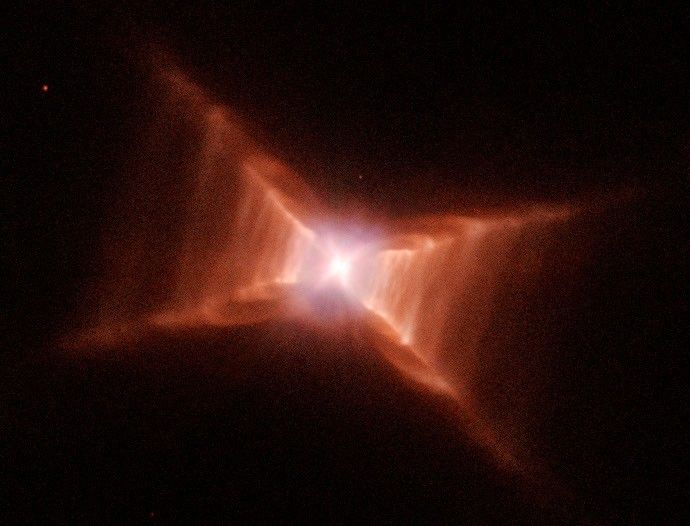
Astronomers may not have observed the fabled "Stairway to Heaven," but they have photographed something almost as intriguing: ladder-like structures surrounding a dying star. This image, taken with NASA's Hubble Space Telescope, reveals startling details of one of the most unusual nebulae known in our Milky Way. Cataloged as HD 44179, this nebula is more commonly called the "Red Rectangle" because of its unique shape and color as seen with ground-based telescopes. Hubble's sharp pictures show that the Red Rectangle is not really rectangular, but has an overall X-shaped structure, which astronomers interpret as arising from outflows of gas and dust from the star in the center. The outflows are ejected from the star in two opposing directions, producing a shape like two ice-cream cones touching at their tips. Also remarkable are straight features that appear like rungs on a ladder, making the Red Rectangle look similar to a spider web, a shape unlike that of any other known nebula in the sky. These rungs may have arisen in episodes of mass ejection from the star occurring every few hundred years. They could represent a series of nested, expanding structures similar in shape to wine glasses, seen exactly edge-on so that their rims appear as straight lines from our vantage point. The star in the center of the Red Rectangle is one that began its life as a star similar to our Sun. It is now nearing the end of its lifetime and is in the process of ejecting its outer layers to produce the visible nebula. The shedding of the outer layers began about 14,000 years ago. In a few thousand years, the star will have become smaller and hotter, and will begin to release a flood of ultraviolet light into the surrounding nebula; at that time, gas in the nebula will begin to fluoresce, producing what astronomers call a planetary nebula.
Image Credit: NASA, ESA, Hans Van Winckel (Catholic University of Leuven, Belgium), and Martin Cohen (University of California, Berkeley)
- X
https://science.nasa.gov/image-detail/amf-22a33c84-80f0-4f5a-ad09-18077c5c7e30/
Image CreditNASA, ESA, Hans Van Winckel (Catholic University of Leuven, Belgium), and Martin Cohen (University of California, Berkeley)
Size690x526px