


















Webb Unravels Small Cosmic Details With Interferometry Observing Mode
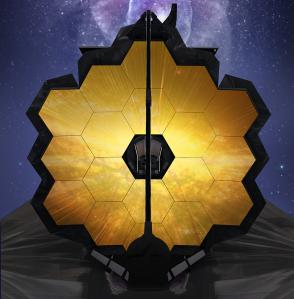
One of the most recognizable features of NASA’s James Webb Space Telescope is its large, segmented, gold-coated mirror, which delivers images twice as sharp as pre-launch estimates. Aperture masking interferometry is an observational technique that allows for high-angular resolution imaging of celestial objects. The basic principle involves placing a specially designed mask with several small pinholes in the light path through the telescope. This mask effectively turns the primary mirror into multiple smaller telescopes.

The technique is called aperture masking interferometry (AMI), and Webb’s tool to do it is the Near Infrared Imager and Slitless Spectrograph, built by the Canadian Space Agency. Three science teams described how unique, specialized observations made this way provide new insights to three cosmic objects.
Massive binary star system Wolf-Rayet 137
Joel Sánchez Bermúdez, a scientist at the National Autonomous University of Mexico in Mexico City, remarks that their science team, called DustERS, “used the AMI mode on Webb to observe WR 137. In this system one star is a Wolf-Rayet: a massive, highly luminous star with strong stellar winds and a mass approximately ten times that of our Sun. Its companion star is another massive star 17 times the mass of our Sun. Both stars orbit around each other, completing a revolution in 13.1 years. We used the AMI mode to spatially resolve the faint dust formed at the innermost 100-200 astronomical units in the colliding wind region of the two stars (Neptune resides nearly 30 astronomical units from the Sun). Here the gas is compressed and cooled enough such that small dust particles can be created.
“We expected the dust pattern to be pinwheel shaped, but were surprised because it forms a linear, almost straight-line, which is quite unusual. This difference suggests that there’s something unique about the way the winds from WR 137 are interacting and creating dust.

“To understand the unusual dust pattern, our team used computer models that simulated the conditions around WR 137. These models turned the AMI data into clear images of the star and its surroundings never obtained before! The study of WR 137 is the first one of its kind using Webb, and it has helped to push the development of new tools for interpreting other AMI data.
“This work shows that, with the super detail of Webb with AMI, analyzing the formation and evolution of the dust over the circumstellar environment of this type of target is important to understand how the universe is enriched of complex chemical compounds that are the basis of new generations of stars and planets.”
PDS 70
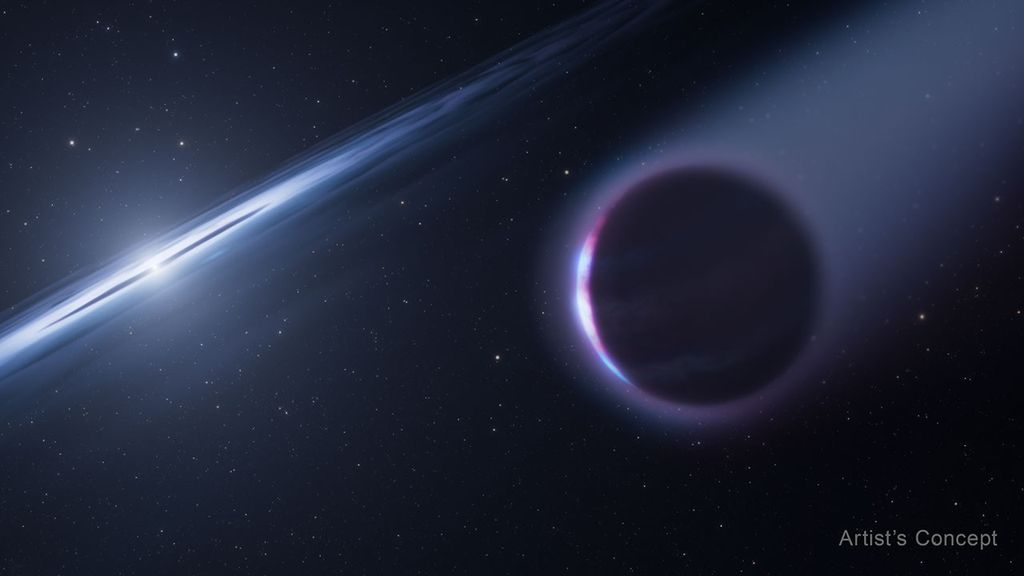
Dori Blakely, a doctoral candidate from the University of Victoria in British Columbia, Canada, is researching PDS 70 with a large international science team. PDS 70 is a young, Sun-like star, approximately 370 light-years away and roughly 5 million years old. It is orbited by two giant planets and surrounded by a protoplanetary disk. The protoplanetary disk is composed of 99% gas and 1% dust leftover from the star formation process and flattened into a rotating disk due to angular momentum. The two planets orbiting PDS 70, known as PDS 70 b and PDS 70 c, likely resemble a very young Jupiter, as it was more than 4.5 billion years ago. These planets, however, orbit somewhat farther away from their host star, with separations of roughly 4 and 8 times that of Jupiter’s distance from the Sun.
Blakely comments that “At just a few million years old, PDS 70 b and c are two of the youngest planets that have been imaged. They present a unique opportunity to learn about how planets form because they are still actively gaining material from the protoplanetary disk surrounding the host star. Thermal emission from cold, roughly minus 418 degrees Fahrenheit (minus 250 degrees Celsius), sand-sized dust particles has been observed in a circumplanetary disk around PDS 70 c. However, the physical conditions within the protoplanetary accretion layer remained unknown.
“Using AMI mode, we precisely measured the brightness of both PDS 70 b and c in the mid-infrared, at 4.8 microns, for the first time. Observing at 4.8 microns (and beyond) is important since these wavelengths’ emission from the inner edge of a circumplanetary accretion disk can be as bright as the emission from the planet itself. This is exactly what we found using Webb. Our measurements reveal excess emission compared to what is expected from just the planet atmospheres. The observed excess emission is consistent with material surrounding the planets at roughly minus 58 degrees Fahrenheit (minus 50 degrees Celsius). Follow-up observations of both planets at additional nearby wavelengths will allow for the temperature and location of the circumplanetary dust to be determined much more precisely.

Io: volcanically active moon around Jupiter
As part of the Webb early release science program 01373 (P.I.’s Imke de Pater & Thierry Fouchet), astronomers used the NIRISS AMI mode to get a new view of Jupiter’s moon, Io.
However, Io’s complex structure and projected size at the time of the observations prevents the use of standard interferometric image reconstruction techniques. Thus, to recover images of Io from the Webb NIRISS/AMI data, a new innovative approach was employed: neural networks. These algorithms (inspired by the human brain) are exceptionally good at learning complex patterns.
This research allowed the astronomers to pinpoint and characterize several volcanoes and large-scale extended emission across Io’s disk. Five images over approximately 30 minutes showed different hot spots associated with different volcanoes over the entire moon’s disk. The study also revealed insights into the size of the structures on Io’s surface. Analyzing the brightness of the moon’s disk, the authors found dominant features at scales of approximately 225 miles (362 kilometers), which likely correspond to the emission regions of individual volcanoes. Other features seen at larger scales of around 360 miles (580 kilometers) might be linked to previously observed sulfur dioxide frost. These findings were consistent with complementary observations taken from the Keck II telescope on Earth, further validating the new neural network technique for analyzing AMI data.
Looking to the future
Employing new techniques, such as AMI, that are used to enhance the sharp resolution of Webb almost two times better is helping guide next-generation instrumentation and space telescopes. There are limitations on the size of space-based telescopes and precision that can be achieved in angular resolution. Having options to gain in that area with instrumentation or new techniques will only enhance these new facilities to unprecedented levels. NASA’s next Astrophysics flagship after the Nancy Grace Roman Space Telescope is the Habitable Worlds Observatory, a concept for a mission with new instruments and technologies capable of imaging habitable worlds in other planetary systems.
About the article:
Authors:
- Joel Sánchez Bermúdez is a researcher at the Instituto de Astronomía, Universidad Nacional Autónoma de México who focuses on image reconstruction using infrared interferometric data and star formation. He developed the neural network technique used in the reconstructions of Io. Sánchez Bermúdez is the developer of SAMPip, a Python code for analyzing AMI data, used in the study of WR 137.
- Dori Blakely is a PhD candidate at the University of Victoria whose research focuses on the direct detection and characterization of planets in protoplanetary disks using direct imaging, interferometry, and absolute astrometry.
- Imke de Pater is a Professor Emerita in the Departments of Astronomy and of Earth and Planetary Science at the University of California, Berkeley. She studies the four giant planets in our solar system, and their rings and satellites, in particular Io, using observations at radio, infrared and visible wavelengths. She, together with Thierry Fouchet, is the principal investigator of the Early Release Science program #1373: “ERS observations of the Jovian System as a demonstration of JWST’s capabilities for solar system science.”
Related Links:
- “A First Look with JWST Aperture Masking Interferometry: Resolving Circumstellar Dust around the Wolf–Rayet Binary WR 137 beyond the Rayleigh Limit” – Ryan M. Lau, et. al., 2024, ApJ, 963, 127
- “Revealing Io’s surface using JWST-NIRISS aperture masking interferometry and neural network deconvolution” – Sanchez-Bermudez, et. al., 2025, MNRAS, 543, 608
- “The James Webb Interferometer: Space-based Interferometric Detections of PDS 70 b and c at 4.8 μm” – Blakely, et. al., 2025, AJ, 169, 137