



























Amid Europe’s scorching summer of 2026, Austria’s largest glacier was holding on by one dwindling thread of ice. The last icefall connecting the upper and lower portions of the Pasterze Glacier in the Eastern Alps appeared poised to break, which would put an end to its reign as the country’s largest. Groups monitoring the glacier say the last conduit of ice may, depending on weather conditions, survive to see another year or two, or it may face its demise before the cold months arrive this year.
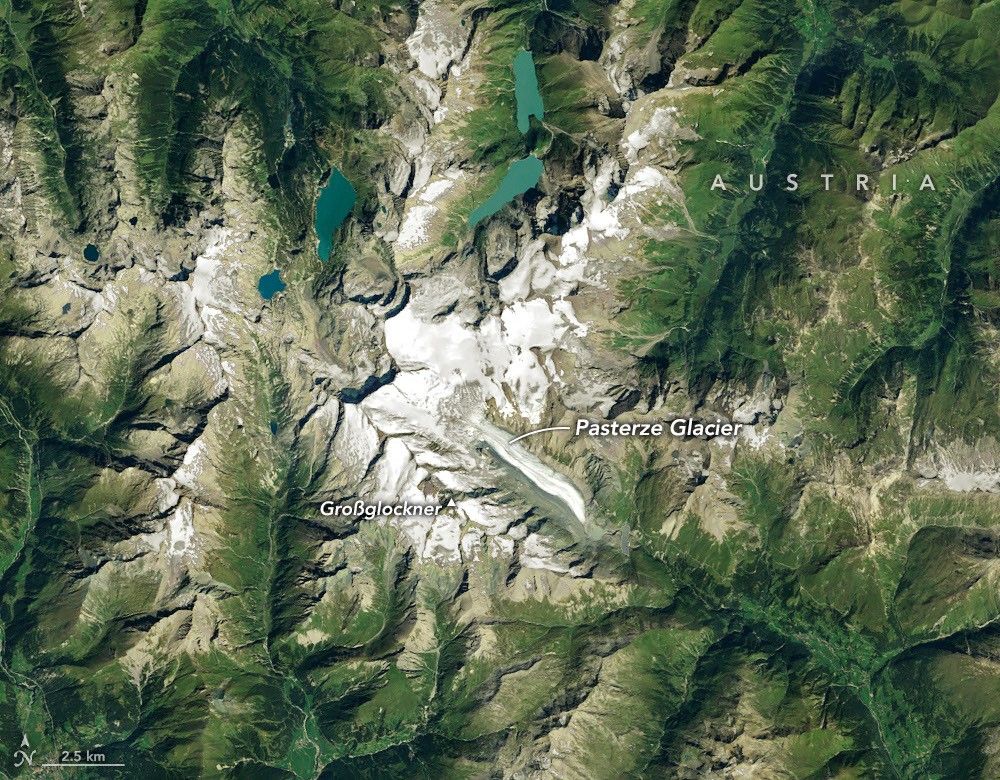
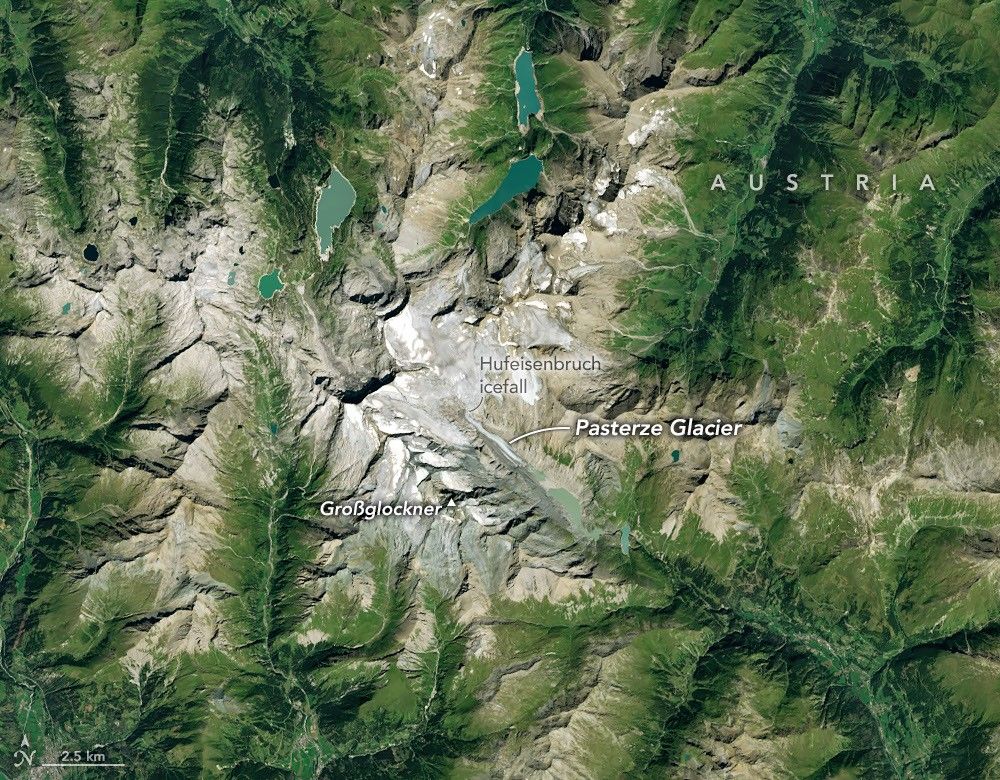
The NASA/USGS Landsat images above capture the glacier’s change from August 22, 1985, to August 15, 2026. In 1985 (left), the higher-elevation portion of the glacier, where ice accumulates, fed ice to the valley below through multiple icefalls. (Note that ice along the southern edge of the valley is covered in debris, giving it a dark appearance.) In 2026 (right), only one icefall, known as the Hufeisenbruch, remained. The glacial ice in the valley below had receded substantially, and a proglacial lake filled in much of the area the ice once occupied.
In retreat since the mid-1800s, the Pasterze has lost mass almost continuously and at increasing rates since 1980, according to scientists from the University of Graz, GeoSphere Austria, and the Austrian Alpine Club. Small advances have occurred in only seven years since 1879. Starting in the 2010s, the volume of ice supplied from higher elevations has been small enough to leave the ice in the valley almost stagnant.
By 2020, the penultimate ice connection to the upper accumulation zone was replaced by a waterfall, leaving the Hufeisenbruch icefall as the glacier’s precarious linchpin. Between 1998 and 2025, scientists from the University of Graz monitored the width of the icefall, finding a decrease from nearly 900 meters (3,000 feet) to just 120 meters (390 feet). Researchers attribute the change to decreasing ice inputs from above, along with increasing thermal energy emitted from ice-free rock faces that furthers the loss of ice.
Photos taken in mid-August 2026 confirmed the icefall was still intact, said Andreas Kellerer-Pirklbauer, a scientist in the geography department at the University of Graz and co-head of the glacier measurement service of the Austrian Alpine Club. Observers expect the connection to last until at least 2027, he said, based on its current condition and assuming relatively normal temperatures in the upcoming autumn and winter.
Coupled with the dramatic loss of ice at Pasterze, apparent in the images above, is the growth of a proglacial lake at its terminus. Kellerer-Pirklbauer and colleagues tracked the lake’s growth from 1998 to 2019 and found that its area increased exponentially over that time. The researchers also documented several large-scale buoyant calving events in which ice slabs in contact with the water broke off from the terminus or even from the lake bed. Researchers are interested in how these lakes form and evolve not only because they can contribute to increased rates of ice loss, but also because they can raise the risk of dangerous outburst floods.
The sweltering spring and summer of 2026 have shone a spotlight on the Pasterze and the many other glaciers in the Alps already undergoing rapid retreat in the 21st century. A hot and dry spring in Austria was followed by the highest combined June and July temperatures on record in Western Europe, according to Europe's Copernicus climate monitoring service. In 2024 and 2025, nearly all of Austria’s glaciers retreated, and signs in 2026 point toward yet more melt. When Pasterze’s Hufeisenbruch icefall does succumb to melting or collapse, the glacier will cede its status as Austria’s largest to Gepatschferner in the Ötztal Alps in Tyrol.
NASA Earth Observatory images by Michala Garrison, using Landsat data from the U.S. Geological Survey. Story by Lindsey Doermann.


References & Resources
- AP News (2026, March 13) All but 2 of Austria’s 96 glaciers have retreated over last 2 years. Accessed August 27, 2026.
- Austrian Alpine Club (2026, July 7) Austria's largest glacier hanging by a thread. Accessed August 27, 2026.
- Kellerer-Pirklbauer, A., et al. (2021) Buoyant calving and ice-contact lake evolution at Pasterze Glacier (Austria) in the period 1998–2019. The Cryosphere, 15, 1237–1258.
- NASA Earth Observatory (2026, August 21) Europe’s Scorching Summer. Accessed August 27, 2026.
- NASA Earth Observatory (2004, June 7) Pasterze Glacier, Austria. Accessed August 27, 2026.