





















Pluto and Its Moons Charon, Nix, and Hydra
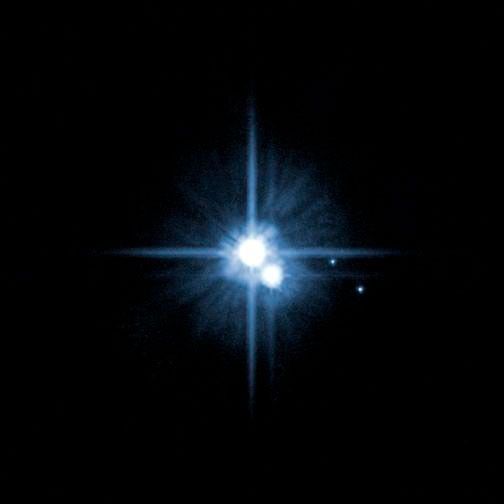
Discovered by Hubble in 2005, Pluto's moons Nix and Hydra are roughly 5,000 times fainter than Pluto and are about two to three times farther from Pluto than its large moon, Charon. The discovery of Nix and Hydra confirmed that the Kuiper Belt, a swarm of icy bodies encircling the solar system beyond Neptune, was more complex and dynamic than astronomers once thought. Pluto resides inside the Kuiper Belt. The moons' orbits are in the same plane as the orbit of the much larger satellite Charon (discovered in 1978). This likely means the moons were not captured, but instead were born, along with Charon, in what is commonly theorized to have been a titanic collision between two Pluto-sized objects over 4 billion years ago.
Image Credit: NASA, ESA, H. Weaver (JHU/APL), A. Stern (SwRI), and the HST Pluto Companion Search Team
- X
https://science.nasa.gov/image-detail/amf-3f5237de-026c-44b7-a44c-69ce41a5ad51/
Image CreditNASA, ESA, H. Weaver (JHU/APL), A. Stern (SwRI), and the HST Pluto Companion Search Team
Size504x504px