


















1 min read
HR 8799 Exoplanet System: Positional Schematic
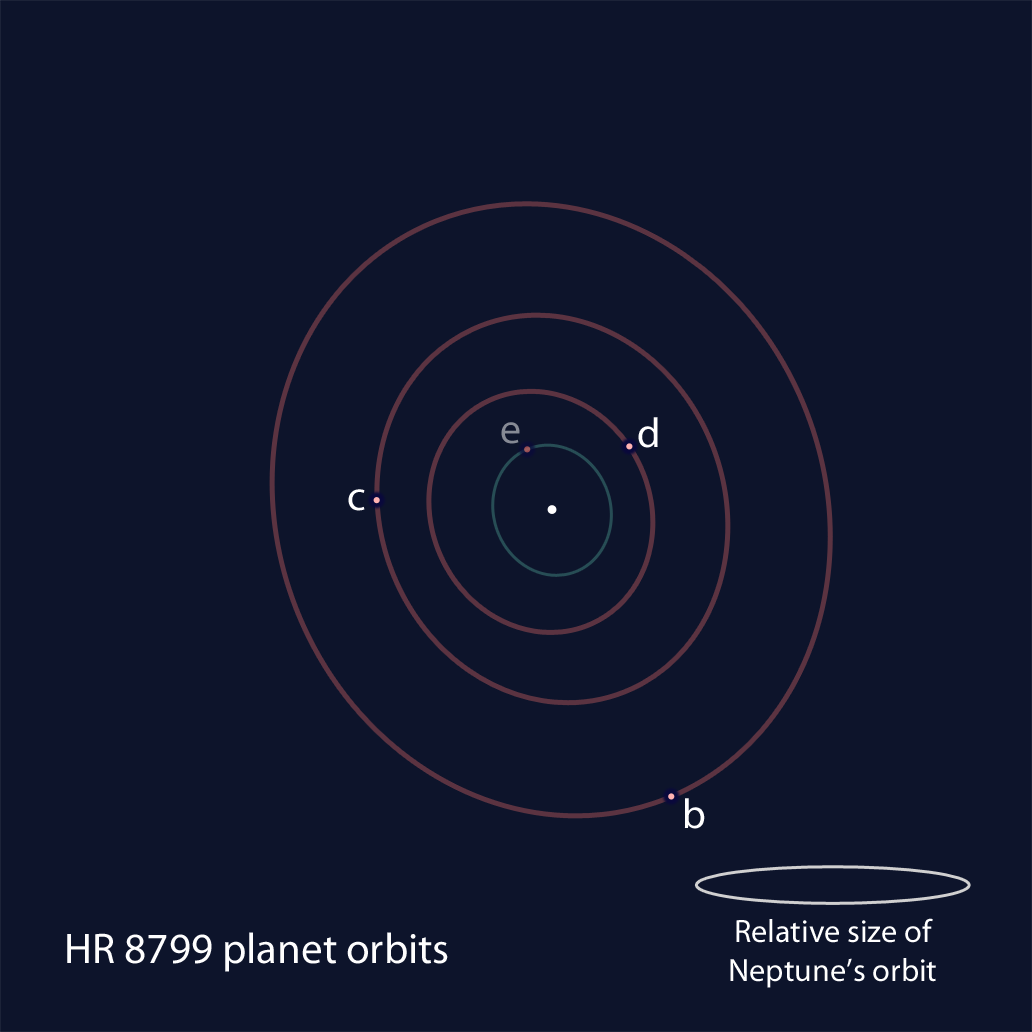
This schematic shows the positions of the four exoplanets orbiting far away from the nearby star HR 8799. The orbits appear elongated because of a slight tilt of the plane of the orbits relative to our line of sight. The size of the HR 8799 planetary system is comparable to our solar system, as indicated by the orbit of Neptune, shown to scale.
Extended Description and Image Alt Text
Extended Description
This diagram depicts the positions of four exoplanets around star HR 8799.
In the bottom left corner is a label that reads “HR 8799 planet orbits.”
In the bottom right corner is a white ellipse that is tilted relative to the viewer. Its widest point is a little larger than a quarter of the overall illustration. Text below the ellipse reads “Relative size of Neptune’s orbit.”
The center of the diagram shows four exoplanets orbiting about a concentric point. This point, represented by a white dot, is star HR 8799.
Immediately outside the white dot is a green oval, which outlines the planet’s elliptical orbit, with a red dot positioned at 11 o’clock. The red dot is labeled “e.” This represents the orbit of exoplanet e of the HR 8799 system, which is about half the relative orbit of Neptune.
The next orbit is represented by a slightly larger red oval with a pink dot positioned at two o’clock. The pink dot is labeled “d.” The orbit of exoplanet d is about the same size as the relative orbit of Neptune.
Beyond the orbit of exoplanet d is another slightly wider red oval with its own pink dot. The pink dot on this orbit, which is near nine o’clock, is labeled “c.” Its orbit is about twice the relative orbit of Neptune.
The outermost and widest orbit is also represented by a red oval with its own pink dot positioned near five o’clock. The dot is labeled “b.” The orbit of b around star HR 8799 is almost three times the relative size of Neptune’s orbit.
Image Alt Text
Diagram of four exoplanets orbiting the star HR 8799.
- Release DateApril 21, 2021
- Science ReleaseNASA’s Webb to Study Young Exoplanets on the Edge
- CreditImage: NASA, ESA, Rémi Soummer (STScI)
Related Images & Videos
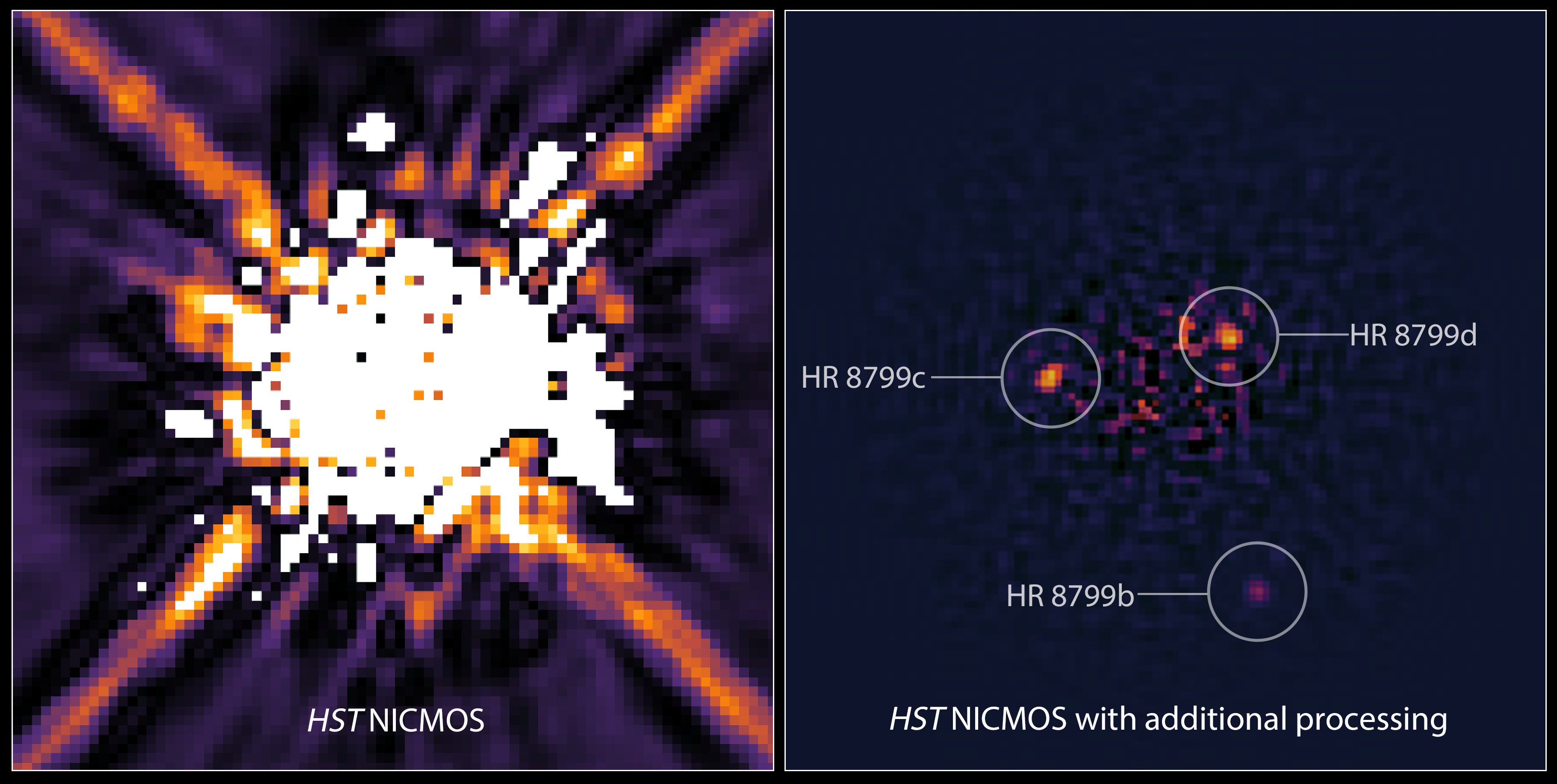
HR 8799 Exoplanet System (Hubble)
Left: This is an image of the star HR 8799 taken by Hubble's Near Infrared Camera and Multi-Object Spectrometer (NICMOS) in 1998. A mask within the camera (coronagraph) blocks most of the light from the star. Astronomers also used software to digitally subtract more starlight....
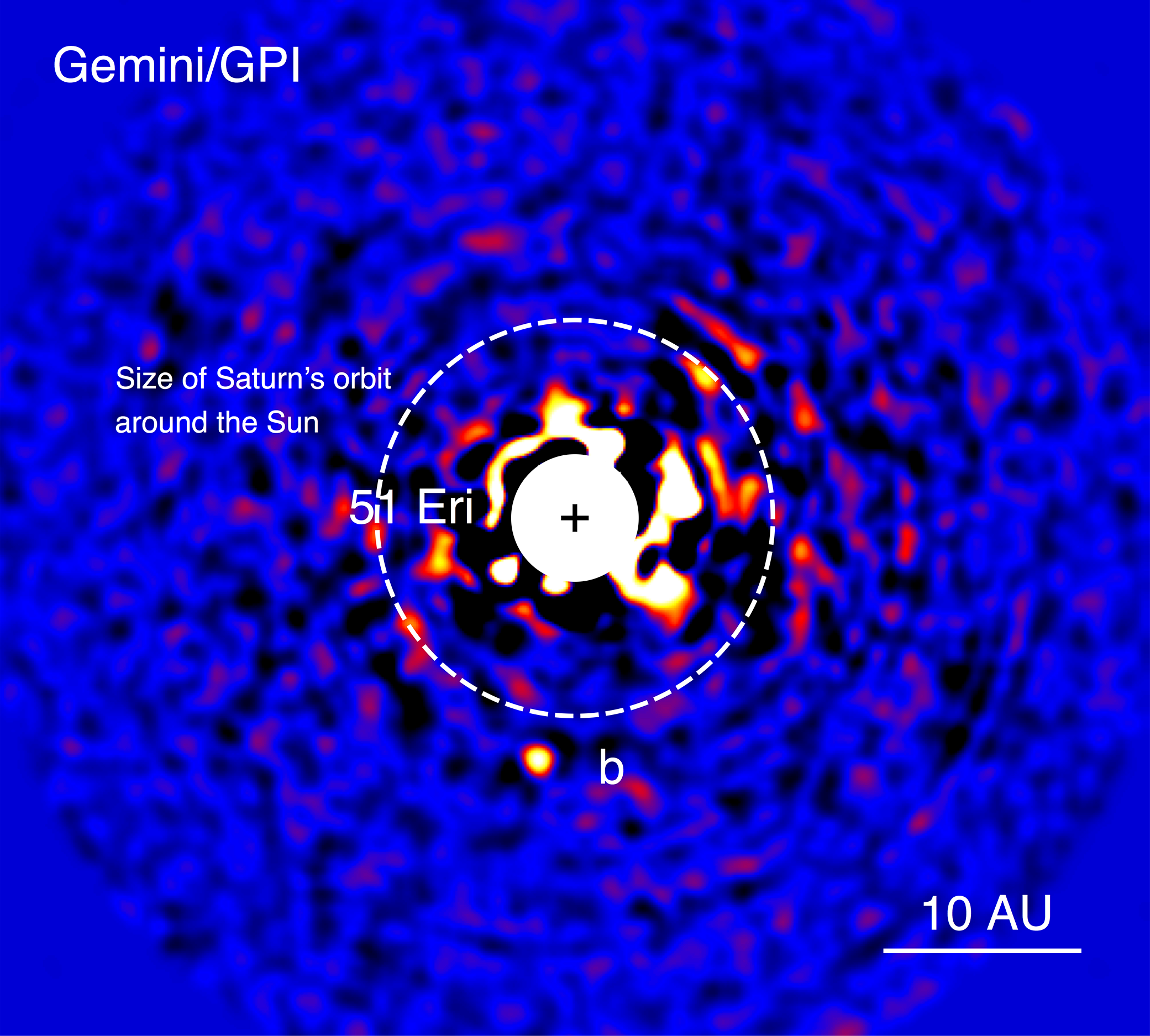
Exoplanet 51 Eridani b (Gemini)
This discovery image of a Jupiter-sized extrasolar planet orbiting the nearby star 51 Eridani was taken in near-infrared light in 2014 by the Gemini Planet Imager. The bright central star is hidden behind a mask in the center of the image to enable the detection of the...
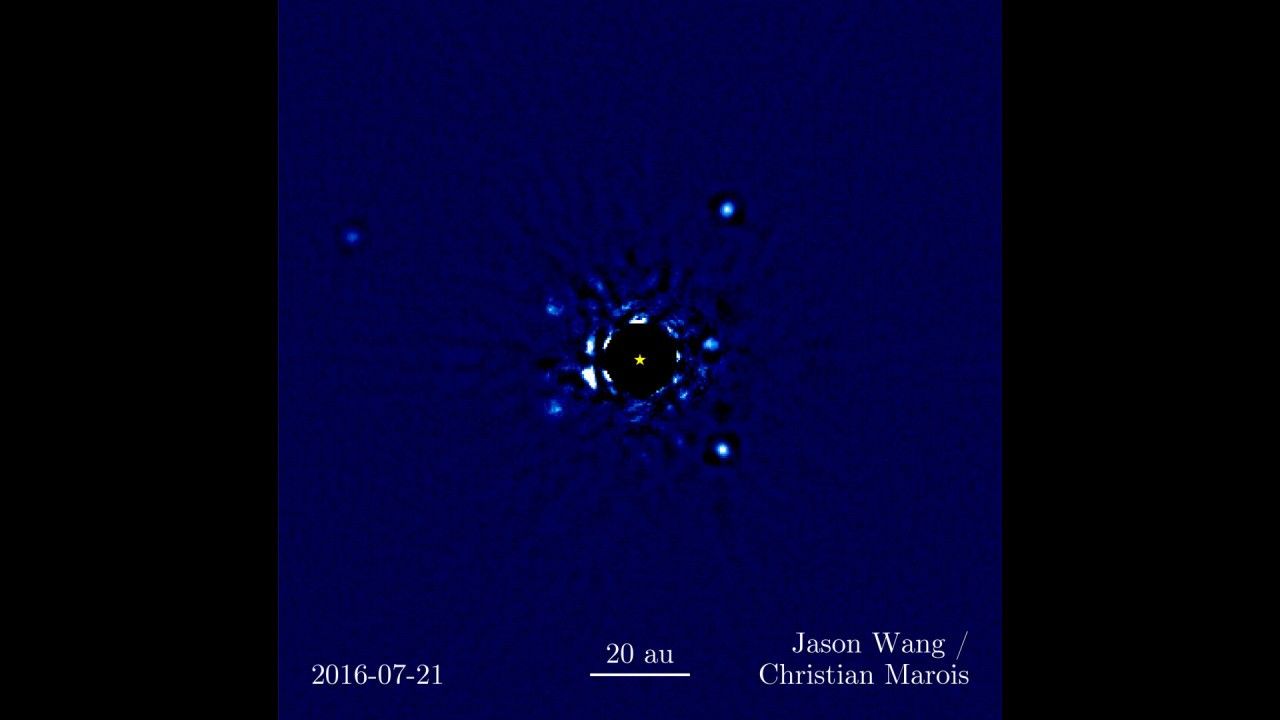
Planets Orbiting HR 8799
This video shows four Jupiter-sized exoplanets orbiting billions of miles away from their star in the nearby HR 8799 system. The planetary system is oriented face-on toward Earth, giving astronomers a unique bird’s-eye view of the planets’ motion. The exoplanets are orbiting so...
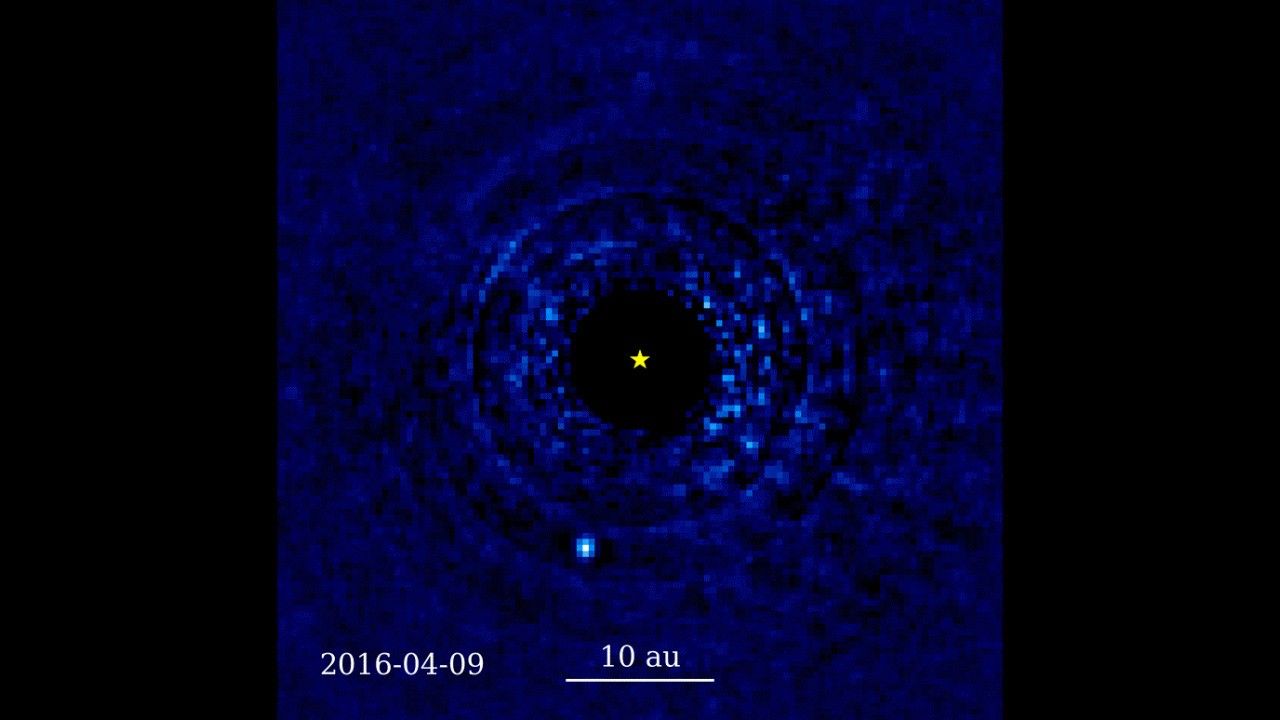
Planet Orbiting 51 Eridani
This video shows a Jupiter-sized exoplanet orbiting far away — roughly 11 billion miles — from a nearby, Sun-like star, 51 Eridani. The planetary system is oriented face-on toward Earth, giving astronomers a unique bird’s-eye view of the planet’s motion. The video consists of...
Share
Details
Laura Betz
NASA’s Goddard Space Flight Center
Greenbelt, Maryland
laura.e.betz@nasa.gov
NASA, ESA, Rémi Soummer (STScI)