























About Webb Images
What you Need to Know
Details on the how, where and why of finding Webb images (and science articles) on the internet as well as information on the Webb specific diffraction spikes seen on stars in Webb images, how Webb images are made and more.
Is there a single location to view ALL published Webb images?
SHORT ANSWER:
There is no one place that all published Webb images are located, because there is no one source that publishes Webb images. However the most comprehensive source is our current year Webb image flickr gallery and/or our Webb Instagram (new tab) which gather imagery from a number of sources mentioned below.
DETAILS:
Webb is used by scientists all over the world from many different organizations: nations, agencies, research institutes, universities, etc. In fact, any individual can download raw Webb data, process it, and release their own version of an image. The raw data archive (called MAST) is the only place that all Webb's unprocessed data is located. While accessible to everyone, knowledge of image processing software is necessary for using the data.
On this site, the official NASA Webb Telescope site (nasa.gov/webb) you will find:
- primarily and most importantly, peer reviewed NASA Science Releases and their associated images/videos which are aggregated with other Webb news in our news feeds (but can easily be filtered to view only Webb Science Releases and/or images/videos).
- some of the more promising "early release science" (meaning not yet peer reviewed), is captured in our Webb Blog.
Images not always included on our website include:
- some images published by the Webb ESA / CSA teams (links open in new tabs);
- some collaborative projects with other NASA missions/Centers where a Webb image is compared or layered into a multi-mission image or possibly reissued as a composite image;
- images created and published outside of NASA by private researchers/individuals/universities;
This means there are Webb articles and images that may not appear on our site but that do appear on the internet. Our social media team tries to collect as many of the ESA/CSA and other NASA Center/Mission releases as possible in our yearly Flickr galleries and on our Webb Telescope Instagram (new tab).
One last note, there are lots of fake and sometimes AI generated images out there that are attributed to Webb (and other NASA missions as well), so be careful and when in doubt, before sharing, look on an official source. NASA does not run ANY topical Facebook groups (even if they use the name of the mission) and those are notorious for sharing fake images.
Where do I Find Webb Science Images
Updated: 4/28/2026
Current Year Science Images : Our Webb FLICKR "quick look" slideshow/gallery collects this calendar year's Webb images from a number of sources in reverse chronological order. These slideshows supply a quick and easy way to move through the latest images but also support click through to pages with image descriptions and a subset of available image formats and resolutions for download.
Prior Year Science Images: FLICKR slideshows/galleries of science images by year as well as Webb's very first images and more.
Search / Filter Science Images : Tools to search webb images by keywords, and filter images by various NASA categories (such as astronomical object), Webb science themes, date ranges and more. These searches result in displays of image detail pages which have detailed descriptions and ALL available formats and resolutions of images available for download.
ESA's Webb Gallery (Offsite) : we often highlight ESA’s picture of the month. You can visit ESA’s Webb Gallery as an alternative source of Webb imagery and information. ESA has an extensive Webb gallery with access to various download resolutions, side by side draggable comparisons of various instruments and missions versions of some images and more.
Webb Social Media : X | Instagram | Facebook | Youtube
The Webb Instagram team collects Webb science images from a number of sources and adds additional descriptive information and social commentary.
Webb News Feed Search/Filter : Our news feed is an aggregation of Webb Science Releases and articles by other NASA missions and centers, and more. One can search and filter all Webb news to only see Webb Science Releases and associated imagery. Go here to not only see the images but read the full story on each.
Webb Blog Search/Filter : Webb science images/spectra occasionally appear here that are not yet peer reviewed and therefore not covered by NASA News feature articles. Often co-authored by scientists and engineers, blog posts have a less formal insiders point of view.
Why are some Webb images / articles on the internet not available on NASA websites?
SHORT ANSWER: NASA/ESA/CSA/STScI generally only publish scientifically peer reviewed results. Exception: We occasionally post exceptional images/science articles on our Webb blog that are "early release science" (still in peer review process).
DETAILS: Investigators from all over the world use Webb everyday to capture images and spectra.
Webb images, spectra, and resulting findings go through scientific peer-review BEFORE being released on NASA/STScI websites and social media.
However, Webb investigators sometimes post "preprint" versions of their papers on NON-NASA/STScI websites and social media before the full science peer-review process is complete.
In general, you will NOT find these "preprint" images/spectra/findings on NASA/STScI websites and social media therefore you must look for them (and related high-resolution images and meta-data) on the publishing institution's websites and social media.
Occasionally NASA and STScI in collaboration with the science community, may publish some exceptional "preprint" images/spectra/findings and they will be labelled as such.
Why do Webb Image Resolutions Vary?
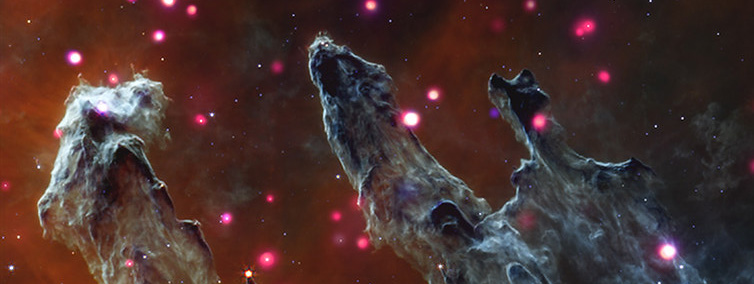
Some images are mosaics of many images, others are subsets of a single image cropping a small section of the field of view during a particular instrument mode.
NASA/STScI Webb Images are always released at the highest resolution available based on the intrinsic resolution of the specific science image.
Image sizes and resolutions vary, sometimes dramatically, because some science images are mosaics assembled from many individual images whereas others maybe a specific astronomical object cropped from a single image possibly via the specific instrument mode employed.
Mosaic Example: Carina Nebula (offsite)
Total mosaic width 14575px by 8441px high - multiple NIRCam images assembled to create the image.
Crop/Masked Example: Exoplanet HIP65426b (offsite)
Four views of the exoplanet with different filters, each using coronagraph masks resulting in each exoplanet image ~350px wide arranged together into a ~1500px wide overall four panel image.
On this website's pages, we will supply embedded images with resolutions ranging from 2-4k in general.
For all resolutions up to the maximum resolution versions of images, use the Multimedia/Images search/filter block to find the image detail page where all available image formats and resolutions are made available for download. But note, in some cases as noted above, there may not be a higher resolution image available.
For all resolutions up to the maximum resolution versions of images, use the Multimedia/Images search/filter block to find the image detail page (mainly for science images) where all available image formats and resolutions are made available for download. But note, in some cases as noted above, there may not be a higher resolution image available.
Resolution Deep Dive: The maximum resolution of Webb's instrument detector arrays and instrument modes used for any particular observation determine maximum resolutions in non-mosaic images. For mosaic images, for example Webb's deep field images, the resolution canbe quite large. For a deep dive into the details see :
Webb's NIRCam Field of View (offsite)
Webb's NIRCam Detectors (offsite)
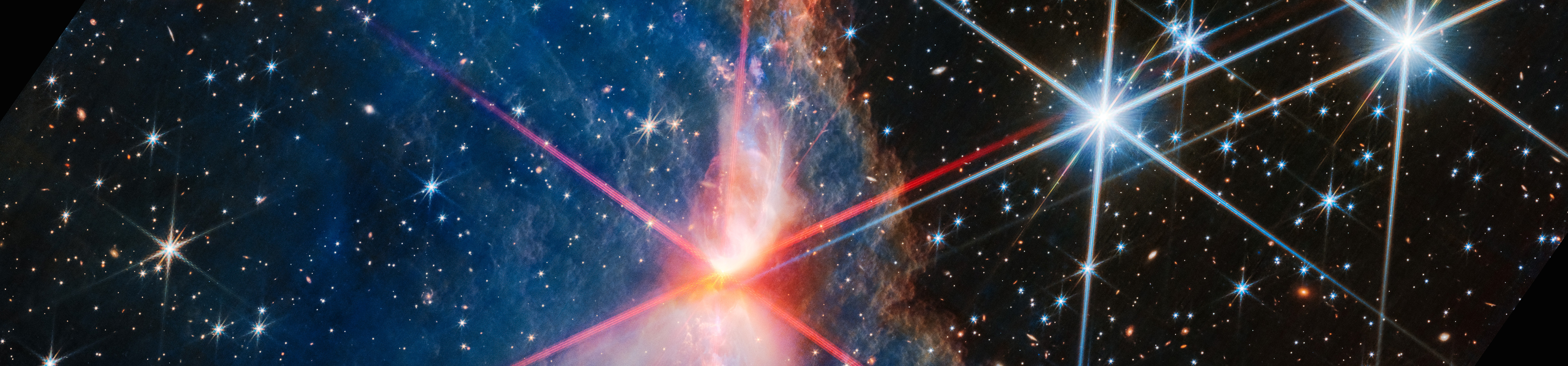
Webb's Diffraction Spikes
Bright stars stand out in Webb images with their eight sharply defined diffraction spikes. In the linked infographic and transcript, the science behind Webb's diffraction spikes is explained (credit: STScI).
How are Webb Images Made?
Images don't come down from Webb in the beautiful full color renderings you see on this website and elsewhere. Someone has to translate the raw black and white image data into the color, especially since Webb collects light that falls outside of human vision. That’s where people like Joe DePasquale and Alyssa Pagan of the Space Telescope Science Institute come in. Learn how they makes choices about color and other aspects of space images.
Note: the following video embed is a playlist, to access all videos in the list, click on the 3 bar icon in upper right.
What is Webb Observing?
See current, upcoming and recent past observations scientists are making with the Webb Space Telescope. View details about each observation's science focus areas, the instruments used and more.
View the Tool
What is Webb Observing Next?
JWST science observations are nominally scheduled in weekly increments. Planned schedules will be posted as they are made available. Since the schedules do not take into account unforeseen events, including some target of opportunity observations, it is possible that the actual executed observations will differ from those planned.