





















1 min read
Abell 2744 GLASS (NIRCam Image)
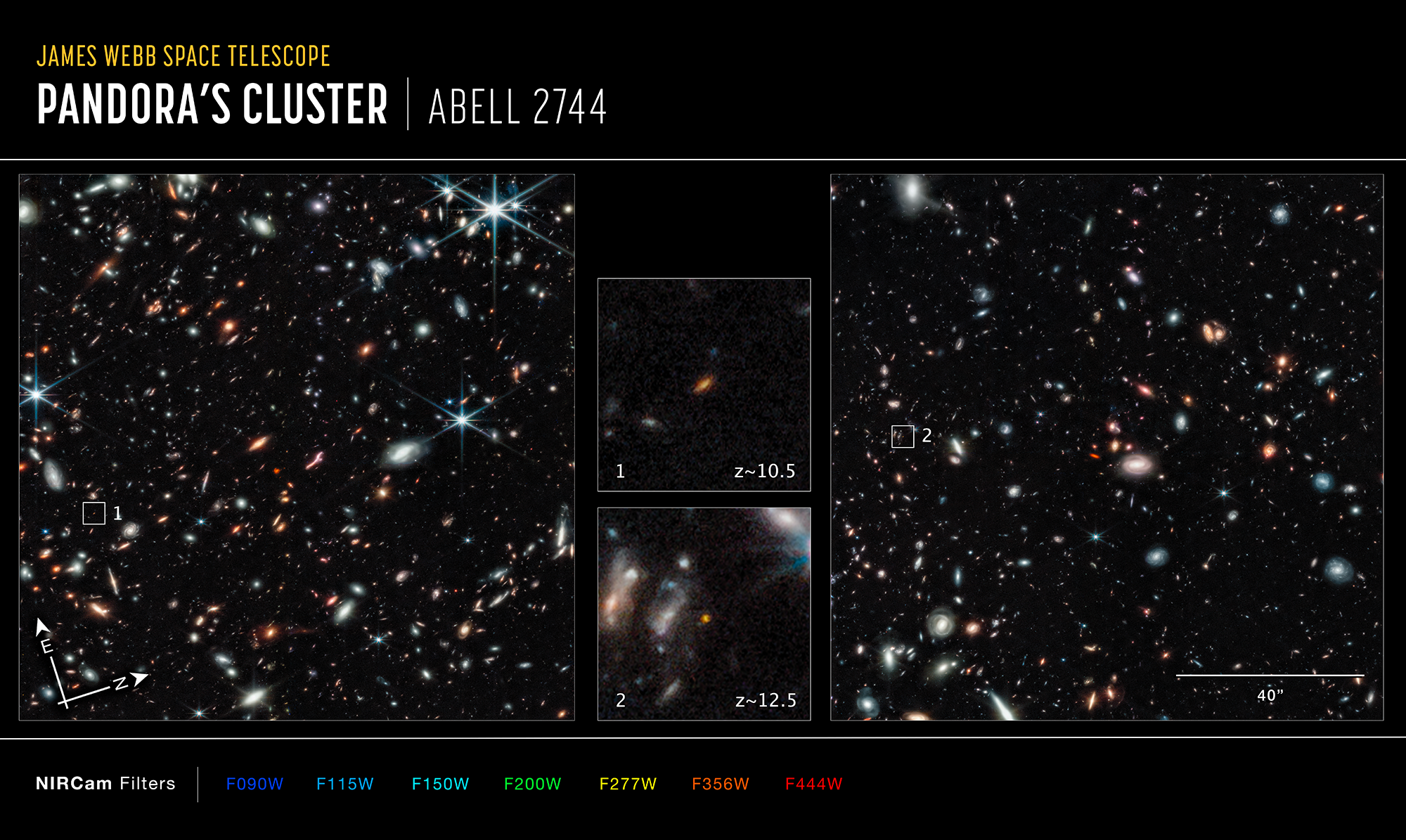
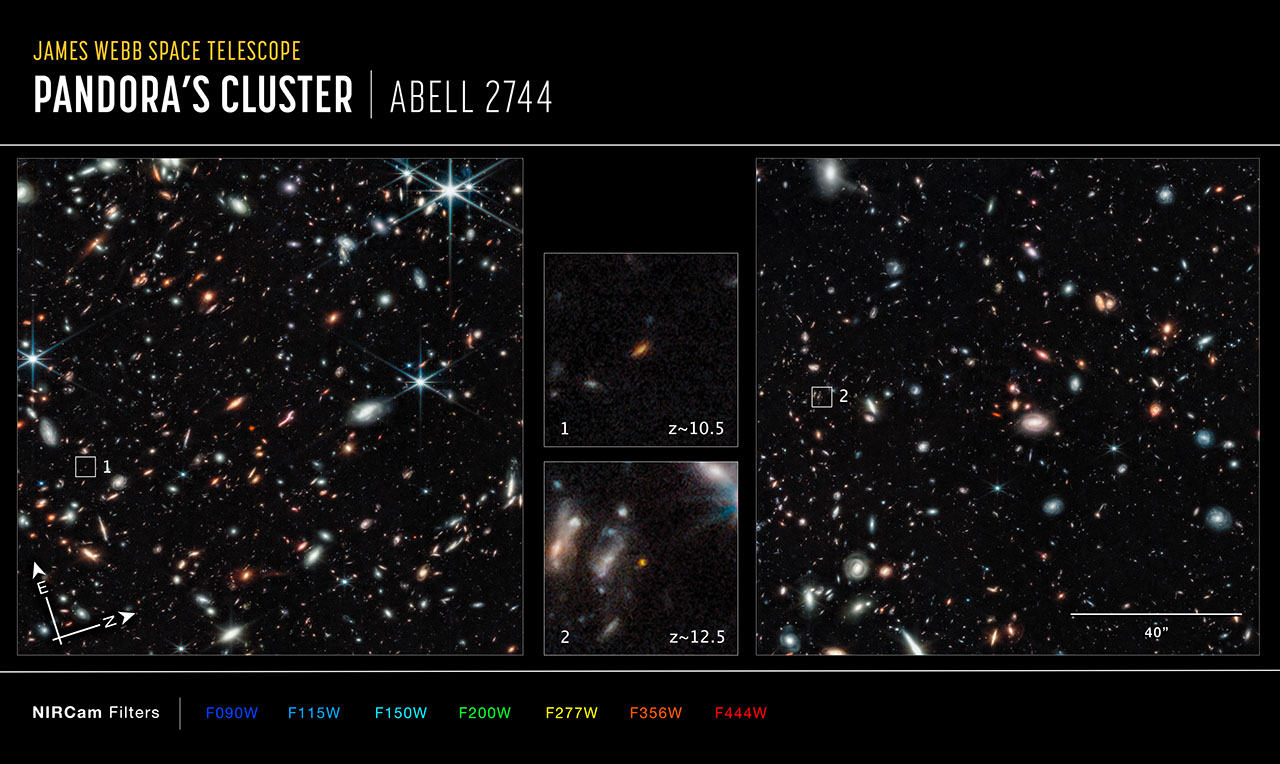
Two of the farthest galaxies seen to date are captured in these Webb Space Telescope pictures of the outer regions of the giant galaxy cluster Abell 2744. The galaxies are not inside the cluster, but many billions of light-years farther behind it. The galaxy labeled (1) existed only 450 million years after the big bang. The galaxy labeled (2) existed 350 million years after the big bang. Both are seen really close in time to the big bang which occurred 13.8 billion years ago. These galaxies are tiny compared to our Milky Way, being just a few percent of its size, even the unexpectedly elongated galaxy labeled (1).
About the Object
- R.A. PositionR.A. PositionRight ascension – analogous to longitude – is one component of an object's position.00:14:22.63
- Dec. PositionDec. PositionDeclination – analogous to latitude – is one component of an object's position.-30:23:44.50
- ConstellationConstellationOne of 88 recognized regions of the celestial sphere in which the object appears.Sculptor
- DistanceDistanceThe physical distance from Earth to the astronomical object. Distances within our solar system are usually measured in Astronomical Units (AU). Distances between stars are usually measured in light-years. Interstellar distances can also be measured in parsecs.The distance to the cluster is 4 billion light-years.
About the Data
- Data DescriptionData DescriptionProposal: A description of the observations, their scientific justification, and the links to the data available in the science archive.
Science Team: The astronomers who planned the observations and analyzed the data. "PI" refers to the Principal Investigator.This image was created from JWST data from proposal: 1324 (T. Treu)
- InstrumentInstrumentThe science instrument used to produce the data.NIRCam
- Exposure DatesExposure DatesThe date(s) that the telescope made its observations and the total exposure time.28-29 June 2022
- FiltersFiltersThe camera filters that were used in the science observations.F090W, F115W, F150W, F200W, F277W, F356W, F444W
- Object NameObject NameA name or catalog number that astronomers use to identify an astronomical object.Abell 2744, Pandora's Cluster
- Object DescriptionObject DescriptionThe type of astronomical object.Galaxy cluster/gravitational lens and high redshift galaxy candidates
- Release DateNovember 17, 2022
- Science ReleaseNASA’s Webb Draws Back Curtain on Universe’s Early Galaxies
- CreditNASA, ESA, CSA, Tommaso Treu (UCLA); Image Processing: Zoltan Levay (STScI)
Downloads
These images are a composite of separate exposures acquired by the James Webb Space Telescope using the NIRCam instrument. Several filters were used to sample different infrared wavelength ranges. The color results from assigning different hues (colors) to each monochromatic (grayscale) image associated with an individual filter. In this case, the assigned colors are: Blue: F090W, F115W Cyan: F150W Green: F220W Yellow: F277W Orange: F356W Red: F444W
Related Images & Videos
Abell 2744 GLASS (NIRCam Compass Image)
Images of Pandora’s Cluster, Abell 2744, captured by Webb’s Near-Infrared Camera (NIRCam), with compass arrows, scale bar, and color key for reference. The north and east compass arrows show the orientation of the image on the sky. Note that the relationship between north and...
Webb Draws Back the Curtains on An Undiscovered Universe (Interview with Tommaso Treu)
This video features an interview with Tommaso Treu, principal investigator of the GLASS-JWST Early Release Science Program (Grism Lens-Amplified Survey from Space). This program recently obtained an image of the galaxy cluster Abell 2744, also known as Pandora's Cluster. In it,...
Share
Details
Laura Betz
NASA’s Goddard Space Flight Center
Greenbelt, Maryland
laura.e.betz@nasa.gov
NASA, ESA, CSA, Tommaso Treu (UCLA)
Zoltan Levay (STScI)