
























1 min read
Exoplanet VHS 1256 b (NIRSpec and MIRI Emission Spectrum)
Ready to look for clouds and molecules on a distant planet?
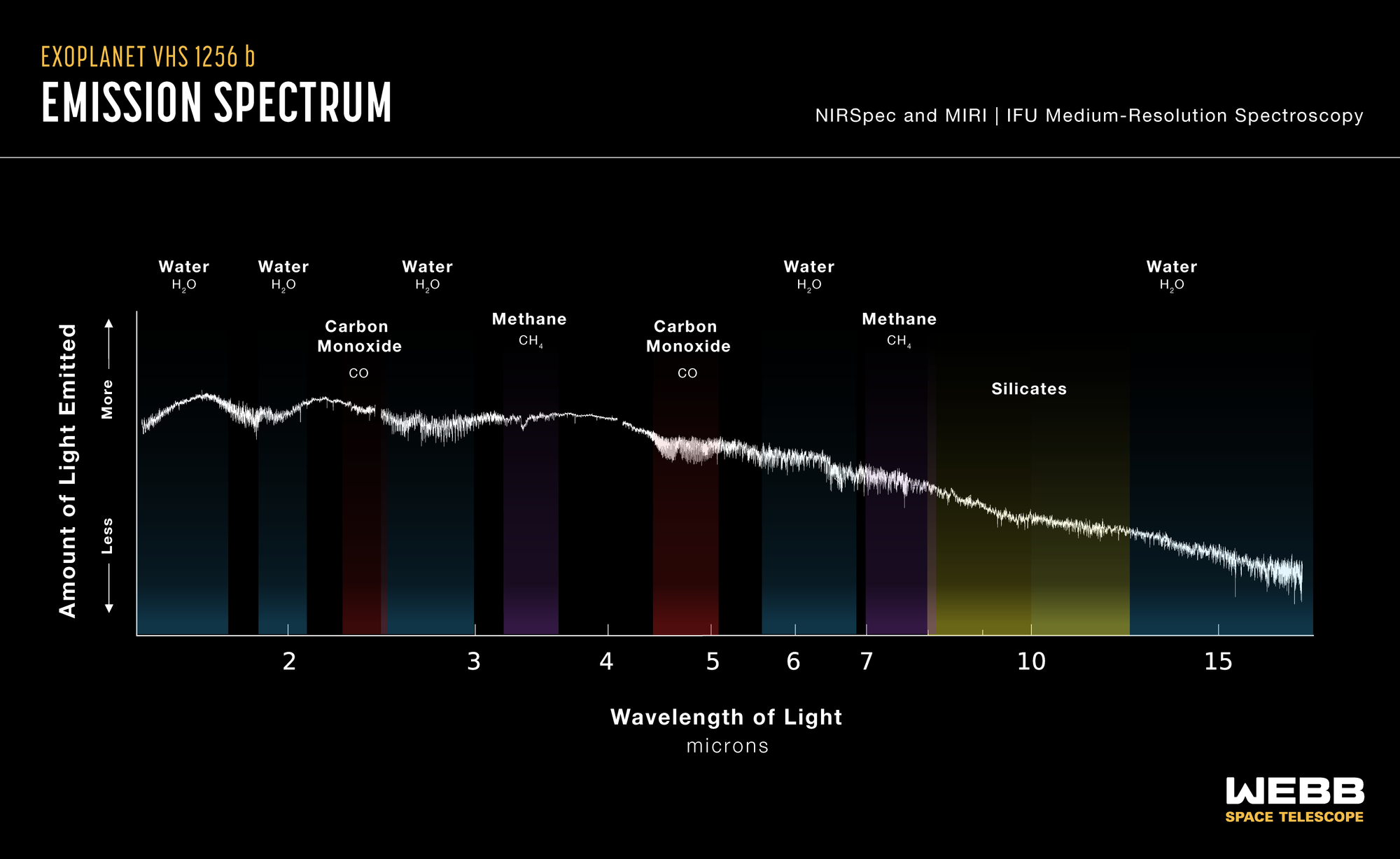
A research team led by Brittany Miles of the University of Arizona used two instruments known as spectrographs aboard the James Webb Space Telescope, one on its Near Infrared Spectrograph (NIRSpec) and another on its Mid-Infrared Instrument (MIRI) to observe a vast section of near- to mid-infrared light emitted by planet VHS 1256 b. They plotted the light on the spectrum above.
First, let’s look for silicate clouds in Webb’s data. Based on observations of many other exoplanets by many telescopes, the researchers know to look for signatures of clouds in particular areas in the spectrum. Signatures of silicates appears before and after 10 microns, a particular wavelength of infrared light.
There is likely a layer of very small grain silicate clouds higher up in the atmosphere. These silicates are finer, more like smoke particles, and are responsible for creating the plateau near 10 microns. Somewhat larger grain clouds are likely a bit deeper. Some particles in these clouds may be about the size of small grains of silt.
The combined evidence of fluctuations in the planet’s brightness over time and the different cloud layers in the spectrum point to turbulent weather on VHS 1256 b. “These detections reflect that the planet’s cloud patterns change fairly rapidly,” explained Beth Biller of the University of Edinburgh in Scotland. If the researchers were to take more, and longer, observations of the planet, they would see the spectrum shape shift as the locations of the clouds move, reflecting that the clouds are rapidly shifting through the planet’s atmosphere during its 22-hour rotation.
But these aren’t like clouds high in Earth’s atmosphere. These clouds are hot – akin to the temperature of a candle flame. Earth’s upper atmosphere is thin and would feel extremely cold.
The researchers also made extraordinarily clear detections of water, methane and carbon monoxide with Webb, and found evidence of carbon dioxide. It’s too early to tell what this combination of molecules might mean, though, since the data need to be fully modeled. “Webb’s high-resolution data are stressing our existing models,” notes Polychronis Patapis of ETH Zurich in Switzerland. “Existing models can ingest one or two features, but not as many as Webb has shown us of this target.” This is an extraordinarily exciting moment for researchers – it means there is an amazing amount to learn as they revamp models to fit these data.
Webb’s observations of VHS 1256 b highlight many of its technical strengths. Not only do its instruments detect a wide range of near- and mid-infrared light, Webb’s position in space means that the telescope can observe more infrared light than is accessible on Earth – and it captures the details in high resolution. (Earth’s atmosphere filters out some near-infrared and all mid-infrared light.) “Webb has effectively doubled the wavelength range that we’re able to capture,” said Brittany Miles of the University of Arizona, the paper’s lead author. “To top that off, we only needed seven hours to capture the spectrum, which is practically overflowing with details.”
VHS 1256 b is about 40 light-years away in the constellation Corvus. It orbits not one, but two stars, which are tightly orbiting one another. The planet lies about four times farther from its stars than Pluto is from our Sun. Although a single day on this planet is 22 hours long, it takes 10,000 years to complete a single orbit or year.
The planet’s clouds were confirmed with data from the Webb Telescope.
MIRI was contributed by ESA and NASA, with the instrument designed and built by a consortium of nationally funded European Institutes (the MIRI European Consortium) in partnership with JPL and the University of Arizona.
NIRSpec was built for the European Space Agency (ESA) by a consortium of European companies led by Airbus Defence and Space (ADS) with NASA’s Goddard Space Flight Center providing its detector and micro-shutter subsystems.
Extended Description and Image Alt Text
Extended Description
Graphic titled “Exoplanet VHS 1256 b Emission Spectrum.” The label at top right reads NIRSpec and MIRI, IFU Medium-Resolution Spectroscopy. Spectrum is plotted on a graph with y- and x-axes.
On the y-axis, an arrow indicating less light emitted points down and a line indicating more light emitted points up. The x-axis has a log scale that ranges from just less than 2 microns to more than 15 microns, with labeled tick marks at 2, 3, 4, 5, 6, 7, 10, and 15.
The graph shows jagged lines. Some are taller than others. Some jagged lines are stacked tightly together.
From left to right (shorter to longer wavelength) there are labels for the following molecules: water (H2O), water, carbon monoxide (CO), water, methane (CH4), carbon monoxide, water, methane, silicates, and water.
There are colors to indicate the wavelengths affected by the molecules, which extend from bottom to top. Water is represented by blue, methane is purple, carbon monoxide is red.
Silicates appear before and after the 10-micron mark. The silicates color looks more gold to the left of 10 microns. Where it overlaps with the water detection after 10 microns, it appears lighter and a bit greener.
Image Alt Text
Graphic titled “Exoplanet VHS 1256 b Emission Spectrum.” The label at top right reads NIRSpec and MIRI, IFU Medium-Resolution Spectroscopy. Spectrum is plotted on a graph with y- and x-axes. The graph shows jagged lines. There are labels for water, carbon monoxide, methane, and silicates.
About the Object
- ConstellationConstellationOne of 88 recognized regions of the celestial sphere in which the object appears.Corvus
About the Data
- Data DescriptionData DescriptionProposal: A description of the observations, their scientific justification, and the links to the data available in the science archive.
Science Team: The astronomers who planned the observations and analyzed the data. "PI" refers to the Principal Investigator.
- Object NameObject NameA name or catalog number that astronomers use to identify an astronomical object.VHS 1256-1257 b (VHS 1256 B)
- Object DescriptionObject DescriptionThe type of astronomical object.Exoplanet
- Release DateMarch 22, 2023
- Science ReleaseNASA’s Webb Spots Swirling, Gritty Clouds on Remote Planet
- CreditImage: NASA, ESA, CSA, Joseph Olmsted (STScI); Science: Brittany Miles (University of Arizona), Sasha Hinkley (University of Exeter), Beth Biller (University of Edinburgh), Andrew Skemer (UC Santa Cruz)
Related Images & Videos
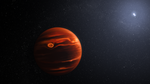
Exoplanet VHS 1256 b and Its Stars (Illustration)
This illustration conceptualizes the swirling clouds identified by the James Webb Space Telescope in the atmosphere of exoplanet VHS 1256 b. The planet is about 40 light-years away and orbits two stars that are locked in their own tight rotation. Its clouds are constantly...
Share
Details
Laura Betz
NASA’s Goddard Space Flight Center
Greenbelt, Maryland
laura.e.betz@nasa.gov
NASA, ESA, CSA, Joseph Olmsted (STScI)
Brittany Miles (University of Arizona), Sasha Hinkley (University of Exeter), Beth Biller (University of Edinburgh), Andrew Skemer (UC Santa Cruz)