









1 min read
Super-Earth Exoplanet 55 Cancri e (Artist’s Concept)
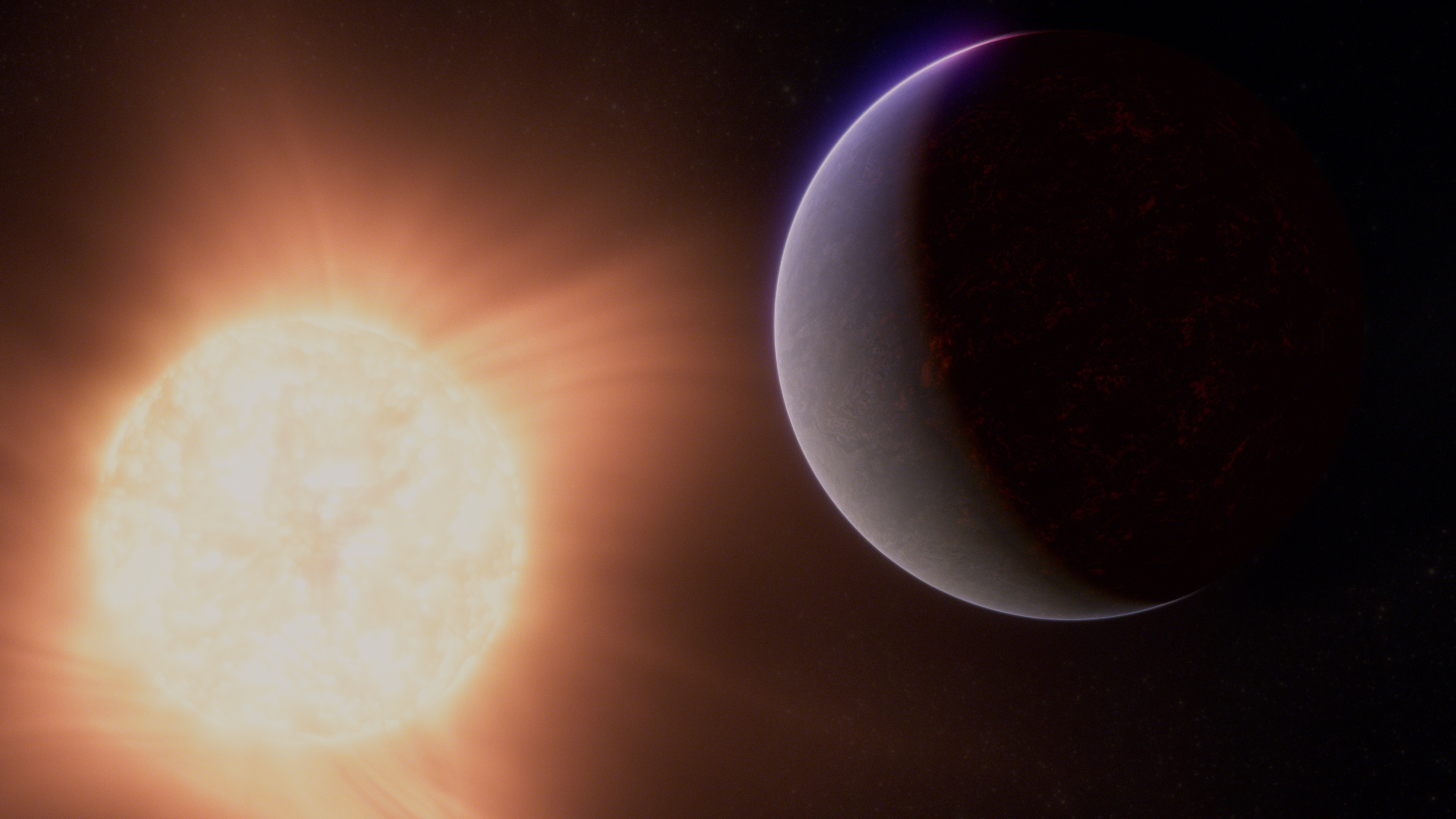
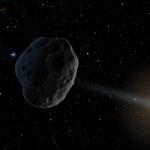
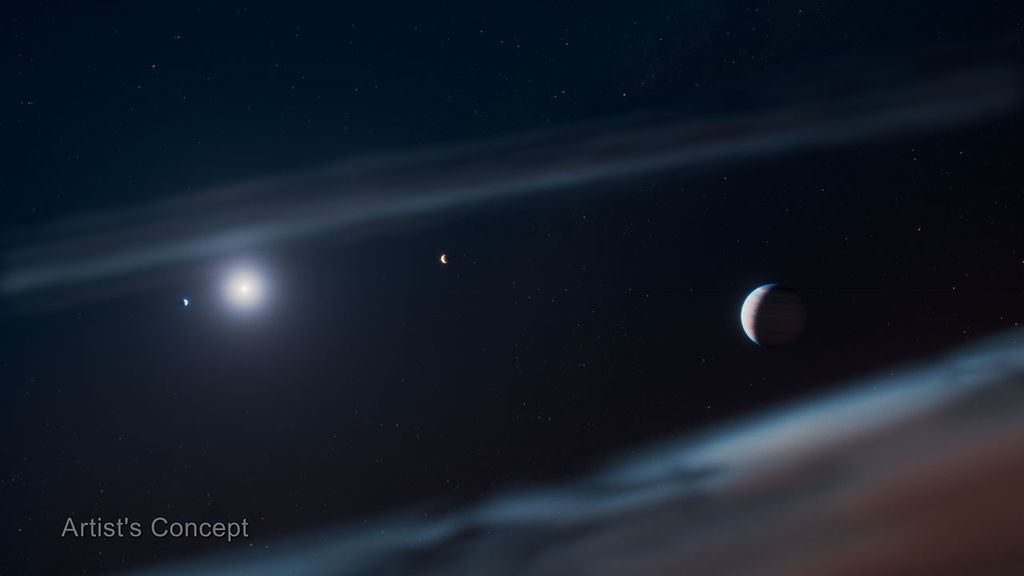
This artist’s concept shows what the exoplanet 55 Cancri e could look like.
Also called Janssen, 55 Cancri e is a so-called super-Earth, a rocky planet significantly larger than Earth but smaller than Neptune, which orbits its star at a distance of only 1.4 million miles (0.015 astronomical units), completing one full orbit in less than 18 hours. (Mercury is 25 times farther from the Sun than 55 Cancri e is from its star.) The system, which also includes four large gas-giant planets, is located about 41 light-years from Earth, in the constellation Cancer.
Observations from Webb’s NIRCam and MIRI suggest that the planet may be surrounded by an atmosphere rich in carbon dioxide (CO2) or carbon monoxide (CO). Because it is so close to its star, the planet is extremely hot and is thought to be covered in molten rock. Researchers think that the gases that make up the atmosphere could have bubbled out of the magma.
An atmosphere on this planet would likely be complex and quite variable due to interactions with the magma ocean. In addition to carbon monoxide or carbon dioxide, there could be gases like nitrogen, water vapor, sulfur dioxide, some vaporized rock, and even short-lived clouds made of tiny droplets of lava condensed from the air.
The star, 55 Cancri, is a K-type star nearly the same size and mass as the Sun, but slightly cooler and dimmer. It is just bright enough to see with the naked eye in a very dark sky. The star and planet are so close to each other that the star would appear 70 times wider in the planet’s sky than the Sun appears in our sky. In addition, because the planet is likely to be tidally locked, from any given point, the star would appear fixed in the sky.
This artist’s concept is based on new data gathered by NIRCam and MIRI as well as previous observations from other ground- and space-based telescopes, including NASA’s Hubble and retired Spitzer space telescopes. Webb has not captured any images of the planet.
About the Object
- R.A. PositionR.A. PositionRight ascension – analogous to longitude – is one component of an object's position.08h52m35.24s
- Dec. PositionDec. PositionDeclination – analogous to latitude – is one component of an object's position.+28d19m47.34s
- ConstellationConstellationOne of 88 recognized regions of the celestial sphere in which the object appears.Cancer
- DistanceDistanceThe physical distance from Earth to the astronomical object. Distances within our solar system are usually measured in Astronomical Units (AU). Distances between stars are usually measured in light-years. Interstellar distances can also be measured in parsecs.41 light-years
- DimensionsDimensionsThe physical size of the object or the apparent angle it subtends on the sky.Radius: 1.95 × Earth; Mass: 8.8 × Earth
About the Data
- Data DescriptionData DescriptionProposal: A description of the observations, their scientific justification, and the links to the data available in the science archive.
Science Team: The astronomers who planned the observations and analyzed the data. "PI" refers to the Principal Investigator.This is an artist's concept based on spectroscopic observations from a number of telescopes, including Webb, Hubble, and Spitzer. There are no direct images of 55 Cancri e.
- Object NameObject NameA name or catalog number that astronomers use to identify an astronomical object.55 Cancri e, also called Janssen
- Object DescriptionObject DescriptionThe type of astronomical object.Super-Earth Exoplanet
- Release DateMay 8, 2024
- Science ReleaseNASA’s Webb Hints at Possible Atmosphere Surrounding Rocky Exoplanet
- CreditIllustration: NASA, ESA, CSA, Ralf Crawford (STScI)
Related Images & Videos
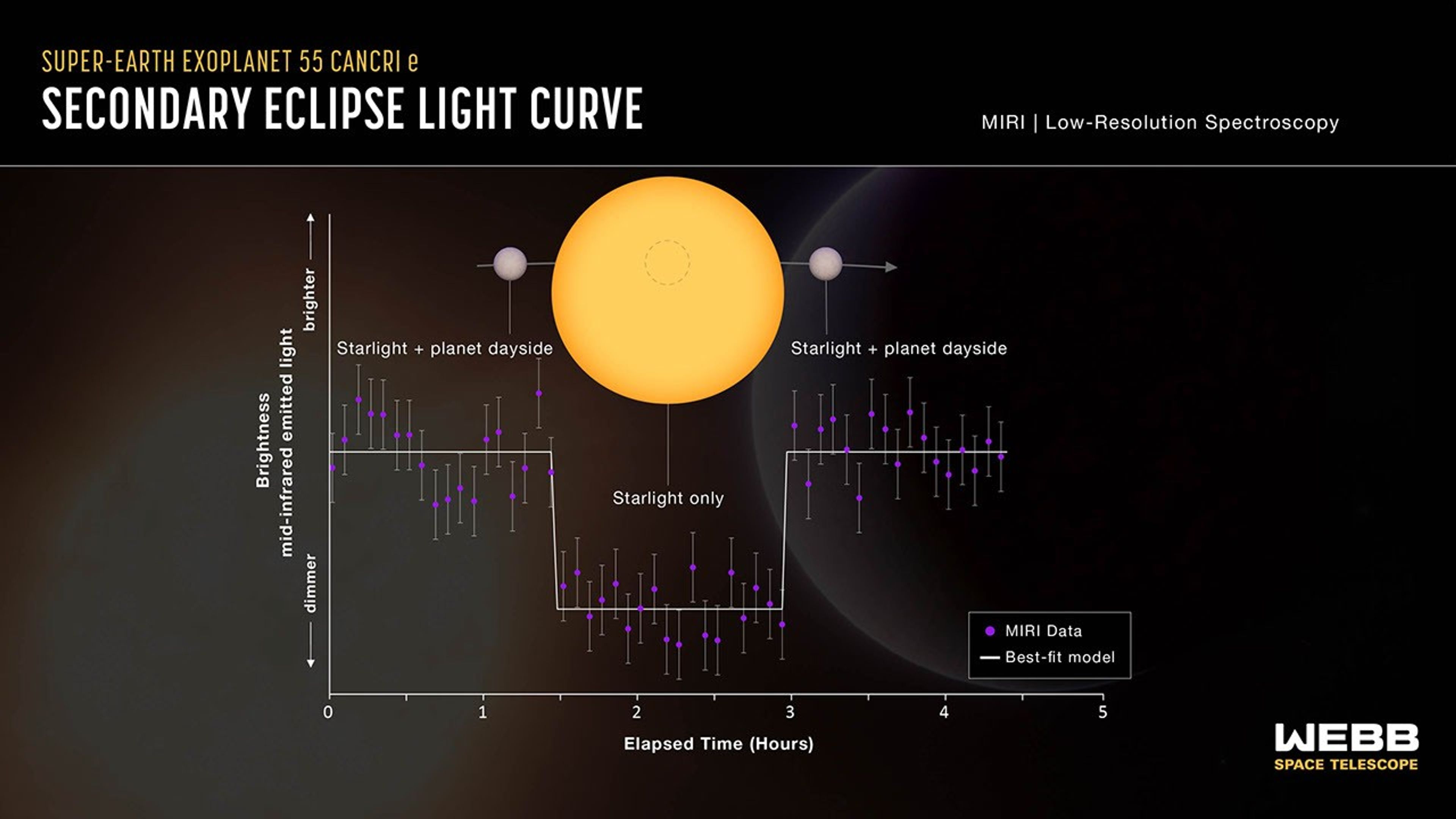
Super-Earth Exoplanet 55 Cancri e (MIRI Secondary Eclipse Light Curve)
This light curve shows the change in brightness of the 55 Cancri system as the rocky planet 55 Cancri e , the closest of the five known planets in the system, moves behind the star. This phenomenon is known a secondary eclipse . When the planet is next to the star, the...
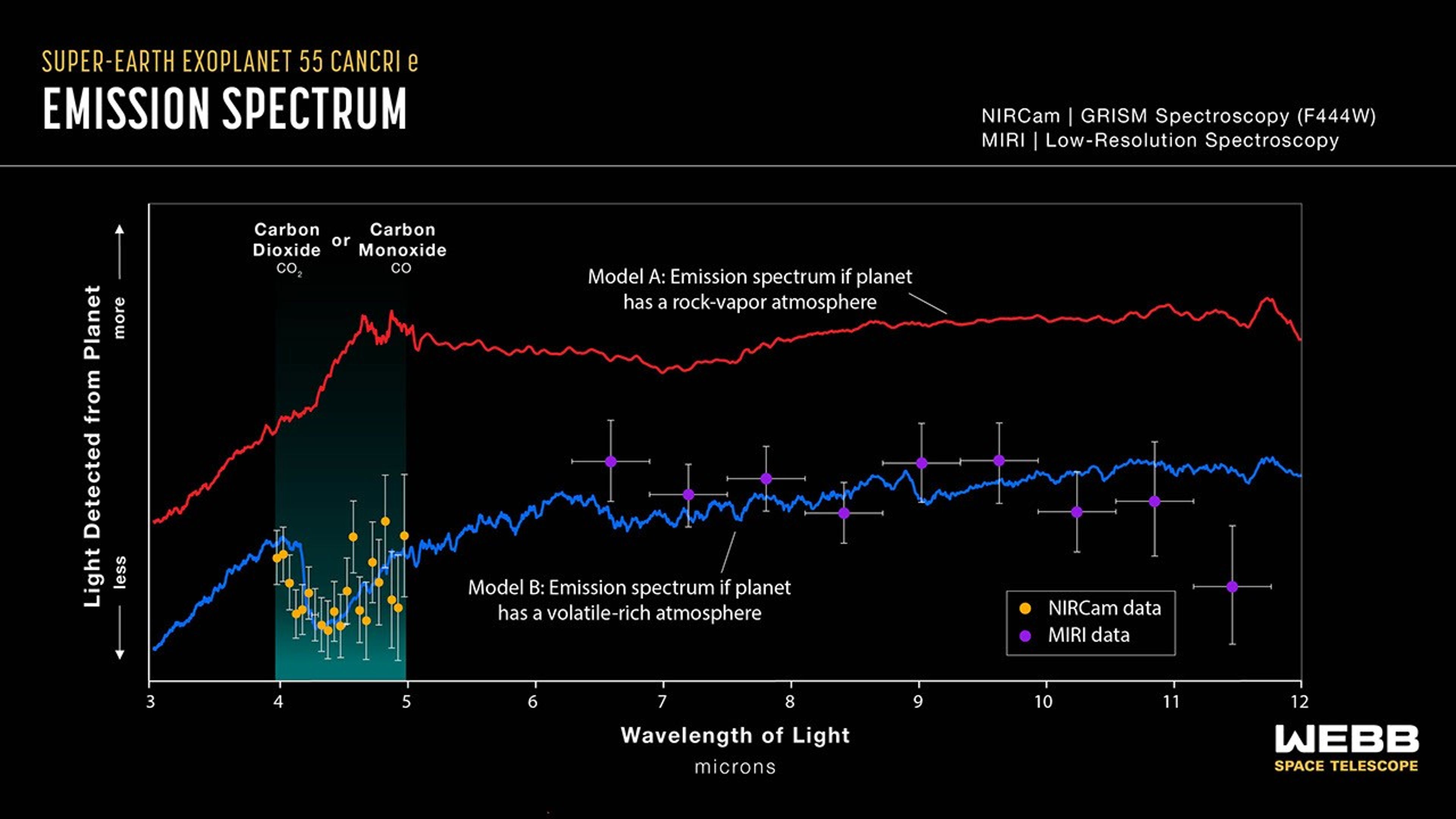
Super-Earth Exoplanet 55 Cancri e (NIRCam + MIRI Emission Spectrum)
A thermal emission spectrum captured by Webb’s NIRCam (Near-Infrared Camera) in November 2022, and MIRI (Mid-Infrared Instrument) in March 2023, shows the brightness ( y -axis) of different wavelengths of infrared light ( x -axis) emitted by the super-Earth exoplanet 55 Cancri e...
Share
Details
Laura Betz
NASA’s Goddard Space Flight Center
Greenbelt, Maryland
laura.e.betz@nasa.gov
NASA, ESA, CSA, Ralf Crawford (STScI)