







![Request for Information – Potential [Placeholder for Prize]](https://assets.science.nasa.gov/dynamicimage/assets/science/psd/solar/2023/09/s/solarsystem_0.jpg?w=1024)




Exoplanet Program

Resources
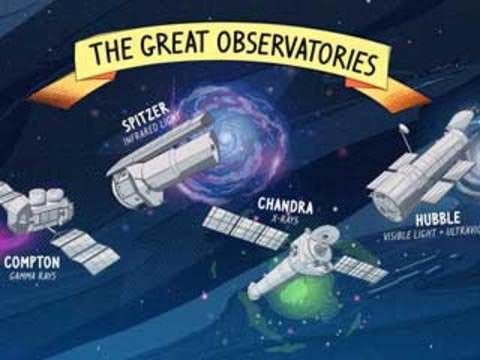
Spitzer and NASA's ‘Great Observatories' Space Telescopes
This is the animated storybook tale of the Spitzer spacecraft and its exploits as part of the space telescope superteam known as NASA’s Great Observatories, which also includes Hubble, Chandra and Compton.
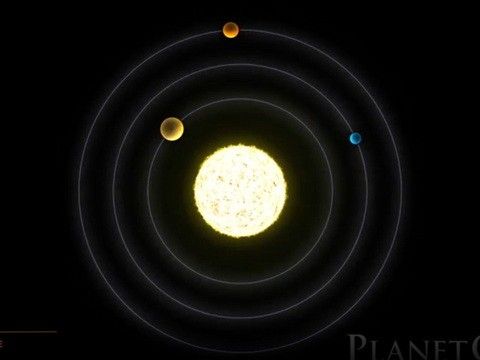
Transit Method Multiple Planets
When a planet passes directly between a star and its observer, it dims the star's light by a measurable amount. Light curves get complicated when more planets are transiting a star. The combined light curves can give us the same information as a single one, it just takes more work from astronomers to pick out each planet in the data.
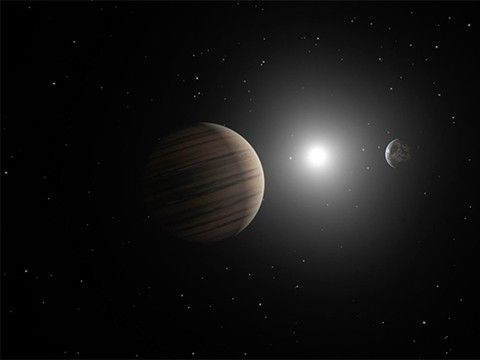
Coronagraph explanation 2 minutes
An animation explaining how the hybrid Lyot coronagraph works. Watch the longer version here.
Coronagraph explanation 2 minutes
An animation explaining how the hybrid Lyot coronagraph works. Watch the longer version here.
5 Ways to Find a Planet- Transits
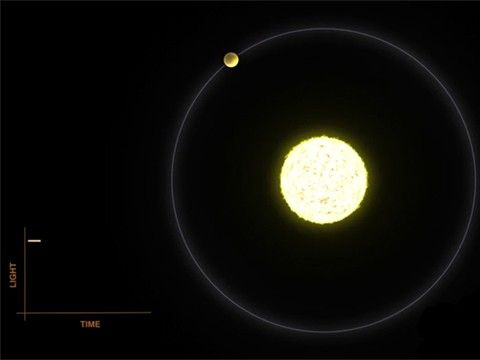
The Kepler mission found 1,284 new planets via the transit method. When a planet passes directly between its star and an observer, it dims the star's light by a measurable amount.

Like ancient explorers who looked to the stars to guide them to new worlds, astronomers today use stars to discover worlds many light years beyond our solar system. By studying stars and their unique influence, we can learn a great deal about their worlds – even their potential to sustain life as we know it.

A furled model of the first starshade built by NASA’s Jet Propulsion Lab is shown in an Astro Aerospace/Northrup Grumman facility in Santa Barbara, California in 2013.
Infographic: Profile of planet Kepler-7b
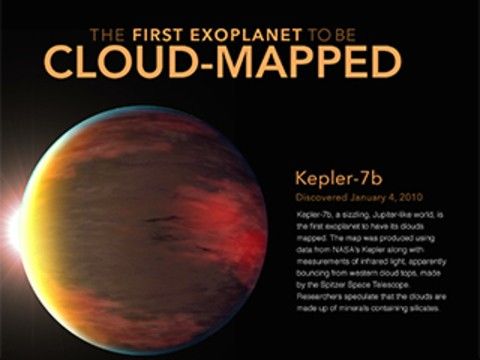
The first planet to have its clouds mapped showed us what weather looked like on a planet outside our solar system.
Twenty years ago astronomers discovered the first planet around a sun-like star, 51 Pegasi b. This is the story of the pioneers in planet-hunting and how those who have followed are now poised to answer one of humanity’s most ancient questions: is there life elsewhere in the universe?
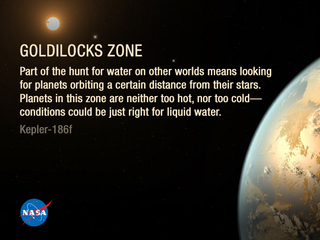
There is only one planet we know of so far that is teeming with life–– Earth. If we want to find life on other planets, we start with the ingredients we know at home.
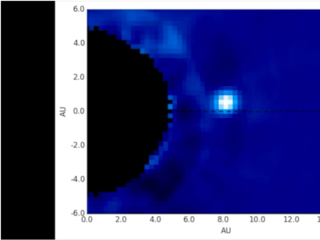
Gemini Planet Imager shows darting exoplanet
A series of images of a distant gas giant reveal its orbit around its star Beta Pictoris, located some 60 light-years from Earth.
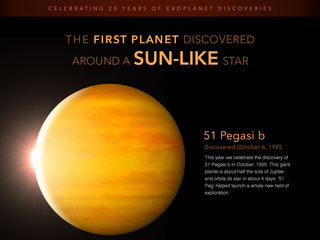
Infographic: Profile of planet 51 Pegasi b
The first exoplanet discovered around a sun-like star, 51 Pegasi b made us question what we knew of our universe and launched the search for new worlds.
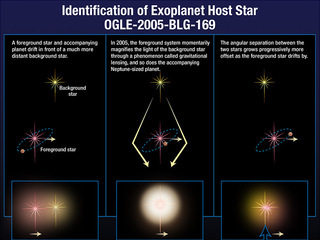
Identification of Exoplanet Host Star OGLE-2005-BLG-169
This diagram shows how astronomers observed a distant gas giant planet around OGLE-2005-BLG-169 using microlensing.
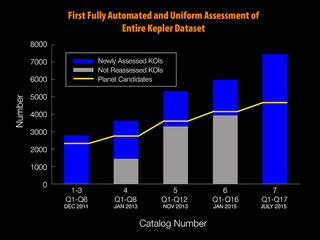
A unique feature of the seventh Kepler candidate catalog is that it is the first to fully automate the assessment of transit-like signals. The total height of each bar shows the total number of Kepler Objects of Interest (KOIs), or transit-like signals, in each catalog.
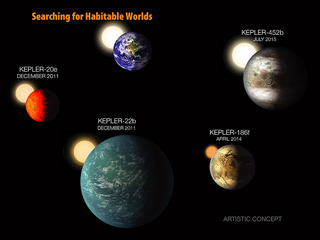
Searching for Habitable Worlds
The sweep of NASA Kepler mission’s search for small, habitable planets in the last six years.
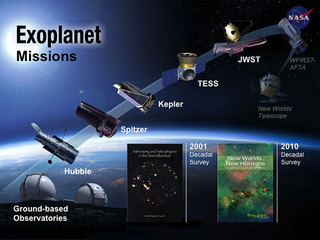
A list of current and future missions that have a role in searching for new worlds.
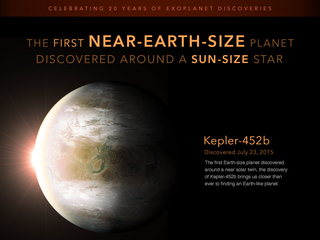
Infographic: Profile of planet Kepler-452b
The first Earth-size planet discovered around a near solar twin, the discovery of Kepler-452b brings us closer than ever to finding an Earth-like planet.
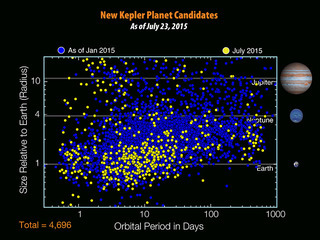
Kepler Planet Candidates, July 2015
There are 4,696 planet candidates now known with the release of the seventh Kepler planet candidate catalog - an increase of 521 since the release of the previous catalog in Jan. 2015.
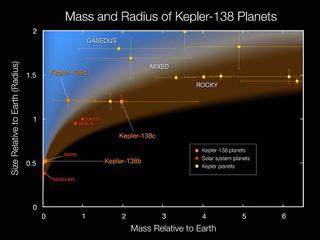
Mars-size Kepler-138b Gets a Mass
This plot shows the masses and sizes of the smallest exoplanets for which both quantities have been measured. The solar system planets (shown in red) are for comparison.
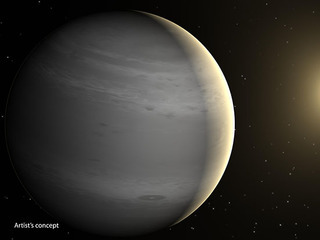
Helium-Shrouded Planets (Artist's Concept)
Planets having atmospheres rich in helium may be common in our galaxy, according to a new theory based on data from NASA's Spitzer Space Telescope. These planets would be around the mass of Neptune, or lighter, and would orbit close to their stars, basking in their searing heat.

Q&Alien - What's a "habitable zone"?
On this episode of Q&Alien, we talk about what the term "habitable zone" means - and what it doesn't.
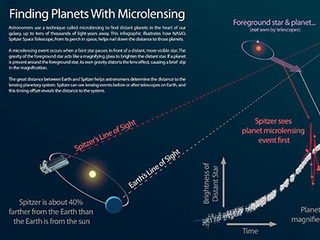
Infographic: Finding Planets With Microlensing
This infographic explains how NASA's Spitzer Space Telescope can be used in tandem with a telescope on the ground to measure the distances to planets discovered using the "microlensing" technique.
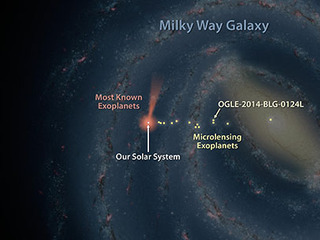
Map of Exoplanets Found in our Galaxy (Artist's Concept)
Astronomers have discovered one of the most distant planets known, a gas giant about 13,000 light-years from Earth, called OGLE-2014-BLG-0124L. The planet was discovered using a technique called microlensing, and the help of NASA's Spitzer Space Telescope and the Optical Gravitational Lensing Experiment, or OGLE. In this artist's illustration, planets discovered with microlensing are shown in yellow. The farthest lies in the center of our galaxy, 25,000 light-years away.

This video is a trailer of the upcoming TESS mission.
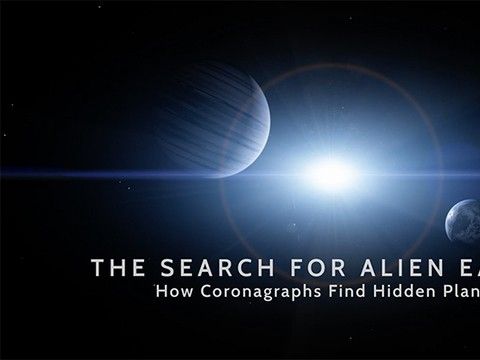
The Search for Alien Earths - How Coronagraphs Find Hidden Planets
How do coronagraphs find exoplanets? Find out in this animation narrated by Dr. Nick Siegler, Technology Manager of the NASA Exoplanet Exploration Program.
Resources
Spitzer and NASA's ‘Great Observatories' Space Telescopes
This is the animated storybook tale of the Spitzer spacecraft and its exploits as part of the space telescope superteam known as NASA’s Great Observatories, which also includes Hubble, Chandra and Compton.
Transit Method Multiple Planets
When a planet passes directly between a star and its observer, it dims the star's light by a measurable amount. Light curves get complicated when more planets are transiting a star. The combined light curves can give us the same information as a single one, it just takes more work from astronomers to pick out each planet in the data.
Coronagraph explanation 2 minutes
An animation explaining how the hybrid Lyot coronagraph works. Watch the longer version here.
Coronagraph explanation 2 minutes
An animation explaining how the hybrid Lyot coronagraph works. Watch the longer version here.
5 Ways to Find a Planet- Transits
The Kepler mission found 1,284 new planets via the transit method. When a planet passes directly between its star and an observer, it dims the star's light by a measurable amount.
Like ancient explorers who looked to the stars to guide them to new worlds, astronomers today use stars to discover worlds many light years beyond our solar system. By studying stars and their unique influence, we can learn a great deal about their worlds – even their potential to sustain life as we know it.
A furled model of the first starshade built by NASA’s Jet Propulsion Lab is shown in an Astro Aerospace/Northrup Grumman facility in Santa Barbara, California in 2013.
Infographic: Profile of planet Kepler-7b
The first planet to have its clouds mapped showed us what weather looked like on a planet outside our solar system.
Twenty years ago astronomers discovered the first planet around a sun-like star, 51 Pegasi b. This is the story of the pioneers in planet-hunting and how those who have followed are now poised to answer one of humanity’s most ancient questions: is there life elsewhere in the universe?
There is only one planet we know of so far that is teeming with life–– Earth. If we want to find life on other planets, we start with the ingredients we know at home.
Gemini Planet Imager shows darting exoplanet
A series of images of a distant gas giant reveal its orbit around its star Beta Pictoris, located some 60 light-years from Earth.
Infographic: Profile of planet 51 Pegasi b
The first exoplanet discovered around a sun-like star, 51 Pegasi b made us question what we knew of our universe and launched the search for new worlds.
Identification of Exoplanet Host Star OGLE-2005-BLG-169
This diagram shows how astronomers observed a distant gas giant planet around OGLE-2005-BLG-169 using microlensing.
A unique feature of the seventh Kepler candidate catalog is that it is the first to fully automate the assessment of transit-like signals. The total height of each bar shows the total number of Kepler Objects of Interest (KOIs), or transit-like signals, in each catalog.
Searching for Habitable Worlds
The sweep of NASA Kepler mission’s search for small, habitable planets in the last six years.
A list of current and future missions that have a role in searching for new worlds.
Infographic: Profile of planet Kepler-452b
The first Earth-size planet discovered around a near solar twin, the discovery of Kepler-452b brings us closer than ever to finding an Earth-like planet.
Kepler Planet Candidates, July 2015
There are 4,696 planet candidates now known with the release of the seventh Kepler planet candidate catalog - an increase of 521 since the release of the previous catalog in Jan. 2015.
Mars-size Kepler-138b Gets a Mass
This plot shows the masses and sizes of the smallest exoplanets for which both quantities have been measured. The solar system planets (shown in red) are for comparison.
Helium-Shrouded Planets (Artist's Concept)
Planets having atmospheres rich in helium may be common in our galaxy, according to a new theory based on data from NASA's Spitzer Space Telescope. These planets would be around the mass of Neptune, or lighter, and would orbit close to their stars, basking in their searing heat.
Q&Alien - What's a "habitable zone"?
On this episode of Q&Alien, we talk about what the term "habitable zone" means - and what it doesn't.
Infographic: Finding Planets With Microlensing
This infographic explains how NASA's Spitzer Space Telescope can be used in tandem with a telescope on the ground to measure the distances to planets discovered using the "microlensing" technique.
Map of Exoplanets Found in our Galaxy (Artist's Concept)
Astronomers have discovered one of the most distant planets known, a gas giant about 13,000 light-years from Earth, called OGLE-2014-BLG-0124L. The planet was discovered using a technique called microlensing, and the help of NASA's Spitzer Space Telescope and the Optical Gravitational Lensing Experiment, or OGLE. In this artist's illustration, planets discovered with microlensing are shown in yellow. The farthest lies in the center of our galaxy, 25,000 light-years away.
This video is a trailer of the upcoming TESS mission.
The Search for Alien Earths - How Coronagraphs Find Hidden Planets
How do coronagraphs find exoplanets? Find out in this animation narrated by Dr. Nick Siegler, Technology Manager of the NASA Exoplanet Exploration Program.