Explore
Search
News & Events
News & Events
Recently Published
Video Series on NASA+
Podcasts & Audio
Blogs
Newsletters
Social Media
Media Resources
Multimedia
Multimedia
NASA+
Images
NASA Live
NASA Apps
Podcasts
Image of the Day
e-Books
3D Resources
Interactives
STEM Multimedia
NASA Brand & Usage Guidelines
NASA+
Search
Suggested Searches
Artemis
ISS
Roman
Webb
Quesst
Moon Base
View All Topics A-Z
Home
Missions
Humans in Space
Earth
The Solar System
The Universe
Science
Aeronautics
Technology
Learning Resources
About NASA
Español
News & Events
Multimedia
NASA+
Highlights
4 min read
NASA’s Swift Mission Ends, Leaves Behind Scientific Bonanza
article
4 days ago
3 min read
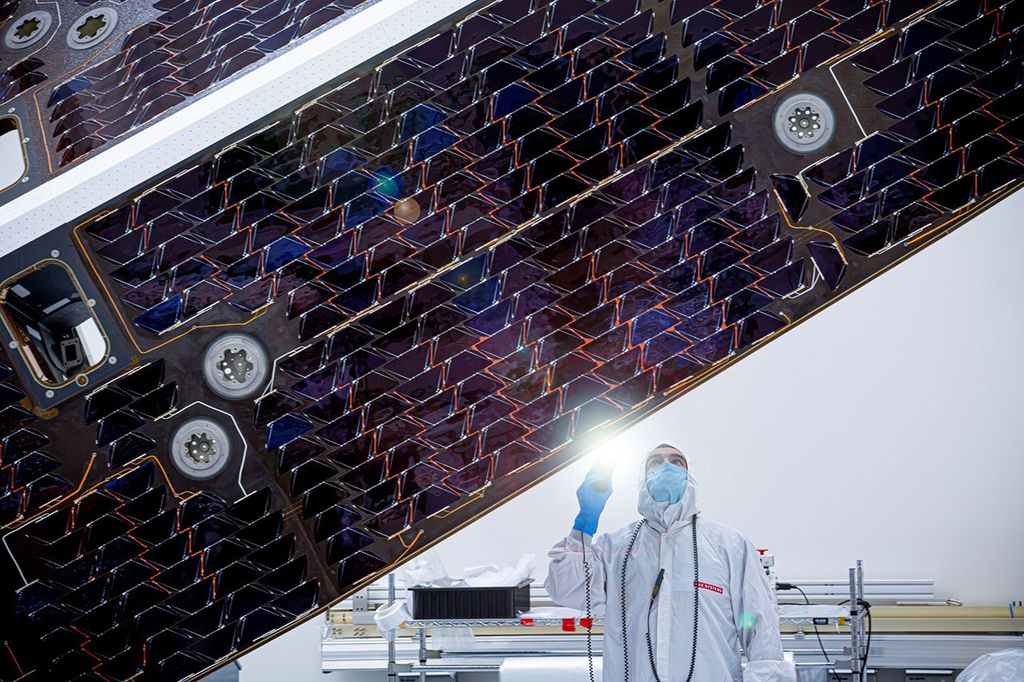
Sunshade for NASA’s NEO Surveyor Mission Ready for Its Day in Sun
article
1 day ago
3 min read
What’s Up: October 2026 Skywatching Tips from NASA
article
4 weeks ago
Back
Missions
Search All NASA Missions
A to Z List of Missions
Upcoming Launches and Landings
Spaceships and Rockets
Communicating with Missions
Artemis
James Webb Space Telescope
Hubble Space Telescope
International Space Station
OSIRIS-REx
Humans in Space
Why Go to Space
Astronauts
Commercial Space
Destinations
Spaceships and Rockets
Living in Space
Earth
Explore Earth Science
Climate Change
Earth, Our Planet
Earth Science in Action
Earth Multimedia
Earth Data
Earth Science Researchers
The Solar System
The Sun
Mercury
Venus
Earth
The Moon
Mars
Jupiter
Saturn
Uranus
Neptune
Pluto & Dwarf Planets
Asteroids, Comets & Meteors
The Kuiper Belt
The Oort Cloud
Skywatching
The Universe
Exoplanets
The Search for Life in the Universe
Stars
Galaxies
Black Holes
The Big Bang
Dark Matter
Dark Energy
Science
Earth Science
Planetary Science
Astrophysics & Space Science
The Sun & Heliophysics
Biological & Physical Sciences
Lunar Science
Citizen Science
Astromaterials
Aeronautics Research
Human Space Travel Research
Aeronautics
Science in the Air
NASA Aircraft
Flight Innovation
Supersonic Flight
Air Traffic Solutions
Green Aviation Tech
Drones & You
Technology
Technology Transfer & Spinoffs
Space Travel Technology
Technology Living in Space
Manufacturing and Materials
Robotics
Science Instruments
Computing
Learning Resources
For Kids and Students
For Educators
For Colleges and Universities
For Professionals
Science for Everyone
Requests for Exhibits, Artifacts, or Speakers
STEM Engagement at NASA
About NASA
NASA's Impacts
Centers and Facilities
Directorates
Organizations
People of NASA
Careers
Internships
Our History
Doing Business with NASA
Get Involved
Contact
NASA en Español
Ciencia
Aeronáutica
Ciencias Terrestres
Sistema Solar
Universo
News & Events
Recently Published
Video Series on NASA+
Podcasts & Audio
Blogs
Newsletters
Social Media
Media Resources
Multimedia
NASA+
Images
NASA Live
NASA Apps
Podcasts
Image of the Day
e-Books
3D Resources
Interactives
STEM Multimedia
NASA Brand & Usage Guidelines
Highlights
4 min read
NASA’s Swift Mission Ends, Leaves Behind Scientific Bonanza
article
4 days ago
5 min read
NASA’s Dragonfly Completes First Simulated Flight
article
4 days ago
5 min read
Pedal to the Metal: NASA’s Psyche Heads Toward Asteroid Belt
article
5 days ago
Highlights
8 min read
NASA’s Artemis III Mission to Test Future Moon Lander Operations
article
4 days ago
3 min read
NASA’s Simulated Mars Crew Marks One Year Inside Habitat
article
1 week ago
2 min read
NASA Astronauts to Answer Questions from Florida Students
article
2 weeks ago
Highlights
3 min read
A-81 Reaches South Georgia
article
22 hours ago
6 min read
Hunting Red Leaves With Satellites
article
2 days ago
4 min read
El Niño Then and Now
article
5 days ago
Highlights
6 min read
NASA’s Perseverance Offers Clues to Protect Crews From Mars Dust
article
1 day ago
4 min read
NASA to Help Unlock Mysteries of Mars’ Moons in Upcoming Mission
article
2 weeks ago
4 min read
NASA JPL Testing Readies Voyager Technologies Lander for Moon Mission
article
2 weeks ago
Highlights
4 min read
NASA’s Swift Mission Ends, Leaves Behind Scientific Bonanza
article
4 days ago
4 min read
NASA’s Hubble Charts Path for Roman with Gravitational Lenses
article
5 days ago
2 min read
NASA’s Hubble Spies Spiral’s Edge
article
2 weeks ago
Highlights
4 min read
NASA SEES Interns Tackle Real-World Challenges in Lunar Exploration
article
1 day ago
1 min read
Spaceflight Science Foundations (ROSES B.8)
article
1 day ago
4 min read
NASA’s Swift Mission Ends, Leaves Behind Scientific Bonanza
article
4 days ago
Highlights
1 min read
NASA Ames Unitary Plan Wind Tunnel
article
1 week ago
1 min read
NASA to Conduct Low-Altitude Flights Over Texas Farmland
article
1 week ago
3 min read
NASA Experimental Mars Helicopter Blade Designs Target Longer Flights
article
1 week ago
Highlights
5 min read
Fires Char New Guinea
article
6 days ago
4 min read
NASA’s CASALS Instrument Bridges Gaps in 3D Maps of Earth’s Surface
article
7 days ago
2 min read
Extratropical Cyclone Whips Past Iceland
article
7 days ago
Highlights
4 min read
NASA SEES Interns Tackle Real-World Challenges in Lunar Exploration
article
1 day ago
3 min read
NASA Awards Enable Research, Technology to Build Future Workforce
article
2 weeks ago
2 min read
NASA Astronauts to Answer Questions from Florida Students
article
2 weeks ago
Highlights
4 min read
NASA Welcomes All Ages, Experience Levels for Space Apps Challenge
article
2 weeks ago
1 min read
TIME Best Inventions of 2026
article
2 weeks ago
2 min read
NASA Releases Artemis II Lunar Science Data, Images
article
3 weeks ago
Highlights
11 min read
La NASA anuncia la cobertura de la misión lunar Artemis II
article
7 months ago
15 min read
Agenda diaria de la misión a la Luna de Artemis II de la NASA
article
8 months ago
6 min read
La NASA refuerza Artemis: añade una misión y perfecciona su arquitectura general
article
8 months ago
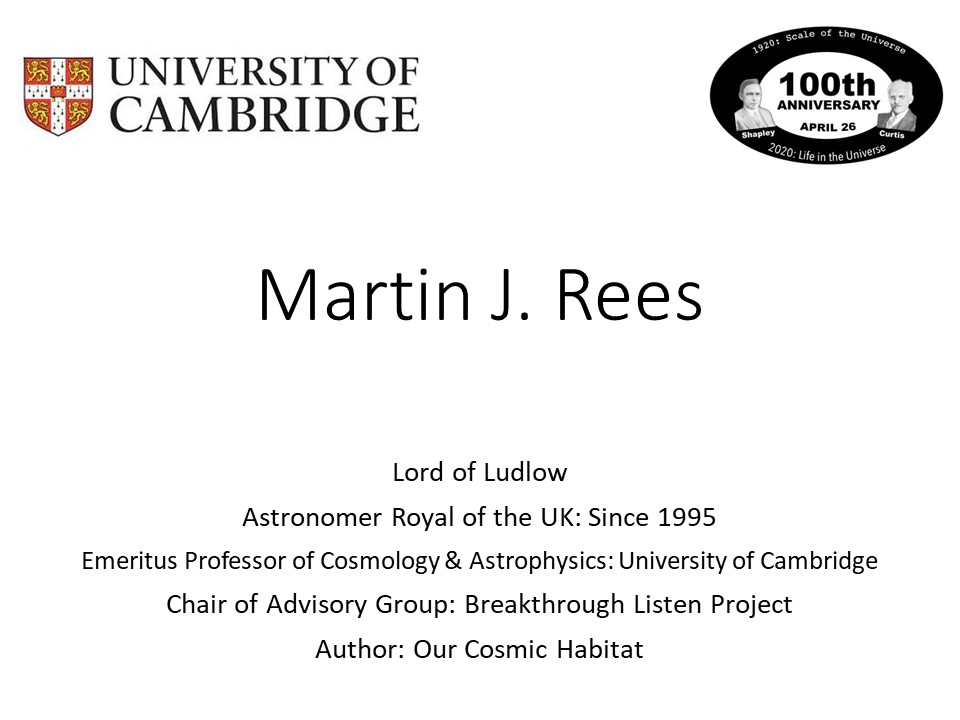
Martin J. Rees
Δ
Did you find what you were looking for?
(Required)
Yes
No
Partly
What were you looking for?
(Required)
What were you hoping to accomplish by visiting our website?
(Required)
×

![How will humanity first discover ET Life?
Best guess: biosignatures for life in general,
but technosignatures for intelligent life (although low probability)
About biosignatures: [Microbes] could be freeze-dried on the
Red Planet, [or] it cold be something under the ice of Enceladus, a moon of Saturn.
About technosignatures: If the emergence of intelligence on another world
had followed the similar evolution to what has happened here,
then were we to detect ET, we would be most unlikely to catch it in the
brief sliver of time when it is still organic. For our Earth, between
four and a half billion years before technology emerged, [life�s] been
around for a few millennia, maybe one more millennium, it�ll be
superseded by electronic intelligence which will then go on for
billions of years. So that means that it�s far more likely if we
detected something artificial, it would be not an organic civilization
but something which was created by a long dead organic civilization.](https://assets.science.nasa.gov/content/dam/science/cds/apod/debate/2020/rees100th/Slide2.JPG)