
























1 min read
Microlensing Event at OGLE-2013-BLG-0341 (Hubble Image)

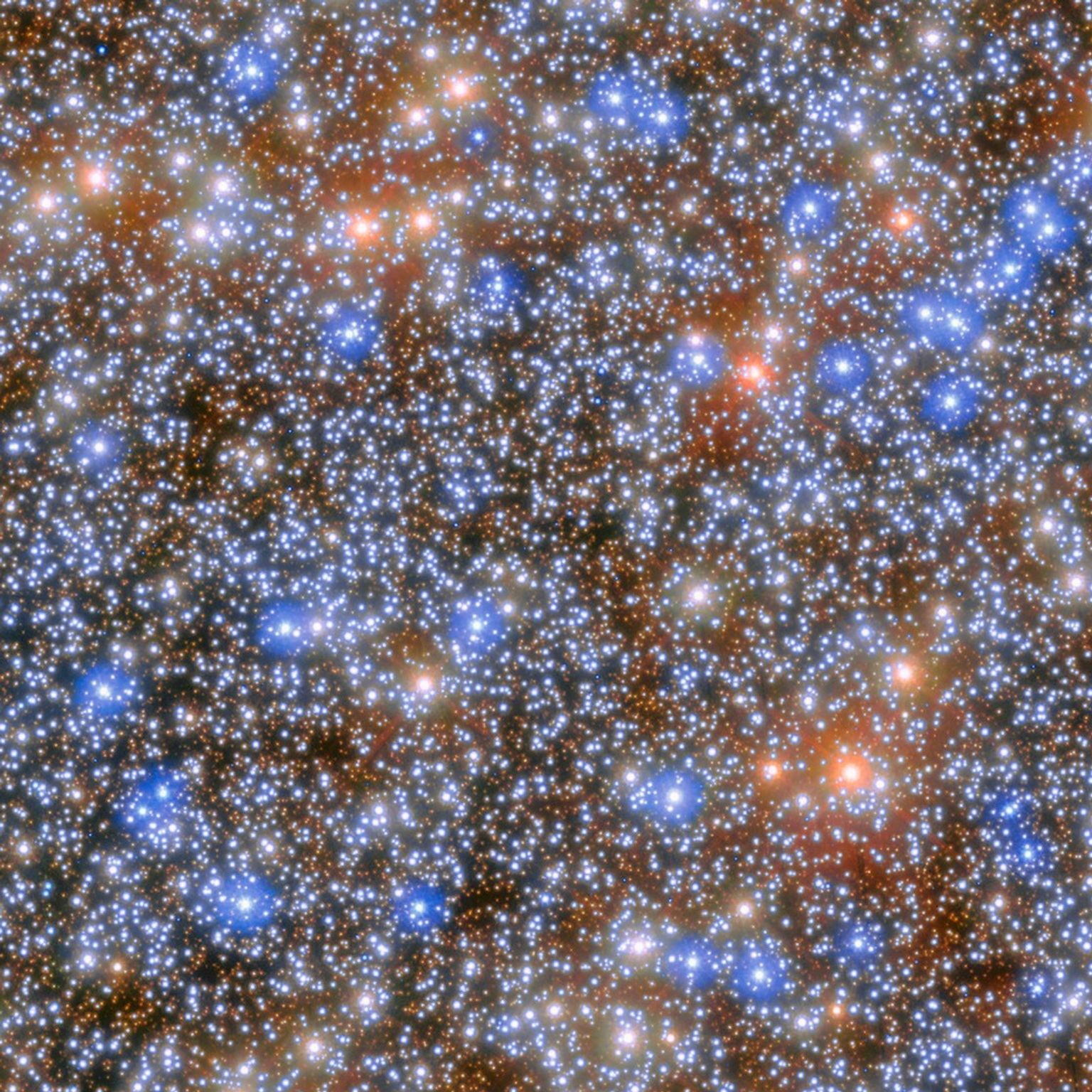
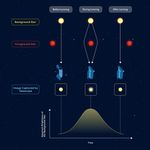
A follow-up observation by NASA's Hubble Space Telescope shows a field containing a microlensing event that was captured by the Optical Gravitational Lensing Experiment (OGLE) in 2013. This provides an example of how a Hubble image could be used to analyze future microlensing events spotted by NASA's Nancy Grace Roman Space Telescope.
In gravitational microlensing, the gravity of a foreground object acts as a lens, magnifying and distorting the light of a background star when the two objects align in the sky.
About the Object
- R.A. PositionR.A. PositionRight ascension – analogous to longitude – is one component of an object's position.17:52:07.49
- Dec. PositionDec. PositionDeclination – analogous to latitude – is one component of an object's position.-29:50:46.0
- ConstellationConstellationOne of 88 recognized regions of the celestial sphere in which the object appears.Sagittarius
- DistanceDistanceThe physical distance from Earth to the astronomical object. Distances within our solar system are usually measured in Astronomical Units (AU). Distances between stars are usually measured in light-years. Interstellar distances can also be measured in parsecs.The center of our galaxy is about 26,000 light-years away
- DimensionsDimensionsThe physical size of the object or the apparent angle it subtends on the sky.This image is 1.3 arcminutes across.
About the Data
- Data DescriptionData DescriptionProposal: A description of the observations, their scientific justification, and the links to the data available in the science archive.
Science Team: The astronomers who planned the observations and analyzed the data. "PI" refers to the Principal Investigator.These images were created with Hubble data from proposal: 17776 (S. Terry).
- InstrumentInstrumentThe science instrument used to produce the data.WFC3/UVIS
- Exposure DatesExposure DatesThe date(s) that the telescope made its observations and the total exposure time.29 March 2025
- FiltersFiltersThe camera filters that were used in the science observations.F606W, F814W
- Object NameObject NameA name or catalog number that astronomers use to identify an astronomical object.OGLE-2013-BLG-0341
- Object DescriptionObject DescriptionThe type of astronomical object.Microlensed Exoplanet, Hubble Galactic Bulge Survey
- Release DateMay 11, 2026
- Science ReleaseHubble Survey Sets Up Roman’s Future Look Near Milky Way’s Center
- CreditImage: NASA, ESA, Sean Terry (UMD), Jay Anderson (STScI); Image Processing: Alyssa Pagan (STScI)
<p>These images were acquired by the <a href="https://science.nasa.gov/mission/hubble/observatory/design/wide-field-camera-3/">Wide Field Camera 3 (WFC3/UVIS)</a> instrument on NASA's <a href="https://science.nasa.gov/mission/hubble/">Hubble Space Telescope</a>. Several filters were used to sample varying wavelength ranges. The color results from assigning different hues (colors) to each monochromatic (grayscale) image associated with an individual filter. In this case, the assigned colors are:</p> <p>Cyan: F606W and Orange: F814W</p>
Related Images & Videos
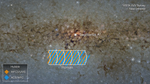
Hubble/Roman Galactic Bulge Survey Region (VISTA VVV Survey)
This VISTA VVV Survey image shows the galactic bulge near Sagittarius A*, the supermassive black hole at the Milky Way’s center. A region planned for observation by NASA’s Nancy Grace Roman Space Telescope is outlined. This area has been observed by NASA’s Hubble Space Telescope.

Share
Details
Claire Andreoli
NASA’s Goddard Space Flight Center
Greenbelt, Maryland
claire.andreoli@nasa.gov