


















1 min read
Microlensing Infographic
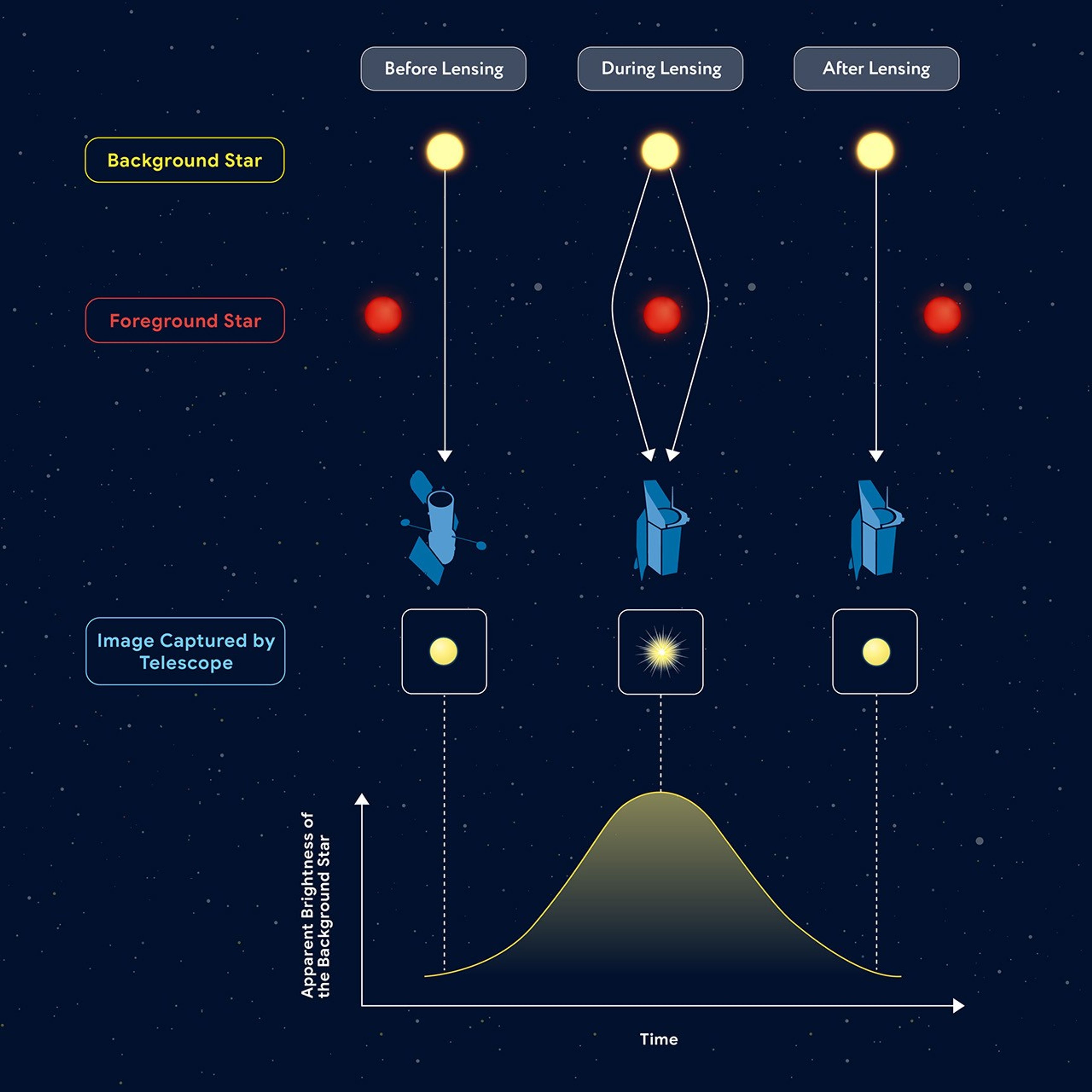
This graphic illustrates a microlensing event, which occurs when the light from a distant object warps as a mass, such as a star (depicted here) or a stellar-mass black hole, precisely aligns in front of that object. In this image, a red, foreground star intervenes between the telescope, acting as the "lens," bending, and magnifying the light of the yellow background star. Unlike some gravitational lensing events, which occur at the scale of galaxies or galaxy clusters, microlensing events occur on a much smaller scale, such as that of individual stars. The lensing effect is, therefore, much smaller.
This image also provides a representation of what the background star would look like to a telescope in a microlensing event. Because of the curvature of space around the foreground star (represented by the white arrows that curve around it in the image), the background star appears to increase in brightness as the event begins before decreasing in apparent brightness as it falls out of alignment. The graph at bottom plots the apparent brightness of the background star over time. Hubble observations taken before microlensing events (left) will help astronomers better analyze Roman data taken during (middle) and after (right) those same events.
- Release DateMay 11, 2026
- Science ReleaseHubble Survey Sets Up Roman’s Future Look Near Milky Way’s Center
- CreditIllustration: NASA, STScI, Joyce Kang (STScI)
Related Images & Videos
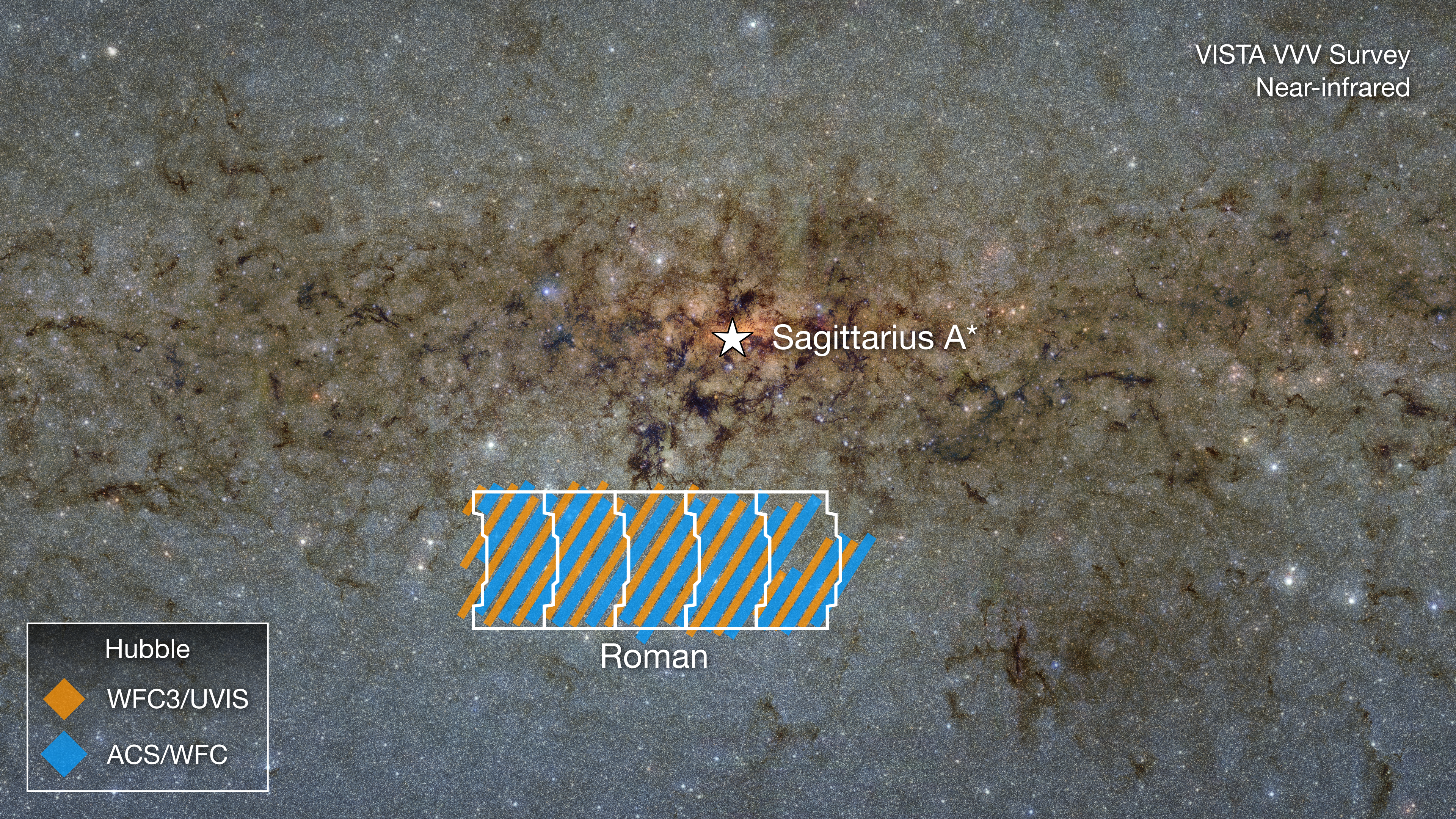
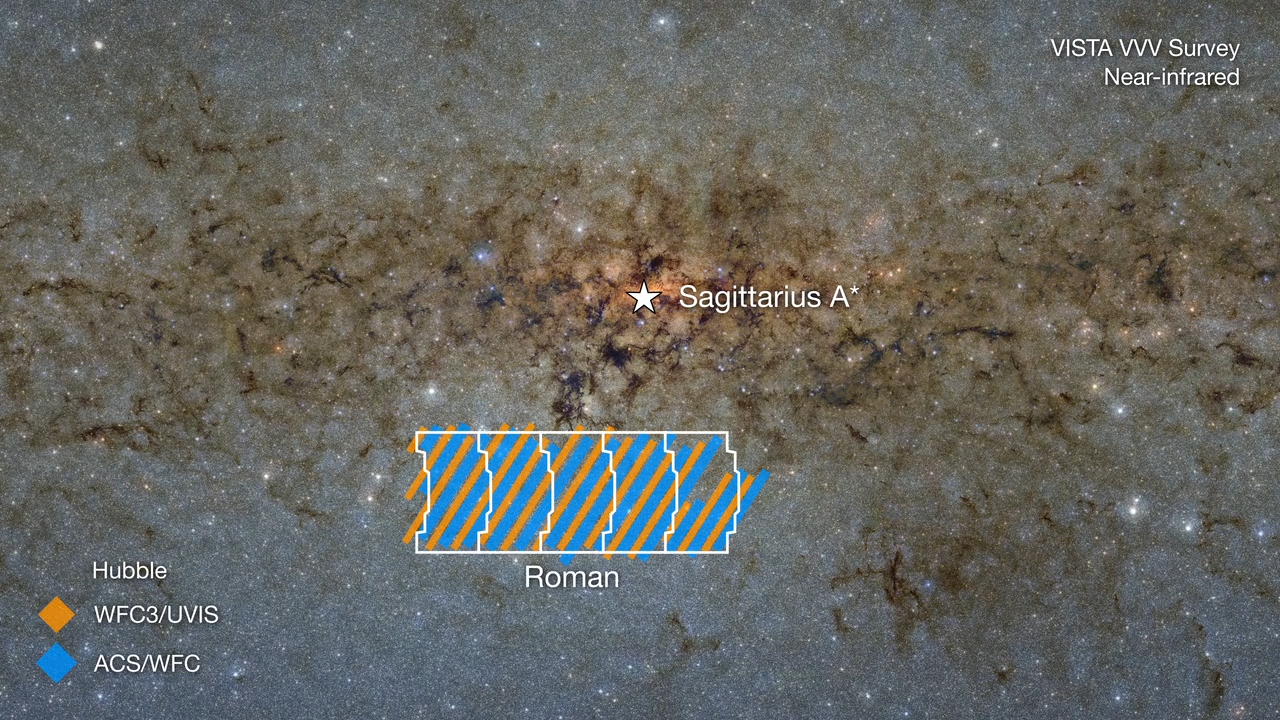
Hubble/Roman Galactic Bulge Survey Region (VISTA VVV Survey)
This VISTA VVV Survey image shows the galactic bulge near Sagittarius A*, the supermassive black hole at the Milky Way’s center. A region planned for observation by NASA’s Nancy Grace Roman Space Telescope is outlined. This area has been observed by NASA’s Hubble Space Telescope.

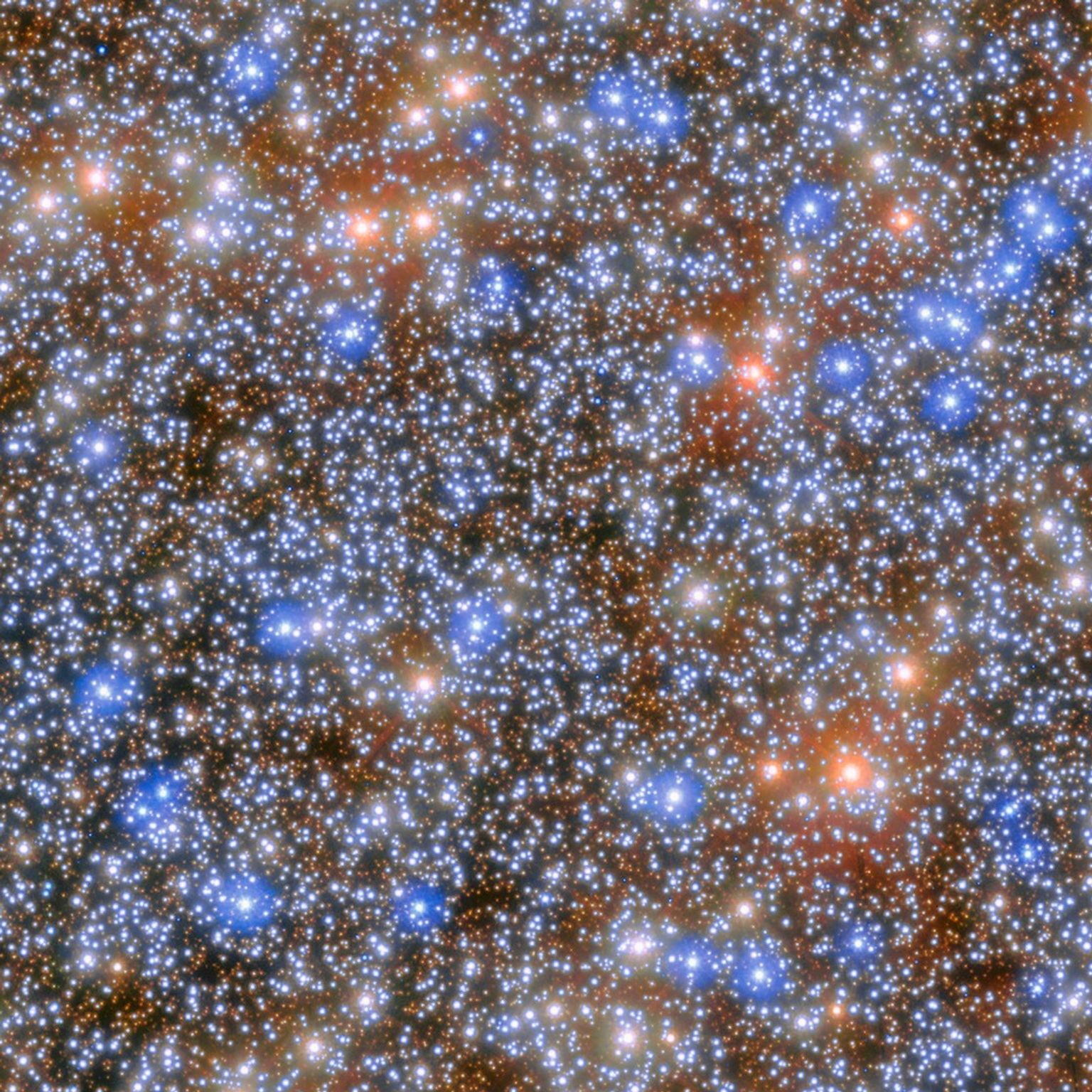
Microlensing Event at OGLE-2013-BLG-0341 (Hubble Image)
A follow-up observation by NASA’s Hubble Space Telescope shows a region containing a microlensing event captured by the Optical Gravitational Lensing Experiment (OGLE) in 2013. Hubble was able to separate the foreground lens from the background star.
Share
Details
Claire Andreoli
NASA’s Goddard Space Flight Center
Greenbelt, Maryland
claire.andreoli@nasa.gov