
























1 min read
Beta Pictoris System (NIRSpec IFU Image Annotated)
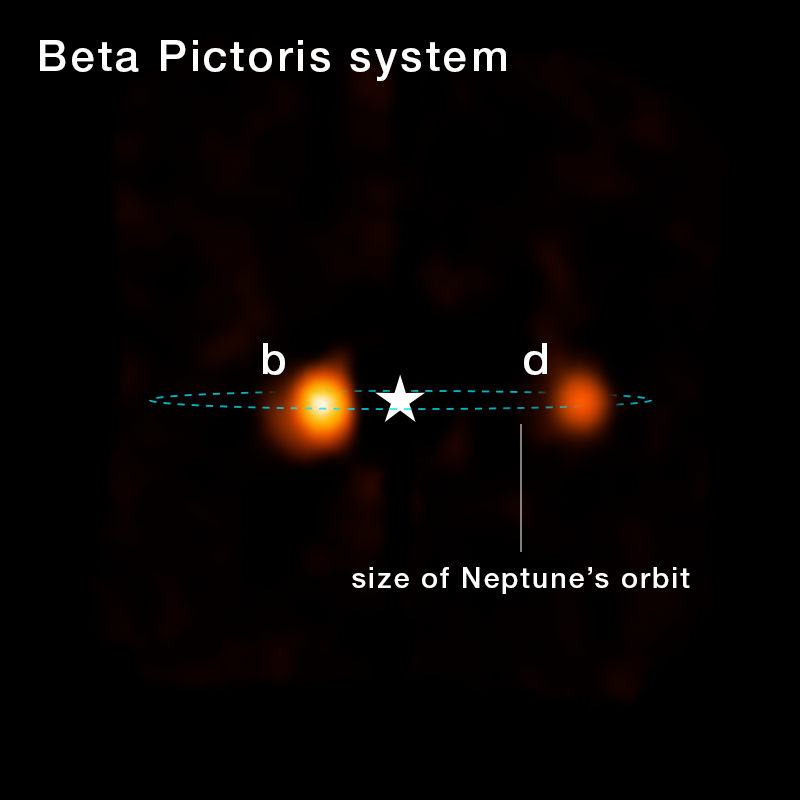
The newly discovered third planet orbiting Beta Pictoris, Beta Pictoris d, appears in reconstructed imagery from NASA’s James Webb Space Telescope’s NIRSpec (Near-Infrared Spectrograph). NIRSpec’s Integral Field Unit (IFU) was used to map chemical contents of the Beta Pictoris system. This allowed researchers to confirm the bright point of light, as seen in the image, was actually a planet by detecting its chemical composition.
Modeling suggests its orbit is comparable to the region occupied by Neptune in our own solar system.
About the Object
- R.A. PositionR.A. PositionRight ascension – analogous to longitude – is one component of an object's position.05:47:17.10
- Dec. PositionDec. PositionDeclination – analogous to latitude – is one component of an object's position.-51:03:57.23
- ConstellationConstellationOne of 88 recognized regions of the celestial sphere in which the object appears.Pictor
- DistanceDistanceThe physical distance from Earth to the astronomical object. Distances within our solar system are usually measured in Astronomical Units (AU). Distances between stars are usually measured in light-years. Interstellar distances can also be measured in parsecs.About 63 light-years
- DimensionsDimensionsThe physical size of the object or the apparent angle it subtends on the sky.This image is about 5 arcseconds across (97 au)
About the Data
- Data DescriptionData DescriptionProposal: A description of the observations, their scientific justification, and the links to the data available in the science archive.
Science Team: The astronomers who planned the observations and analyzed the data. "PI" refers to the Principal Investigator.This image was created with Webb data from proposal: 12518(A. Gibbs)
- InstrumentInstrumentThe science instrument used to produce the data.NIRSpec
- Exposure DatesExposure DatesThe date(s) that the telescope made its observations and the total exposure time.29 March 2026
- FiltersFiltersThe camera filters that were used in the science observations.G395H
- Object NameObject NameA name or catalog number that astronomers use to identify an astronomical object.Beta Pictoris system
- Object DescriptionObject DescriptionThe type of astronomical object.Gas giant exoplanet
- Release DateJuly 15, 2026
- Science ReleaseNASA’s Webb Discovers Hidden Planet in Famous Star System
- CreditImage: NASA, ESA, CSA, STScI; Science: Aidan Gibbs (UC San Diego), Jean-Baptiste Ruffio (UC San Diego); Image Processing: Alyssa Pagan (STScI)
Related Images & Videos


Beta Pictoris System (NIRSpec IFU Image and Spectrum)
Researchers used the NIRSpec (Near-Infrared Spectrograph) Integral Field Unit on NASA’s James Webb Space Telescope to map chemical contents of the Beta Pictoris system. As a result, they discovered a third planet, Beta Pictoris d, orbiting the young star.
Share
Details
Laura Betz
NASA’s Goddard Space Flight Center
Greenbelt, Maryland
laura.e.betz@nasa.gov