















1 min read
Chemistry in Titan’s Atmosphere
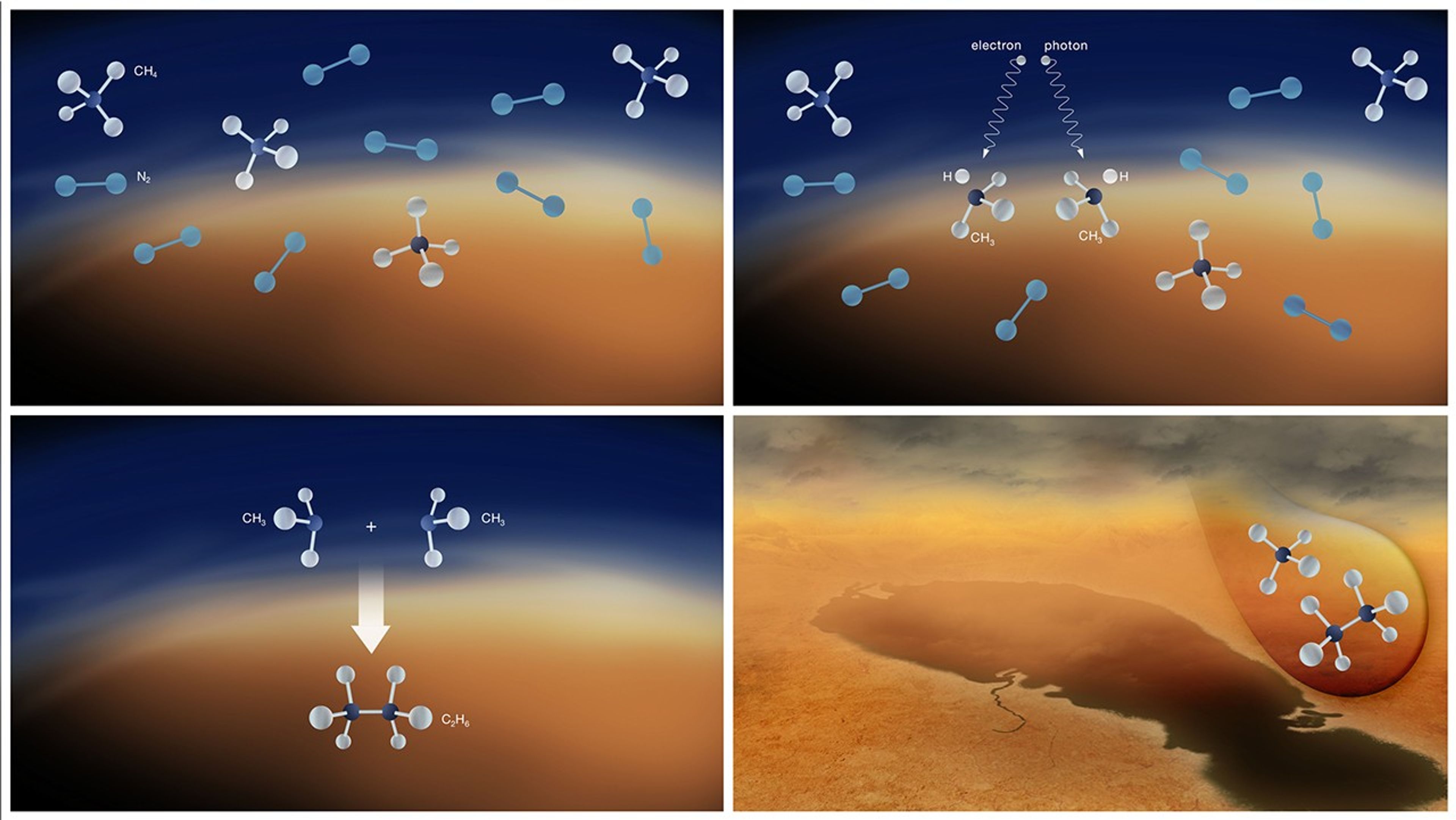
This four-panel infographic demonstrates a key chemical process believed to occur in the atmosphere of Saturn’s moon Titan. 1) Titan has a thick, nitrogen (N2) atmosphere that also contains methane (CH4). 2) Molecules known as methyl radicals (CH3) form when methane is broken apart by sunlight or energetic electrons from Saturn’s magnetosphere. 3) It then recombines with other molecules or with itself to make substances like ethane (C2H6). 4) Methane, ethane and other molecules condense and rain out of the atmosphere, forming lakes and seas on Titan’s surface. NASA’s James Webb Space Telescope detected the methyl radical on Titan for the first time, providing a key missing piece for our understanding of Titan’s chemical processes.
- Release DateMay 14, 2025
- Science ReleaseWebb’s Titan Forecast: Partly Cloudy With Occasional Methane Showers
- CreditArtwork: NASA, ESA, CSA, Elizabeth Wheatley (STScI)
Related Images & Videos
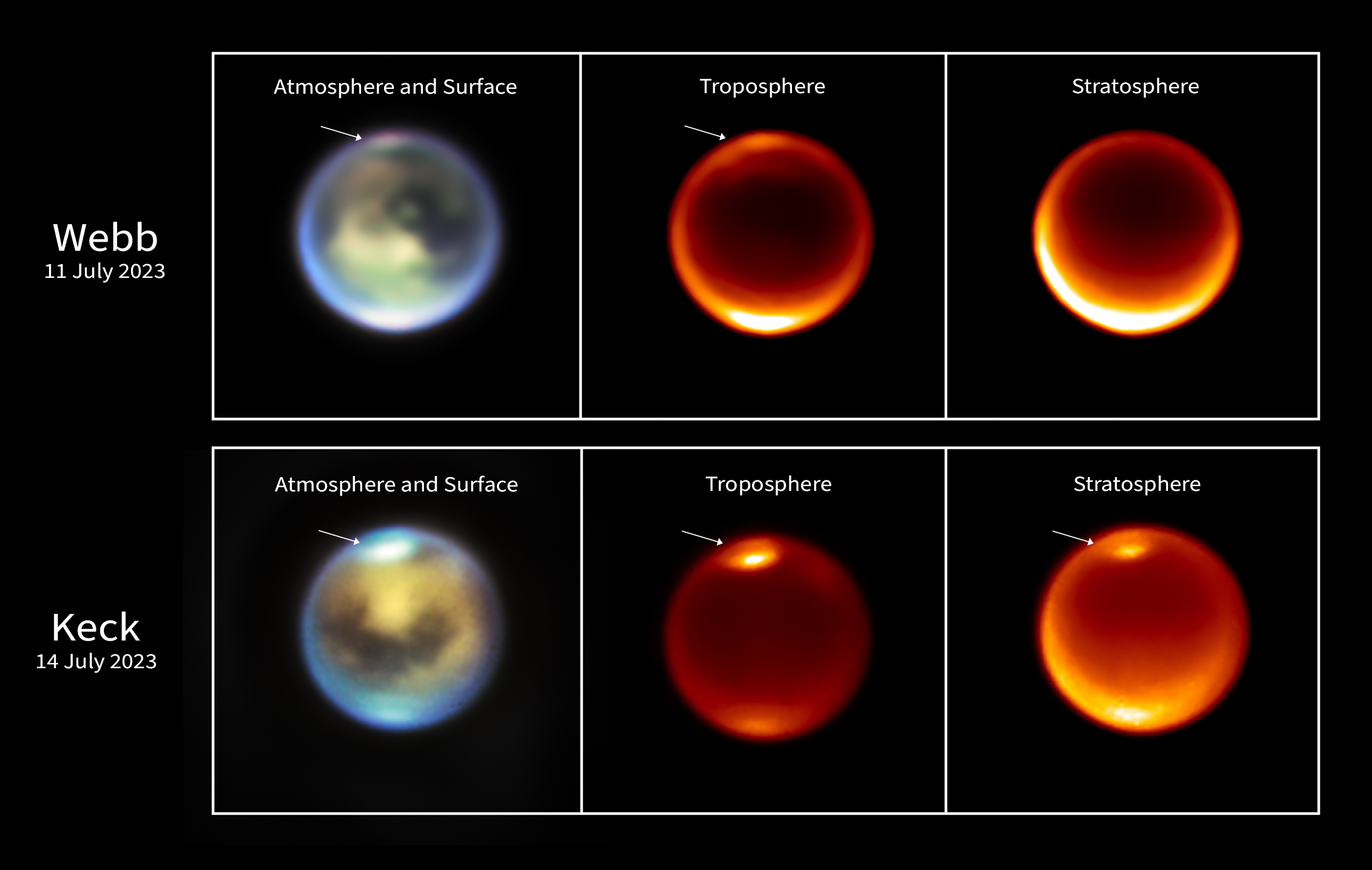
Titan (Webb and Keck Image)
These images of Titan were taken by NASA’s James Webb Space Telescope on July 11, 2023 (top row) and the ground-based W.M. Keck Observatories on July 14, 2023 (bottom row). They show methane clouds (denoted by the white arrows) appearing at different altitudes in Titan’s...
Share
Details
Laura Betz
NASA’s Goddard Space Flight Center
Greenbelt, Maryland
laura.e.betz@nasa.gov
NASA, ESA, CSA, Elizabeth Wheatley (STScI)