
















1 min read
Infrared Universe: The Effects of Eta Carinae
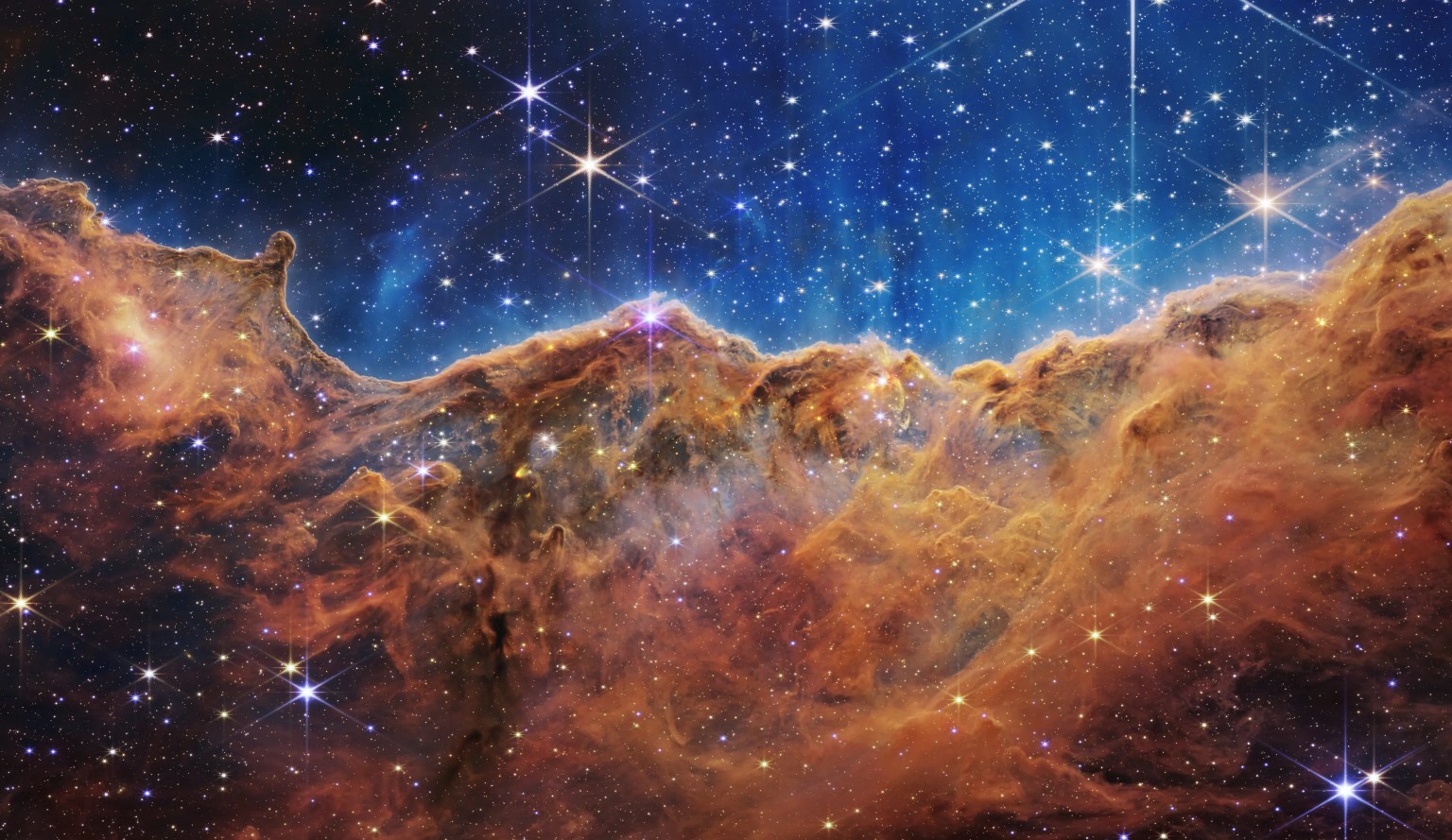
Eta Carinae is one of the most massive stars in the galaxy. It glows brilliantly in visible and ultraviolet light, which destroys the surrounding dust clouds. Though the star is above the edge of this image, its effect on the surrounding material can be seen clearly in the infrared. Pillars of dust and gas that are boiling away in its light point back toward the young star.
Optical: Dazzling light from the massive star Eta Carinae shapes these dust clouds.
Credit: NOAO, AURA, NSF
Infrared: Pillars of dust that survive the devastating glow of Eta Carinae stand out in infrared light.
Credit: >NASA, JPL-Caltech, N. Smith (University of Colorado at Boulder)
About the Infrared Universe Collection
The human eye can only see visible light, but objects give off a variety of wavelengths of light. To see an object as it truly exists, we would ideally look at its appearance through the full range of the electromagnetic spectrum. Telescopes show us objects as they appear emitting different energies of light, with each wavelength conveying unique information about the object. The Webb Space Telescope will study infrared light from celestial objects with much greater clarity and sensitivity than ever before. Explore the Infrared Universe. Adapted from Cool Cosmos by IPAC, with additional contributions from Bruno Merin and Miguel Merin (Pludo).
- Release DateMay 22, 2018
- CreditVideo: NASA, ESA, Gregory Bacon (STScI)
Downloads
Share
Details
Laura Betz
NASA’s Goddard Space Flight Center
Greenbelt, Maryland
laura.e.betz@nasa.gov
NASA, ESA, Gregory Bacon (STScI)