
















1 min read
JADES-GS-z13-1 Spectrum Graphic
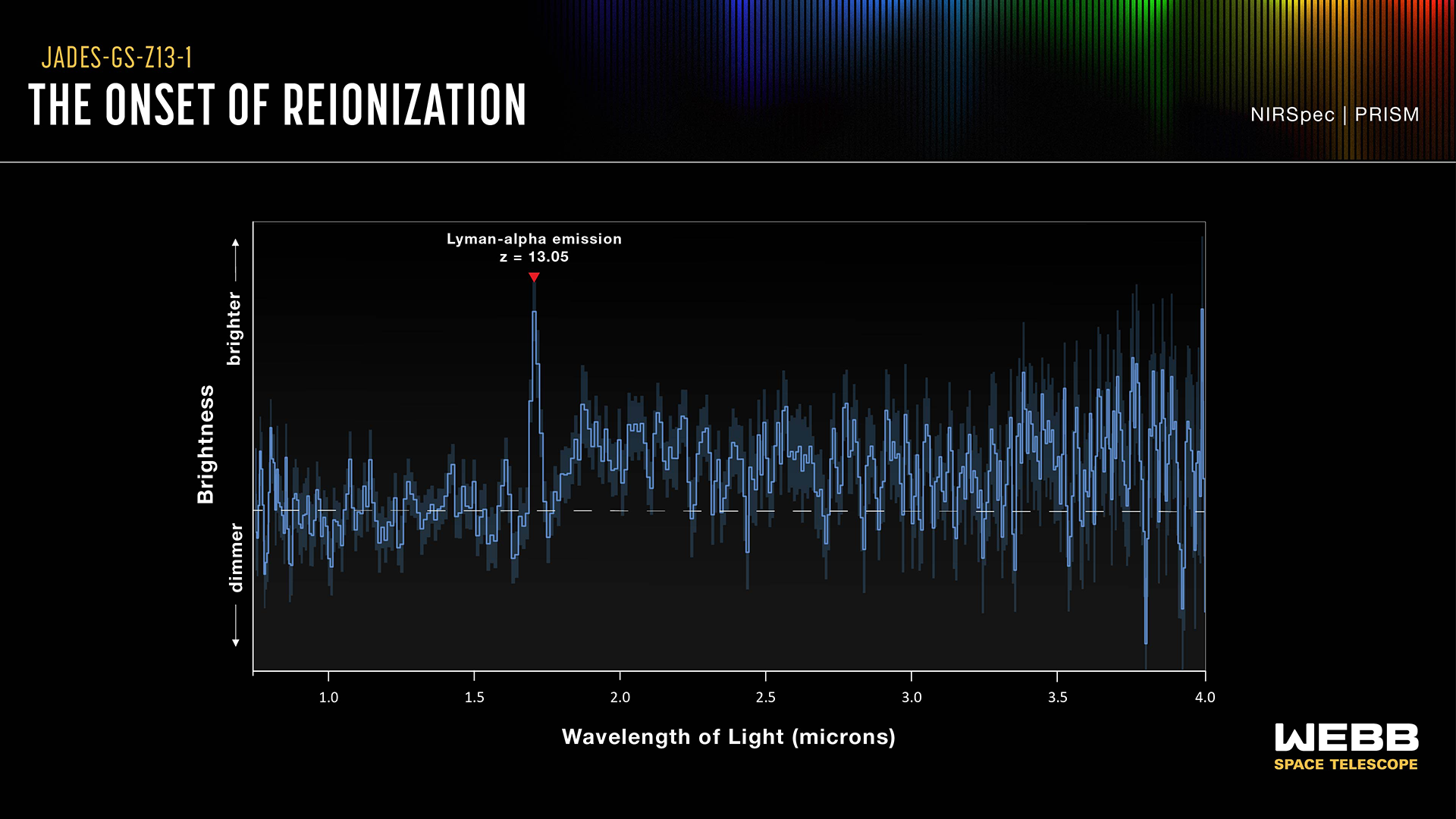
NASA’s James Webb Space Telescope has detected unexpected light from a distant galaxy. The galaxy JADES-GS-z13-1, observed just 330 million years after the big bang (corresponding to a redshift of z=13.05), shows bright emission from hydrogen known as Lyman-alpha emission. This is surprising because that emission should have been absorbed by a dense fog of neutral hydrogen that suffused the early universe. In this graphic, the solid blue line shows the cleaned, averaged spectrum while the faint blue shows the error bars.
- Release DateMarch 26, 2025
- Science ReleaseNASA’s Webb Sees Galaxy Mysteriously Clearing Fog of Early Universe
- CreditIllustration: NASA, ESA, CSA, Stefano Carniani (Scuola Normale Superiore), P. Jakobsen (University of Copenhagen), Joseph Olmsted (STScI)
Related Images & Videos
JADES-GS-z13-1 in the GOODS-S field (NIRCam Image)
The incredibly distant galaxy JADES-GS-z13-1, observed just 330 million years after the big bang, was initially discovered with deep imaging from NASA’s James Webb Space Telescope’s NIRCam (Near-Infrared Camera). Now, an international team of astronomers definitively has...
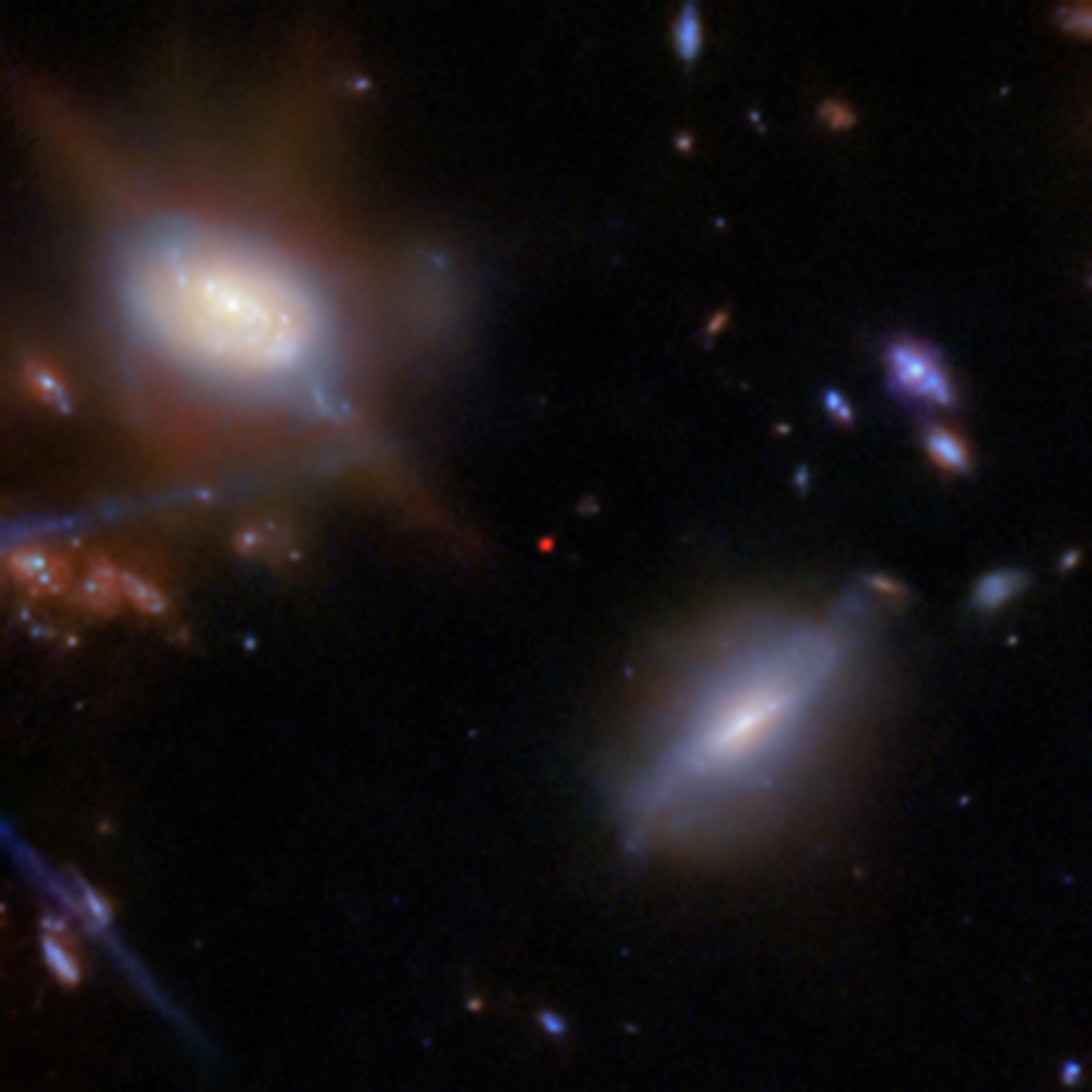
JADES-GS-z13-1 (NIRCam Close-Up)
This image shows the galaxy JADES GS-z13-1 (the red dot at center), imaged with NASA’s James Webb Space Telescope’s NIRCam (Near-Infrared Camera) as part of the JWST Advanced Deep Extragalactic Survey (JADES) program. These data from NIRCam allowed researchers to identify...
Share
Details
Laura Betz
NASA’s Goddard Space Flight Center
Greenbelt, Maryland
laura.e.betz@nasa.gov
NASA, ESA, CSA, Stefano Carniani (Scuola Normale Superiore), P. Jakobsen (University of Copenhagen), Joseph Olmsted (STScI)