















1 min read
MACS 0416 (Hubble ACS and WFC3 + Webb NIRCam Image)
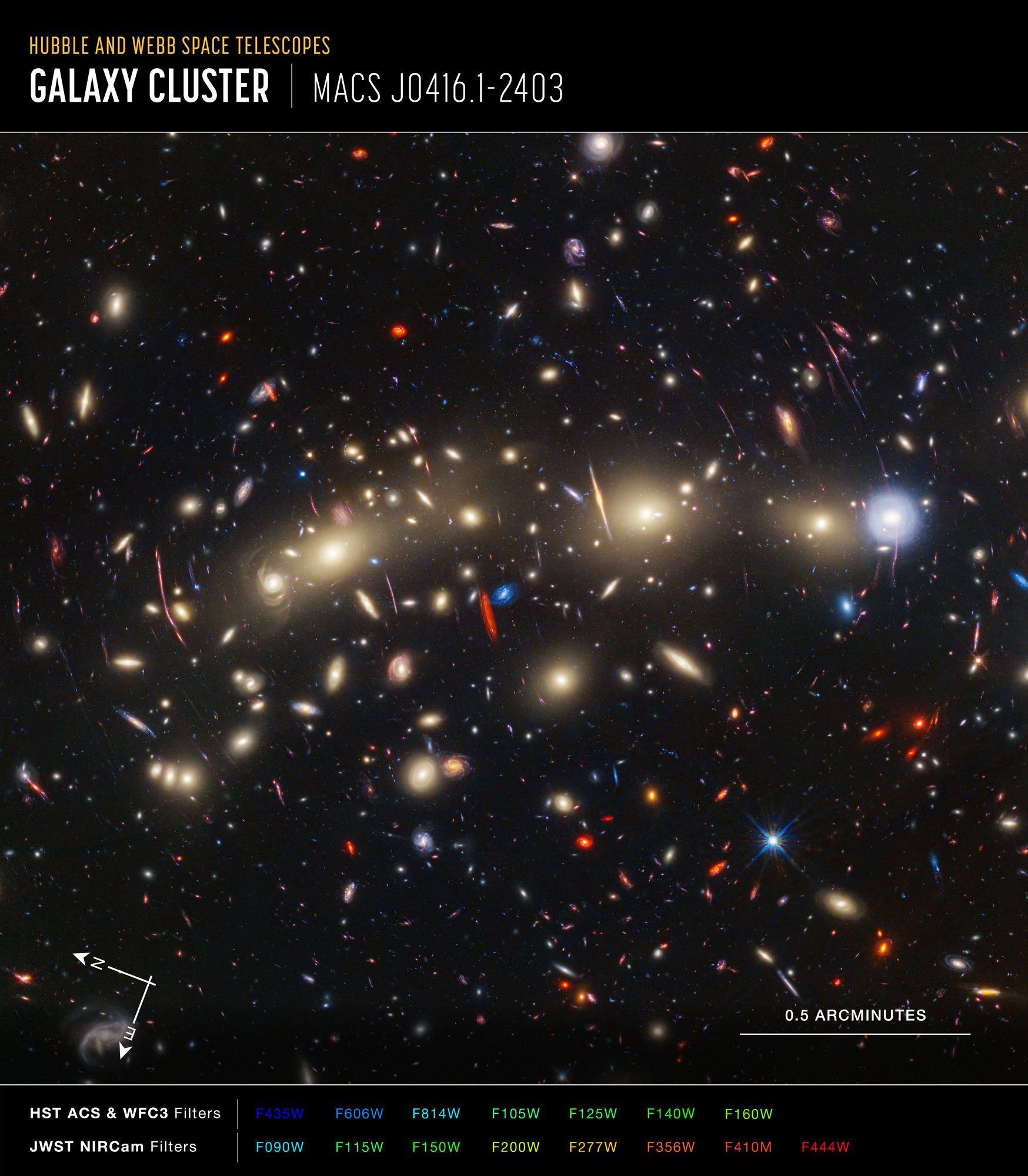
This panchromatic view of galaxy cluster MACS0416 was created by combining infrared observations from NASA’s James Webb Space Telescope with visible-light data from NASA’s Hubble Space Telescope. To make the image, in general the shortest wavelengths of light were color-coded blue, the longest wavelengths red, and intermediate wavelengths green. The resulting wavelength coverage, from 0.4 to 5 microns, reveals a vivid landscape of galaxies that could be described as one of the most colorful views of the universe ever created.
MACS0416 is a galaxy cluster located about 4.3 billion light-years from Earth, meaning that light we see now left the cluster shortly after the formation of our solar system. This cluster magnifies the light from more distant background galaxies through gravitational lensing. As a result, the research team has been able to identify magnified supernovae and even very highly magnified individual stars.
Those colors give clues to galaxy distances: The bluest galaxies are relatively nearby and often show intense star formation, as best detected by Hubble, while the redder galaxies tend to be more distant, or else contain copious amount of dust, as detected by Webb. The image reveals a wealth of details that are only possible to capture by combining the power of both space telescopes.
In this image, blue represents data at wavelengths of 0.435 and 0.606 microns (Hubble filters F435W and F606W); cyan is 0.814, 0.9, and 1.05 microns (Hubble filters F814W, and F105W and Webb filter F090W); green is 1.15, 1.25, 1.4, 1.5, and 1.6 microns (Hubble filters F125W, F140W, and F160W, and Webb filters F115W and F150W); yellow is 2.00 and 2.77 microns (Webb filters F200W, and F277W); orange is 3.56 microns (Webb filter F356W); and red represents data at 4.1 and 4.44 microns (Webb filters F410M and F444W).
About the Object
- R.A. PositionR.A. PositionRight ascension – analogous to longitude – is one component of an object's position.04:16:9.89
- Dec. PositionDec. PositionDeclination – analogous to latitude – is one component of an object's position.-24:03:58.0
- ConstellationConstellationOne of 88 recognized regions of the celestial sphere in which the object appears.Eridanus
About the Data
- Data DescriptionData DescriptionProposal: A description of the observations, their scientific justification, and the links to the data available in the science archive.
Science Team: The astronomers who planned the observations and analyzed the data. "PI" refers to the Principal Investigator. - InstrumentInstrumentThe science instrument used to produce the data.HST ACS & WFC3; JWST NIRCam
- Exposure DatesExposure DatesThe date(s) that the telescope made its observations and the total exposure time.HST: July 2012 - Feb 2023 JWST: 7 Oct 2022, 29 Dec 2022, 10 Feb 2022
- FiltersFiltersThe camera filters that were used in the science observations.HST ACS: F435W, F606W, F814W; WFC3/IR: F105W, F125W, F140W, F160W; JWST NIRCam: F090W, F115W, F150W, F200W, F277W, F356W, F410M, F444W
- Object NameObject NameA name or catalog number that astronomers use to identify an astronomical object.MACS J0416.1-2403
- Object DescriptionObject DescriptionThe type of astronomical object.Lensing Galaxy Cluster
- Release DateNovember 9, 2023
- Science ReleaseNASA’s Webb, Hubble Combine to Create Most Colorful View of Universe
- CreditImage: NASA, ESA, CSA, STScI, Jose Diego (IFCA), Jordan D'Silva (UWA), Anton Koekemoer (STScI), Jake Summers (ASU), Rogier Windhorst (ASU), Haojing Yan (University of Missouri); Image Processing: Joseph DePasquale (STScI)
These images are a composite of separate exposures acquired by the Hubble and Webb Space Telescopes using the ACS, WFC3, and NIRCam instruments. Multiple filters were used to sample broad and narrow wavelength ranges. The color results from assigning different hues (colors) to each monochromatic (grayscale) image associated with an individual filter. In this case, the assigned colors are: Red: F444W and F410M, Orange: F356W, Yellow: F277W and F200W, Green: F160W, F150W, F140W, F125W, F115W, Cyan: F090W, F105W, F814W, Blue: F606W, F435W
Related Images & Videos
MACS 0416 Mothra Pullout (Hubble ACS and WFC3 + Webb NIRCam Image)
This image of galaxy cluster MACS0416 highlights one particular gravitationally lensed background galaxy, which existed about 3 billion years after the big bang. That galaxy contains a transient, or object that varies in observed brightness over time, that the science team...
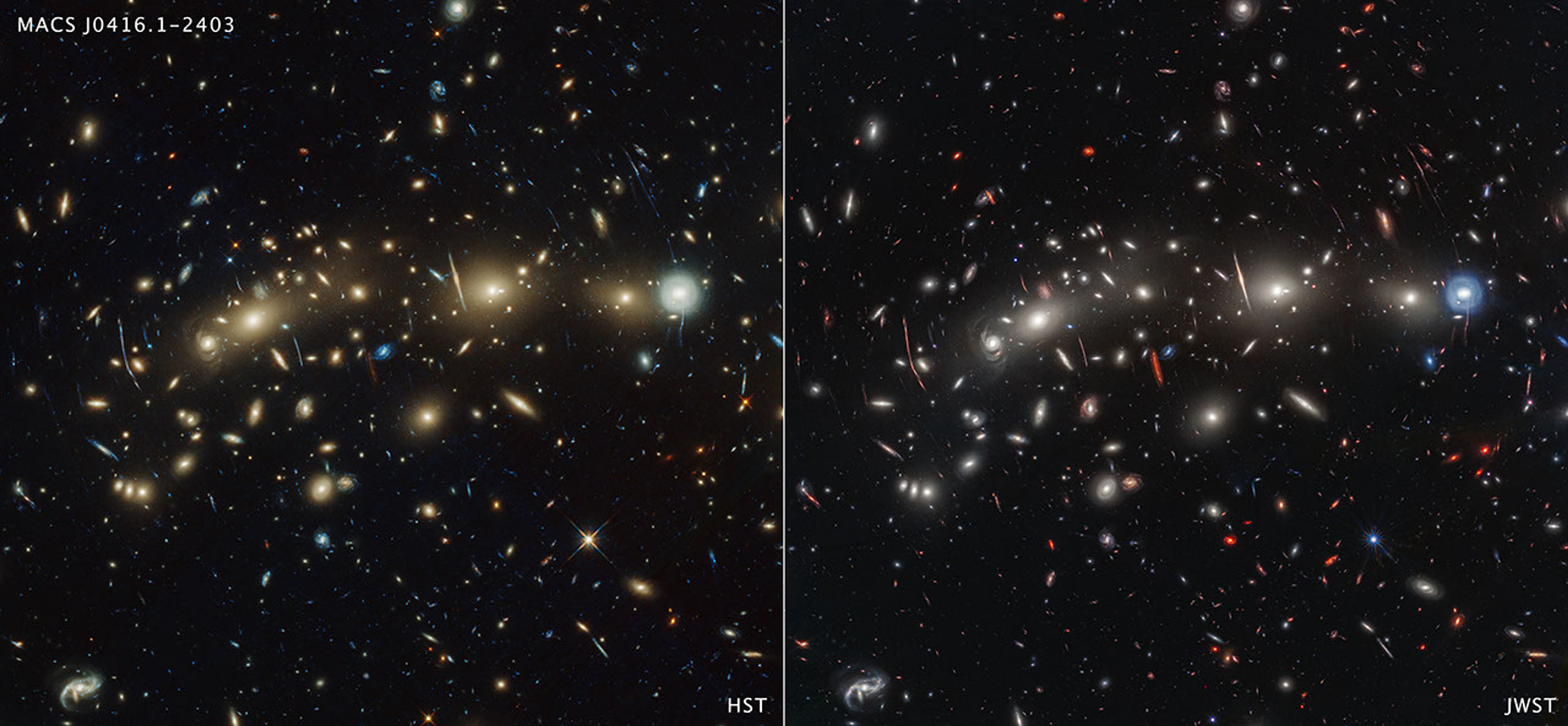
MACS 0416 (Hubble and Webb Compared)
This side-by-side comparison of galaxy cluster MACS0416 as seen by the Hubble Space Telescope in optical light (left) and the James Webb Space Telescope in infrared light (right) reveals different details. Both images feature hundreds of galaxies, however the Webb image shows...
MACS 0416 (Hubble + Webb Compass Image)
Image of galaxy cluster MACS0416 captured in visible light by Hubble’s ACS and WFC3 and in infrared light by Webb’s NIRCam, with compass arrows, scale bar, and color key for reference. The north and east compass arrows show the orientation of the image on the sky. Note that the...
Share
Details
Laura Betz
NASA’s Goddard Space Flight Center
Greenbelt, Maryland
laura.e.betz@nasa.gov
NASA, ESA, CSA, STScI, Jose Diego (IFCA), Jordan D’Silva (UWA), Anton Koekemoer (STScI), Jake Summers (ASU), Rogier Windhorst (ASU), Haojing Yan (University of Missouri)
Joseph DePasquale (STScI)