














1 min read
Massive Star-Forming Region in 30 Doradus (Hubble)
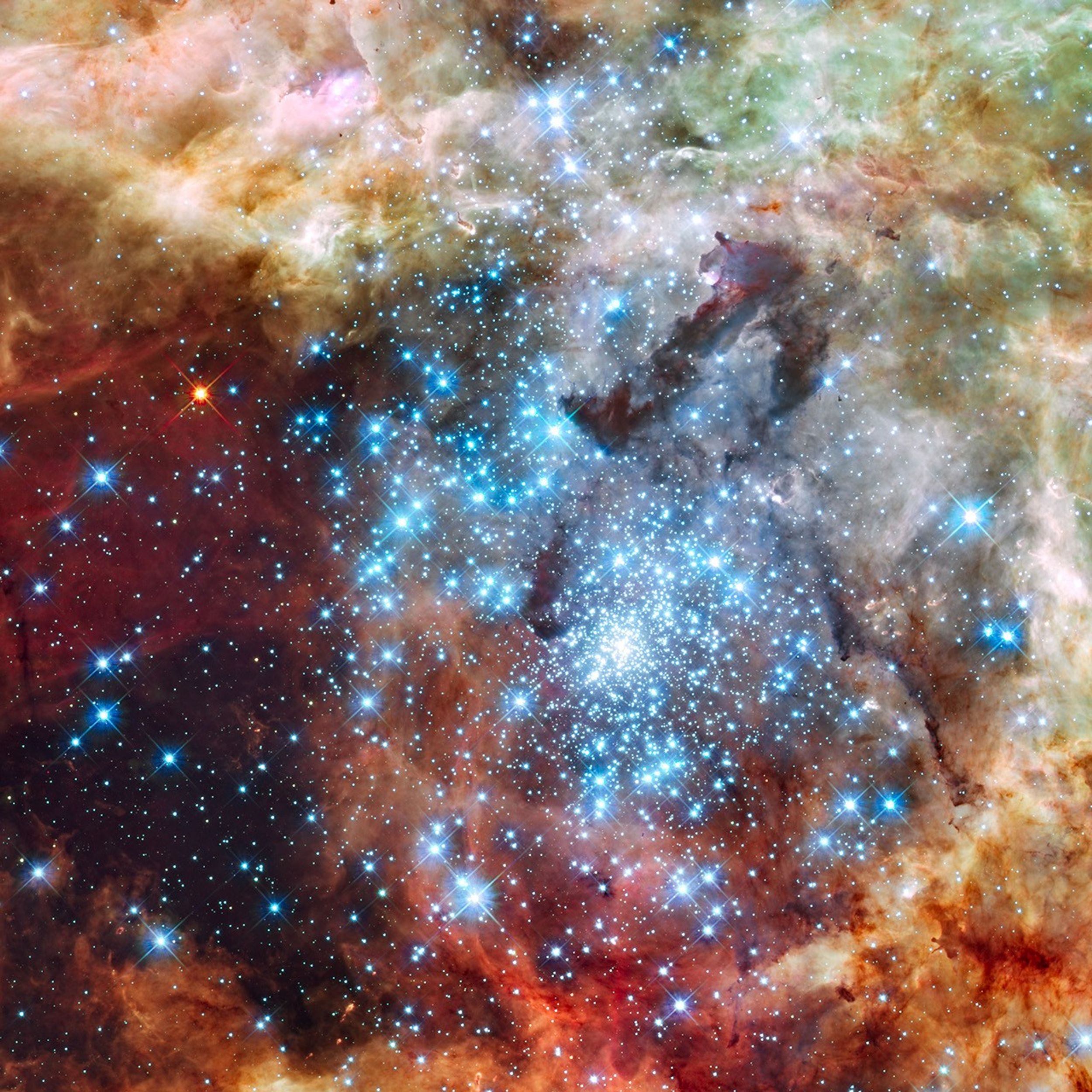
The Hubble Space Telescope captured this image of the massive young stellar grouping R136. The cluster of stars resides in the 30 Doradus nebula, a turbulent star birth region in the Large Magellanic Cloud (LMC), a satellite galaxy of our Milky Way. The blue color is light from the hottest, most massive stars; the green from the glow of oxygen; and the red from fluorescing hydrogen.
This nearby stellar nursery provides insights into the star life cycle and how star clusters may have formed in the early universe.
About the Object
- R.A. PositionR.A. PositionRight ascension – analogous to longitude – is one component of an object's position.05h 38m 42.36s
- Dec. PositionDec. PositionDeclination – analogous to latitude – is one component of an object's position.-69° 6' 3.24"
- ConstellationConstellationOne of 88 recognized regions of the celestial sphere in which the object appears.Dorado
- DistanceDistanceThe physical distance from Earth to the astronomical object. Distances within our solar system are usually measured in Astronomical Units (AU). Distances between stars are usually measured in light-years. Interstellar distances can also be measured in parsecs.170,000 light-years (52,000 parsecs)
- DimensionsDimensionsThe physical size of the object or the apparent angle it subtends on the sky.About 100 light-years across
About the Data
- Data DescriptionData DescriptionProposal: A description of the observations, their scientific justification, and the links to the data available in the science archive.
Science Team: The astronomers who planned the observations and analyzed the data. "PI" refers to the Principal Investigator.The image was created from Hubble data from proposal 11360: R. O'Connell (University of Virginia), B. Balick (University of Washington), H. Bond (STScI), D. Calzetti (University of Massachusetts), M. Carollo (Swiss Federal Institute of Technology, Zurich), M. Disney (University of Wales, College of Cardiff), M. Dopita (Australian National University), J. Frogel (Ohio State University Research Foundation), D. Hall (University of Hawaii), J. Holtzman (New Mexico State University), P. McCarthy (Carnegie Institution of Washington), F. Paresce (European Southern Observatory, Germany), A. Saha (NOAO/AURA), J. Silk (University of Oxford), A. Walker (NOAO/CTIO), B. Whitmore (STScI), R. Windhorst (Arizona State University), and E. Young (University of Arizona). SCIENCE TEAM: E. Sabbi and D.J. Lennon (ESA/STScI), M. Gieles (University of Cambridge, UK), S.E. de Mink (STScI/JHU), N.R. Walborn, J. Anderson, A. Bellini, N. Panagia, and R. van der Marel (STScI), and J. Maíz Apellániz (Instituto de Astrofísica de Andalucía, CISC, Spain).
- InstrumentInstrumentThe science instrument used to produce the data.HST>WFC3/UVIS and HST>WFC/IR
- Exposure DatesExposure DatesThe date(s) that the telescope made its observations and the total exposure time.October 20 - 27, 2009 (WFC3/UVIS), and October 20 - 27, 2009 (WFC/IR), Exposure Times: 11.7 hours, and 2.6 hours
- FiltersFiltersThe camera filters that were used in the science observations.F336W (U), F438W (B), F555W (V), F656N (H-alpha), and F814W (I)
- Object NameObject NameA name or catalog number that astronomers use to identify an astronomical object.30 Doradus, 30 Dor, Tarantula Nebula
- Object DescriptionObject DescriptionThe type of astronomical object.Nebula in the Large Magellanic Cloud
- Release DateMay 25, 2018
- CreditImage: NASA, ESA, Elena Sabbi (ESA, STScI); Acknowledgment: SOC-WFC3, Robert O'Connell (UVA)
The images are composites of separate exposures made by the WFC3 instrument on the Hubble Space Telescope. Five filters were used to sample broad and narrow wavelength ranges for the UVIS image. The colors result from assigning different hues (colors) to each monochromatic image. In this case, the assigned colors are: Blue: F336W (U) + F438W (B); Green: F555W (V); Red: F814W (I); Orange/red: F656N (H-alpha)
Share
Details
Laura Betz
NASA’s Goddard Space Flight Center
Greenbelt, Maryland
laura.e.betz@nasa.gov
NASA, ESA, Elena Sabbi (ESA, STScI)
SOC-WFC3, Robert O’Connell (UVA)