






1 min read
Multiwavelength View of NGC 3351 (Hubble, VLT, ALMA)
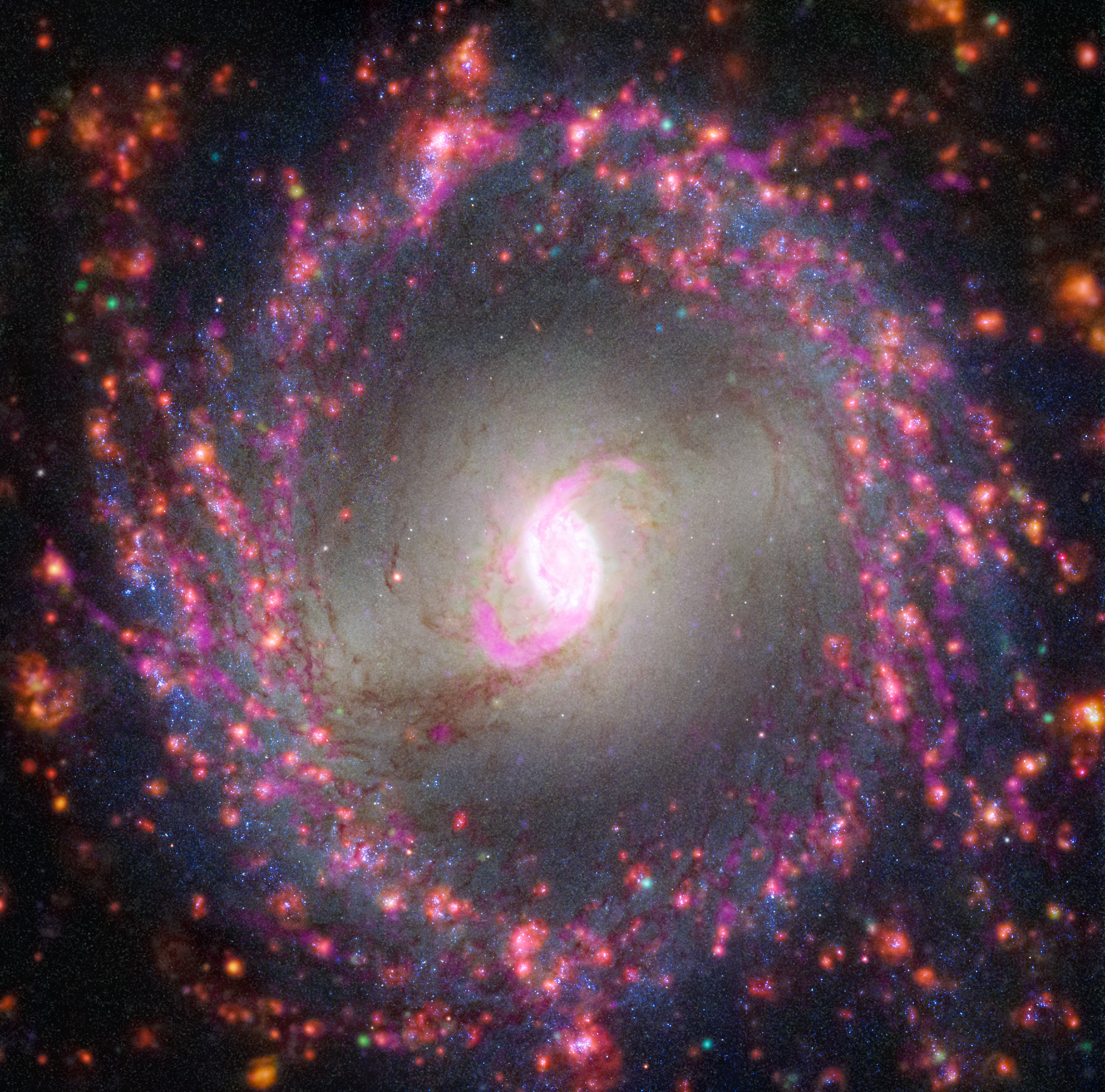
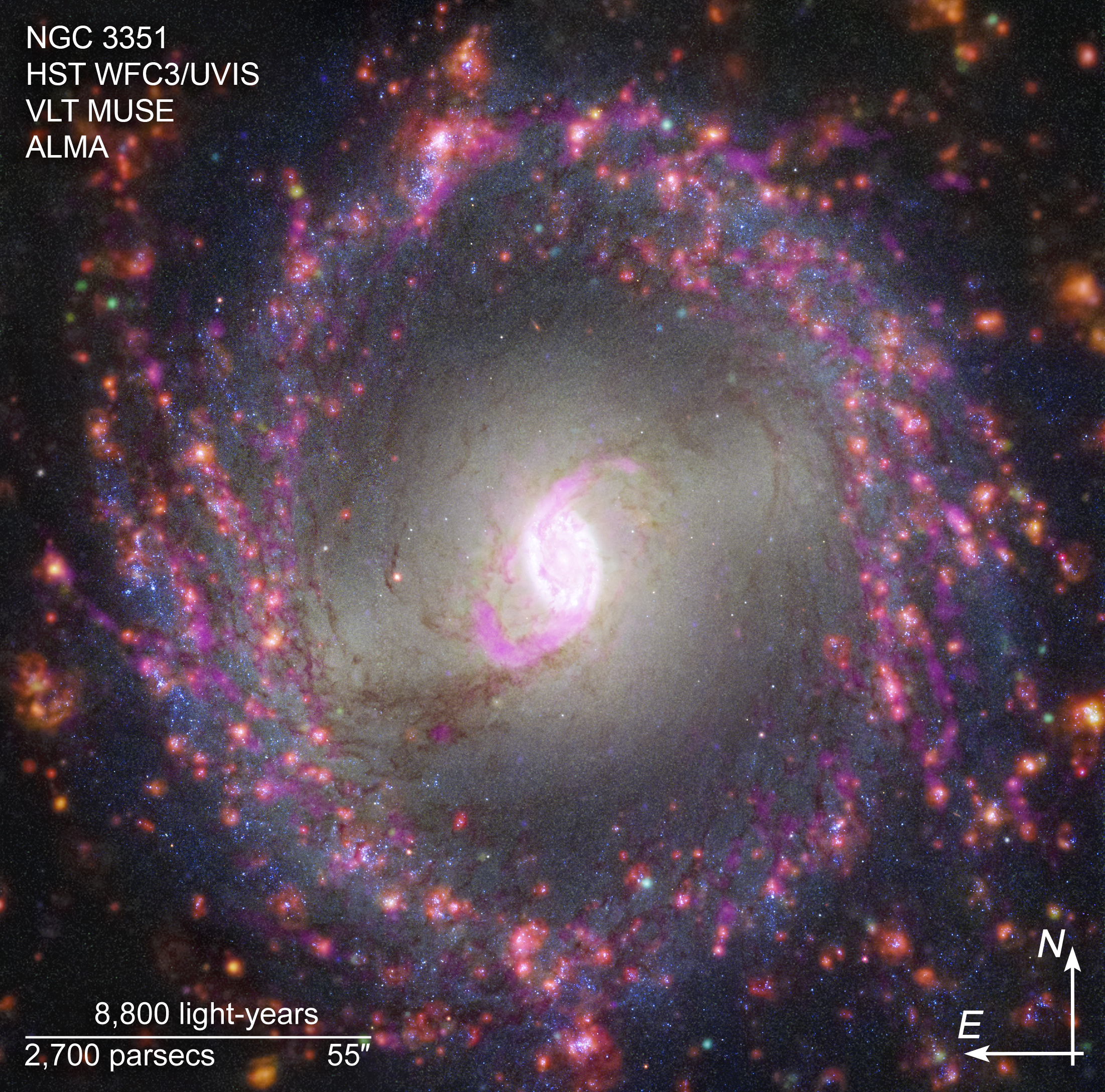
This image of spiral galaxy NGC 3351 combines observations from several observatories to reveal details about its stars and gas. Radio observations from the Atacama Large Millimeter/submillimeter Array (ALMA) show dense molecular gas in magenta. The Very Large Telescope’s Multi Unit Spectroscopic Explorer (MUSE) instrument highlights where young massive stars illuminate their surroundings, set off in red. The Hubble Space Telescope’s images highlight dust lanes in white and newly formed stars in blue. High-resolution infrared images from the Webb Space Telescope will help researchers identify where stars are forming behind dust and study the earliest stages of star formation in this galaxy.
About the Object
- R.A. PositionR.A. PositionRight ascension – analogous to longitude – is one component of an object's position.10:43:55.08
- Dec. PositionDec. PositionDeclination – analogous to latitude – is one component of an object's position.+11:41:24.70
- ConstellationConstellationOne of 88 recognized regions of the celestial sphere in which the object appears.Leo
- DistanceDistanceThe physical distance from Earth to the astronomical object. Distances within our solar system are usually measured in Astronomical Units (AU). Distances between stars are usually measured in light-years. Interstellar distances can also be measured in parsecs.Approximately 33 million light-years.
- DimensionsDimensionsThe physical size of the object or the apparent angle it subtends on the sky.Image is 2.9 arcmin across (about 28,000 light-years)
About the Data
- Data DescriptionData DescriptionProposal: A description of the observations, their scientific justification, and the links to the data available in the science archive.
Science Team: The astronomers who planned the observations and analyzed the data. "PI" refers to the Principal Investigator.The Hubble portion of this image was created from HST data from proposal: 13364 (D. Calzetti)
- InstrumentInstrumentThe science instrument used to produce the data.HST>WFC3/UVIS VLT>MUSE ALMA
- Exposure DatesExposure DatesThe date(s) that the telescope made its observations and the total exposure time.HST> 01 March 2014, 23 April 2014
- FiltersFiltersThe camera filters that were used in the science observations.HST/WFC3> F275W, F336W, F438W, F555W, F814W VLT/MUSE> F502N, F673N, F656N, Johnson B, Johnson V, Johnson R, SDSS b, SDSS r, SDSS i
- Object NameObject NameA name or catalog number that astronomers use to identify an astronomical object.NGC 3351
- Object DescriptionObject DescriptionThe type of astronomical object.Barred spiral galaxy
- Release DateJanuary 19, 2022
- Science ReleaseCapturing All That Glitters in Galaxies with NASA’s Webb
- CreditNASA, ESA, ESO-Chile, ALMA, NAOJ, NRAO; Image Processing: Joseph DePasquale (STScI)
These images are a composite of separate exposures acquired by the Hubble Space Telescope, the Very Large Array and the Atacama Large Millimeter/submillimeter Array. Several filters were used to sample narrow and broad wavelength ranges. The color results from assigning different hues (colors) to each monochromatic (grayscale) image associated with an individual filter. In this case, the assigned colors are: HST/WFC3> Magenta: F275W Purple: F336W Blue: F438W Green: F555W Red: F814W VLT/MUSE> Blue: F502N + Johnson B + SDSS b Green: F673N + Johnson V + SDSS r Red: F656N + Johnson R + SDSS i ALMA> Magenta
Related Images & Videos
Multiwavelength View of NGC 3351 (Hubble, VLT, ALMA Compass Image)
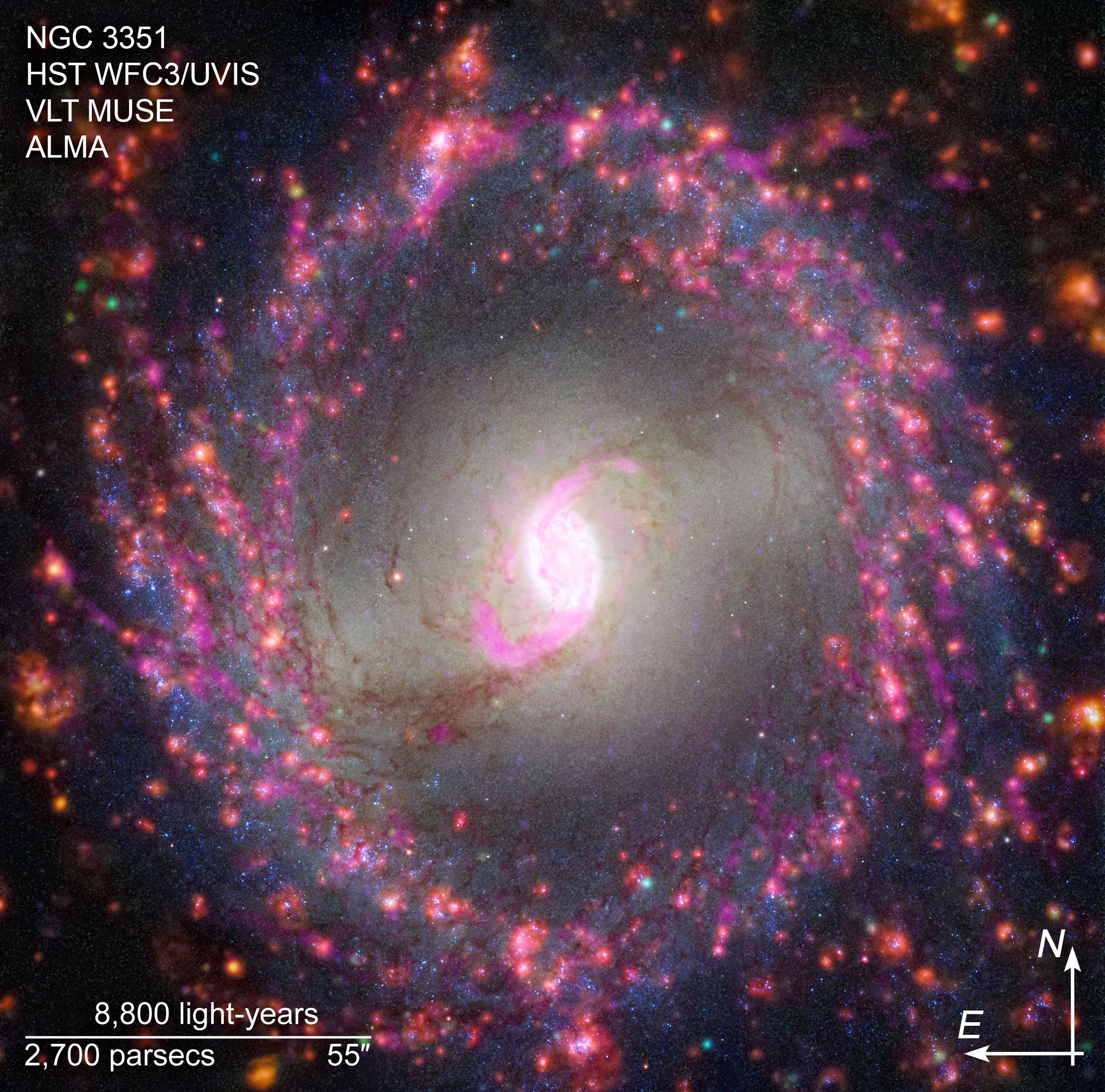
This composite image of NGC 3351, captured by the Hubble Space Telescope’s Wide Field Camera 3, the Atacama Large Millimeter/submillimeter Array (ALMA), and the Very Large Telescope’s Multi Unit Spectroscopic Explorer (MUSE) instrument, shows compass arrows and labels for...
Multiwavelength View of NGC 1300 (ALMA, VLT)
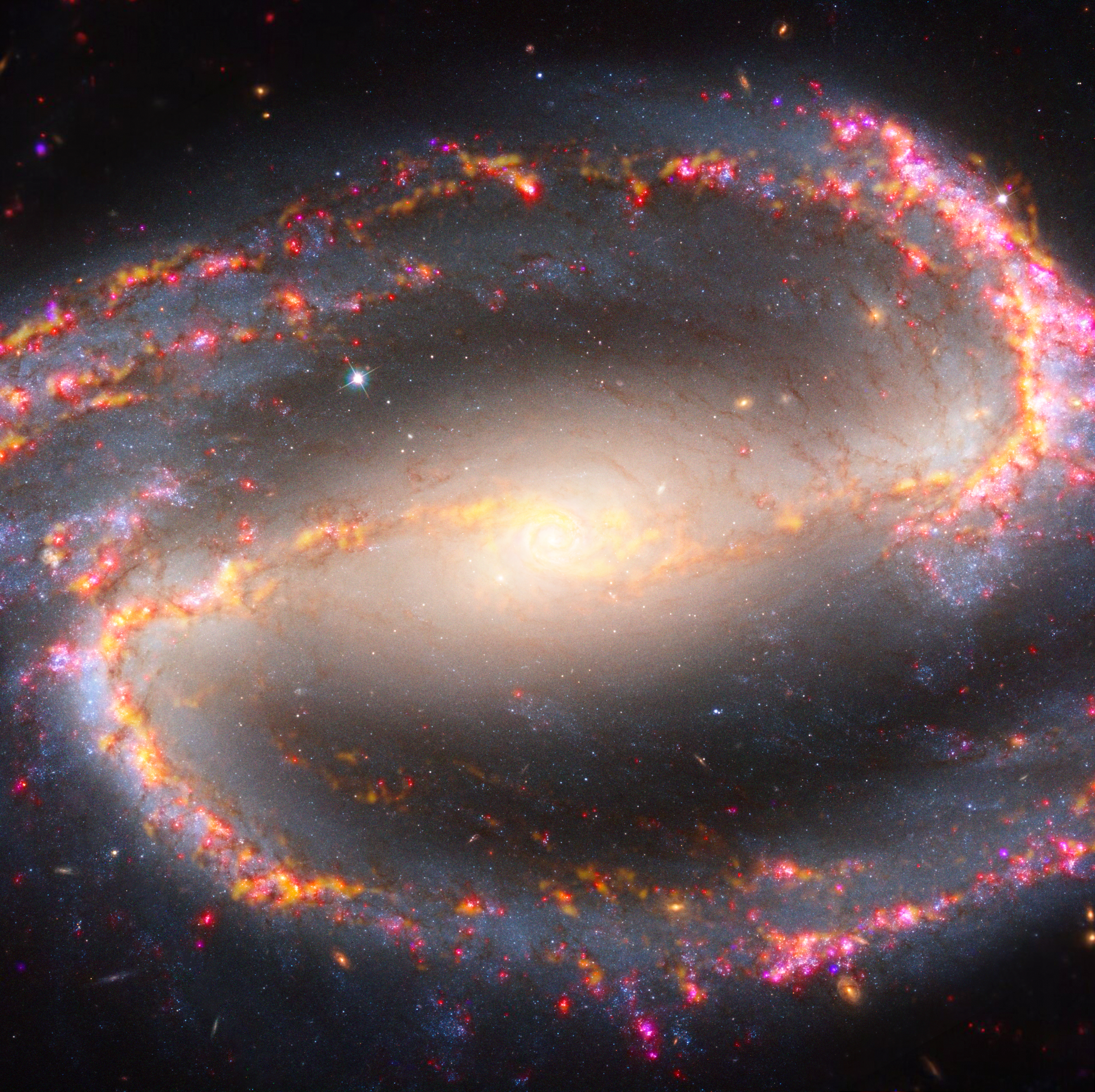
This image of spiral galaxy NGC 1300 combines multiple observations to map stellar populations and gas. Radio light observed by the Atacama Large Millimeter/submillimeter Array (ALMA), represented in yellow, highlights the clouds of cold molecular gas that provide the raw...
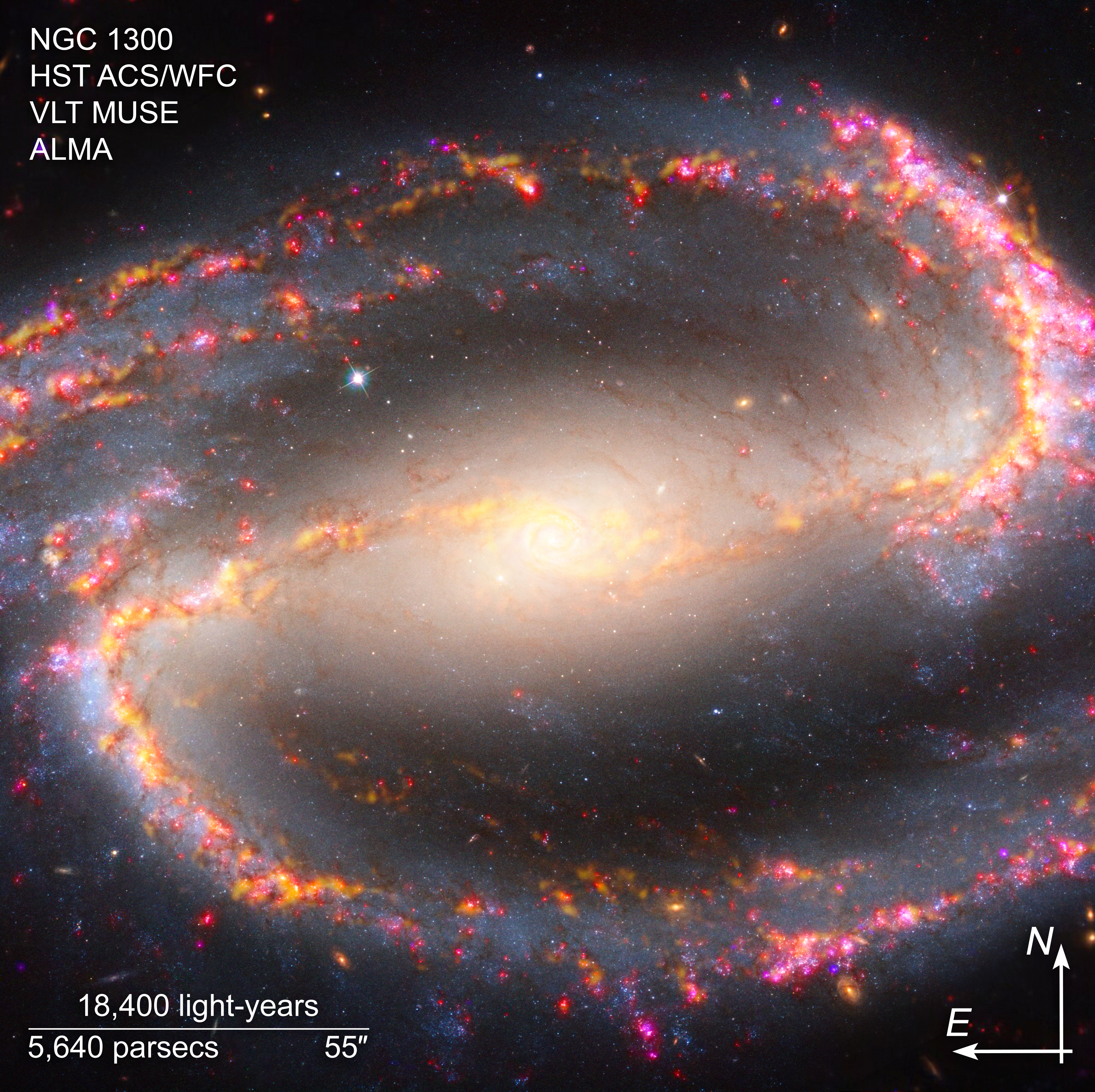
Multiwavelength View of NGC 1300 (ALMA, VLT Compass Image)
This composite image of NGC 1300, captured by the Hubble Space Telescope’s Advanced Camera for Surveys, the Atacama Large Millimeter/submillimeter Array (ALMA), and the Very Large Telescope’s Multi Unit Spectroscopic Explorer (MUSE) instrument, shows compass arrows and labels...
Share
Details
Laura Betz
NASA’s Goddard Space Flight Center
Greenbelt, Maryland
laura.e.betz@nasa.gov
NASA, ESA, ESO-Chile, ALMA, NAOJ, NRAO
Joseph DePasquale (STScI)