













1 min read
Multiwavelength View of NGC 346 (Spitzer, NTT, XMM-Newton)
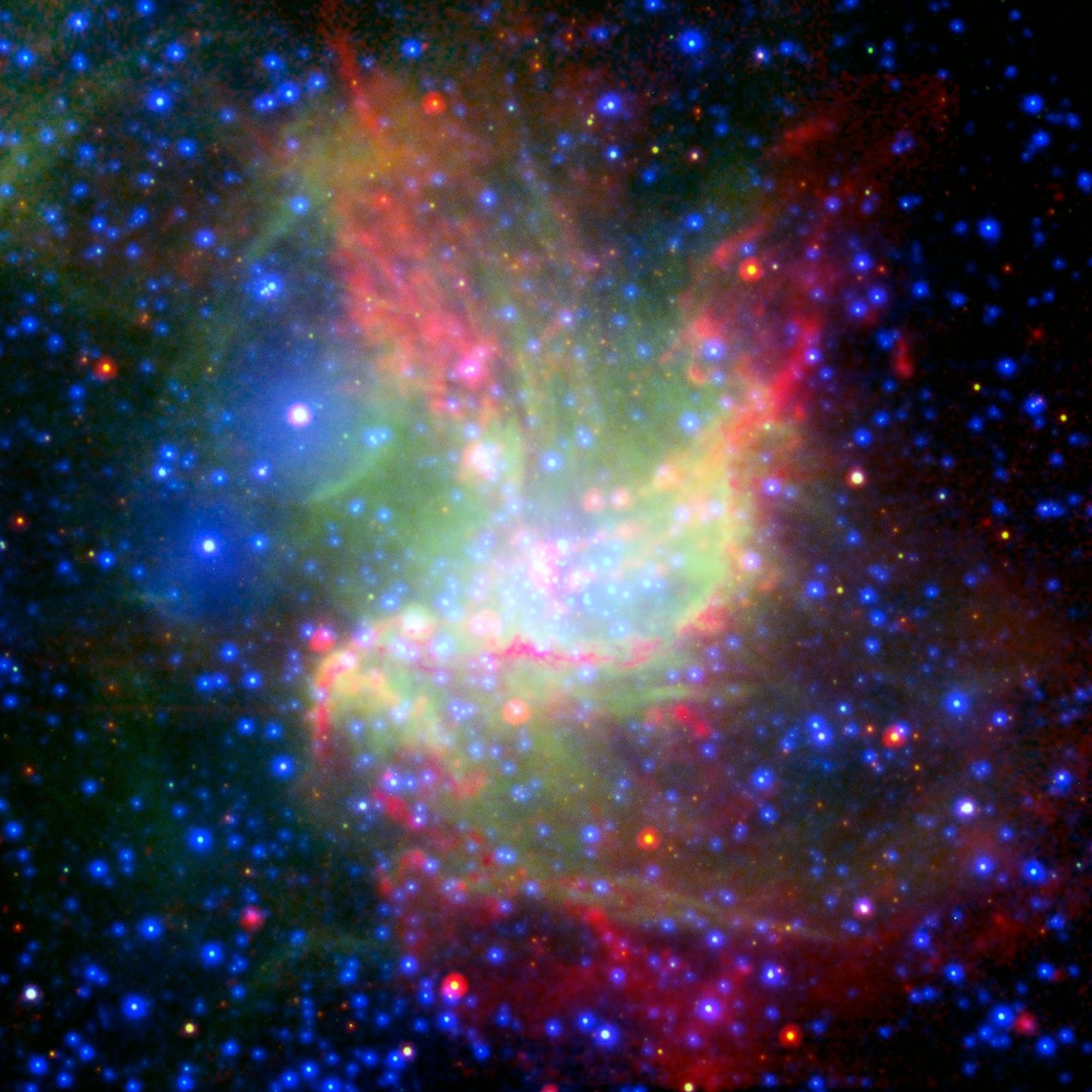
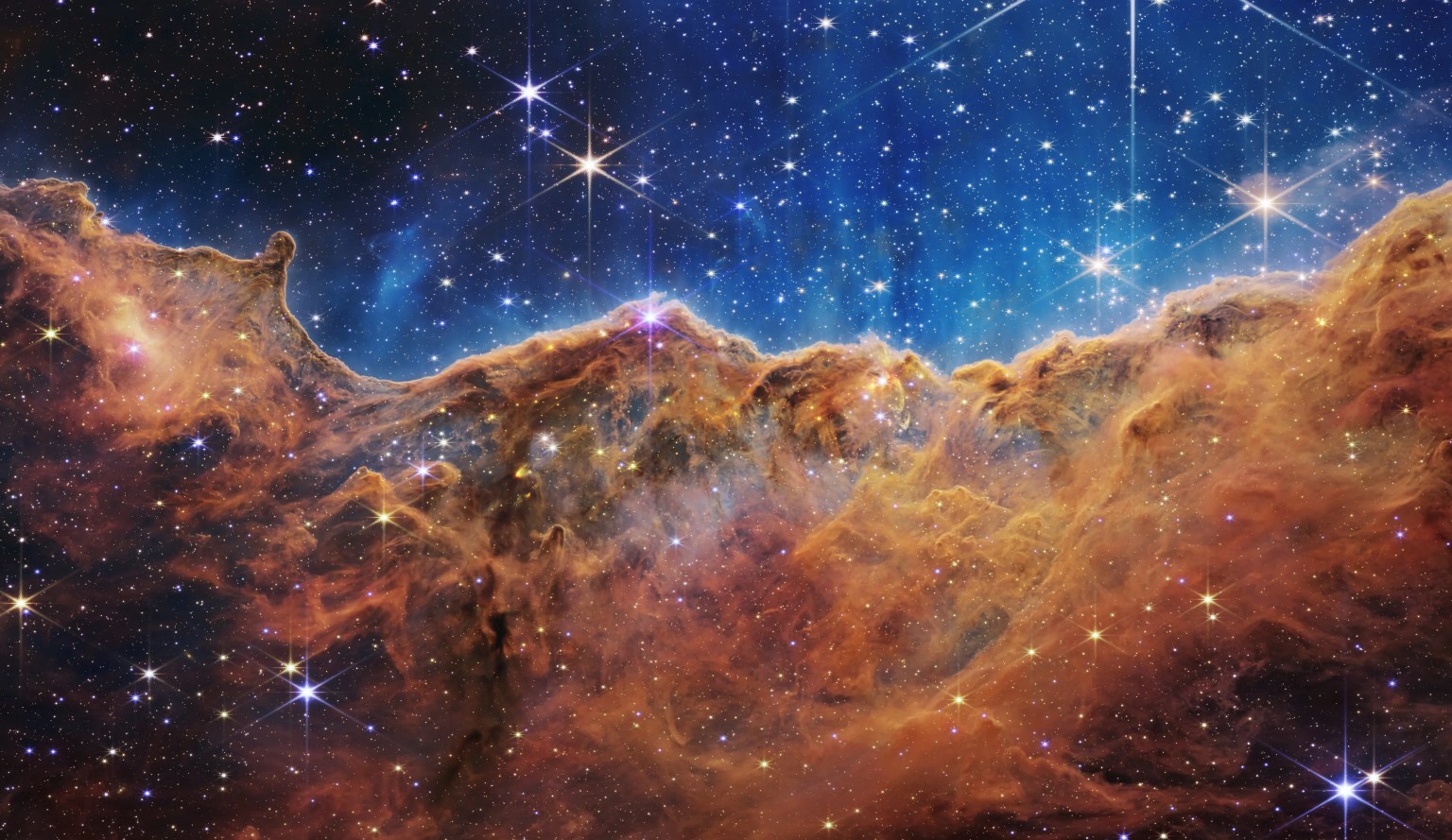
This image of the star-forming cloud NGC 346 is a combination of multiwavelength light from NASA's Spitzer Space Telescope (infrared), the European Southern Observatory's New Technology Telescope (visible), and the European Space Agency's XMM-Newton space telescope (X-ray). Webb’s sharper infrared vision will allow astronomers to survey in greater detail developing stars still encased in their natal cocoons of gas and dust.
About the Object
- R.A. PositionR.A. PositionRight ascension – analogous to longitude – is one component of an object's position.00h 59m 18s
- Dec. PositionDec. PositionDeclination – analogous to latitude – is one component of an object's position.-72° 10' 48.0"
- ConstellationConstellationOne of 88 recognized regions of the celestial sphere in which the object appears.Tucana
- DistanceDistanceThe physical distance from Earth to the astronomical object. Distances within our solar system are usually measured in Astronomical Units (AU). Distances between stars are usually measured in light-years. Interstellar distances can also be measured in parsecs.210,000 light-years away (64,000 parsecs)
- Object NameObject NameA name or catalog number that astronomers use to identify an astronomical object.NGC 346
- Object DescriptionObject DescriptionThe type of astronomical object.Star-forming region in the Small Magellanic Cloud
- Release DateDecember 12, 2018
- Science ReleaseNASA’s Webb Telescope Will Provide Census of Fledgling Stars in Stellar Nursery
- CreditImage: NASA, Caltech, Dimitrios Gouliermis (MPIA)
Related Images & Videos
Are All Galaxies the Same?
Galaxies come in many shapes and sizes, reflecting their formation histories. Some galaxies are orderly spirals, while others appear disorganized or more complex. Galaxies also collide to create new forms and shapes. Production Details All images, illustrations, and videos...
Share
Details
Laura Betz
NASA’s Goddard Space Flight Center
Greenbelt, Maryland
laura.e.betz@nasa.gov
NASA, Caltech, Dimitrios Gouliermis (MPIA)