
















1 min read
North Ecliptic Pole Time Domain Field
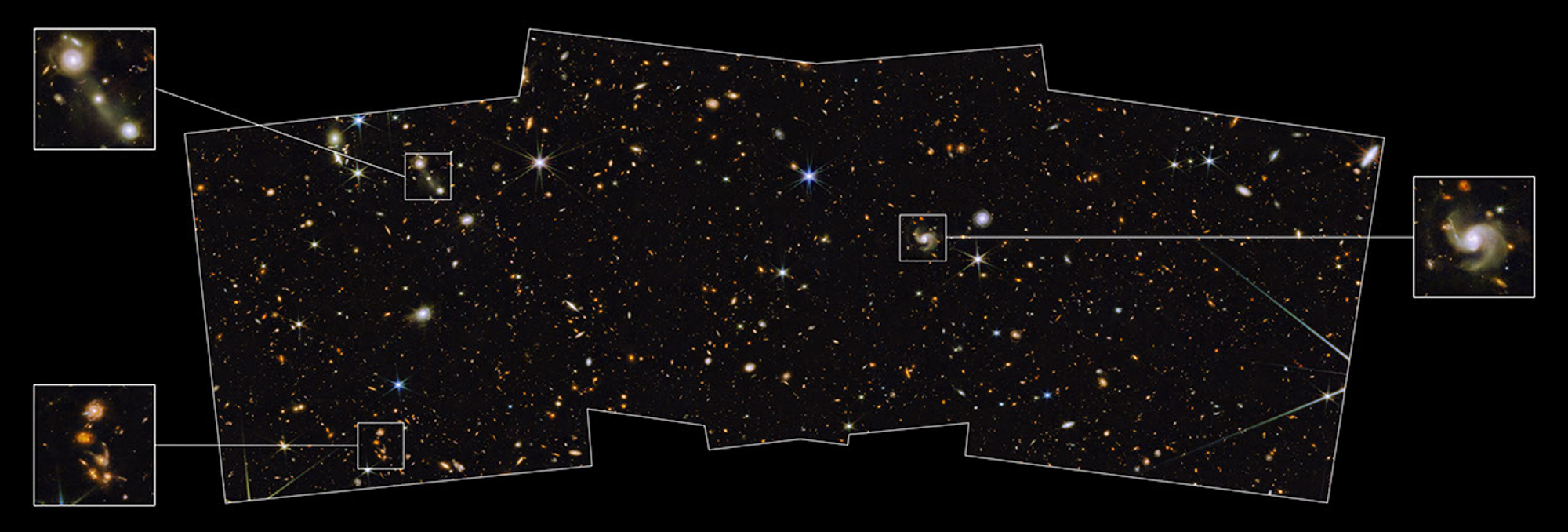
A swath of sky measuring 2% of the area covered by the full moon was imaged with Webb’s Near-Infrared Camera (NIRCam) in eight filters and with Hubble’s Advanced Camera for Surveys (ACS) and Wide-Field Camera 3 (WFC3) in three filters that together span the 0.25 – 5-micron wavelength range. This image represents a portion of the full PEARLS field, which will be about four times larger. Thousands of galaxies over an enormous range in distance and time are seen in exquisite detail, many for the first time. Light from the most distant galaxies has traveled almost 13.5 billion years to reach us. Because this image is a combination of multiple exposures, some stars show additional diffraction spikes. This representative-color image was created using Hubble filters F275W (purple), F435W (blue), and F606W (blue); and Webb filters F090W (cyan), F115W (green), F150W (green), F200W (green), F277W (yellow), F356W (yellow), F410M (orange), and F444W (red).
About the Object
- R.A. PositionR.A. PositionRight ascension – analogous to longitude – is one component of an object's position.17:22:47.90
- Dec. PositionDec. PositionDeclination – analogous to latitude – is one component of an object's position.+65:49:21.54
- ConstellationConstellationOne of 88 recognized regions of the celestial sphere in which the object appears.Draco
About the Data
- Data DescriptionData DescriptionProposal: A description of the observations, their scientific justification, and the links to the data available in the science archive.
Science Team: The astronomers who planned the observations and analyzed the data. "PI" refers to the Principal Investigator. - InstrumentInstrumentThe science instrument used to produce the data.Hubble> ACS/WFC, WFC3/UVISWebb> NIRCam
- Exposure DatesExposure DatesThe date(s) that the telescope made its observations and the total exposure time.26 Aug 2022, 14 Sept 2022 (Webb)
- FiltersFiltersThe camera filters that were used in the science observations.Hubble> F275W, F435W, F606WWebb> F090W, F115W, F150W, F200W, F277W, F356W, F410M, F444W
- Object NameObject NameA name or catalog number that astronomers use to identify an astronomical object.North Ecliptic Pole (NEP), PEARLS
- Object DescriptionObject DescriptionThe type of astronomical object.Deep Survey
- Release DateDecember 14, 2022
- CreditNASA, ESA, CSA, JWST PEARLS Team, Rolf Jansen (ASU), Jake Summers (ASU), Rosalia O'Brien (ASU), Rogier Windhorst (ASU), Aaron Robotham (UWA), Anton Koekemoer (STScI), Christopher Willmer (University of Arizona); Image Processing: Rolf Jansen (ASU), Alyssa Pagan (STScI)
Downloads
These images are a composite of separate exposures acquired by the James Webb Space Telescope using the NIRCam instrument and the Hubble Space Telescope using the ACS/WFC and UVIS/WFC3 instruments. Several filters were used to sample specific wavelength ranges. The color results from assigning different hues (colors) to each monochromatic (grayscale) image associated with an individual filter. In this case, the assigned colors are: Purple: F275W, Indigo: F435W, Blue: F606W, Light-Blue: F090W, Cyan: F115W, Green: F150W, Yellow/Green: F200W, Yellow: F277W, Light-Orange: F356W, Orange: F410M, Red: F444W
Share
Details
Laura Betz
NASA’s Goddard Space Flight Center
Greenbelt, Maryland
laura.e.betz@nasa.gov
NASA, ESA, CSA, JWST PEARLS Team, Rolf Jansen (ASU), Jake Summers (ASU), Rosalia O’Brien (ASU), Rogier Windhorst (ASU), Aaron Robotham (UWA), Anton Koekemoer (STScI), Christopher Willmer (University of Arizona)
Rolf Jansen (ASU), Alyssa Pagan (STScI)