1 min read
Protoplanetary Disk SZ Cha (MIRI Spectrum)
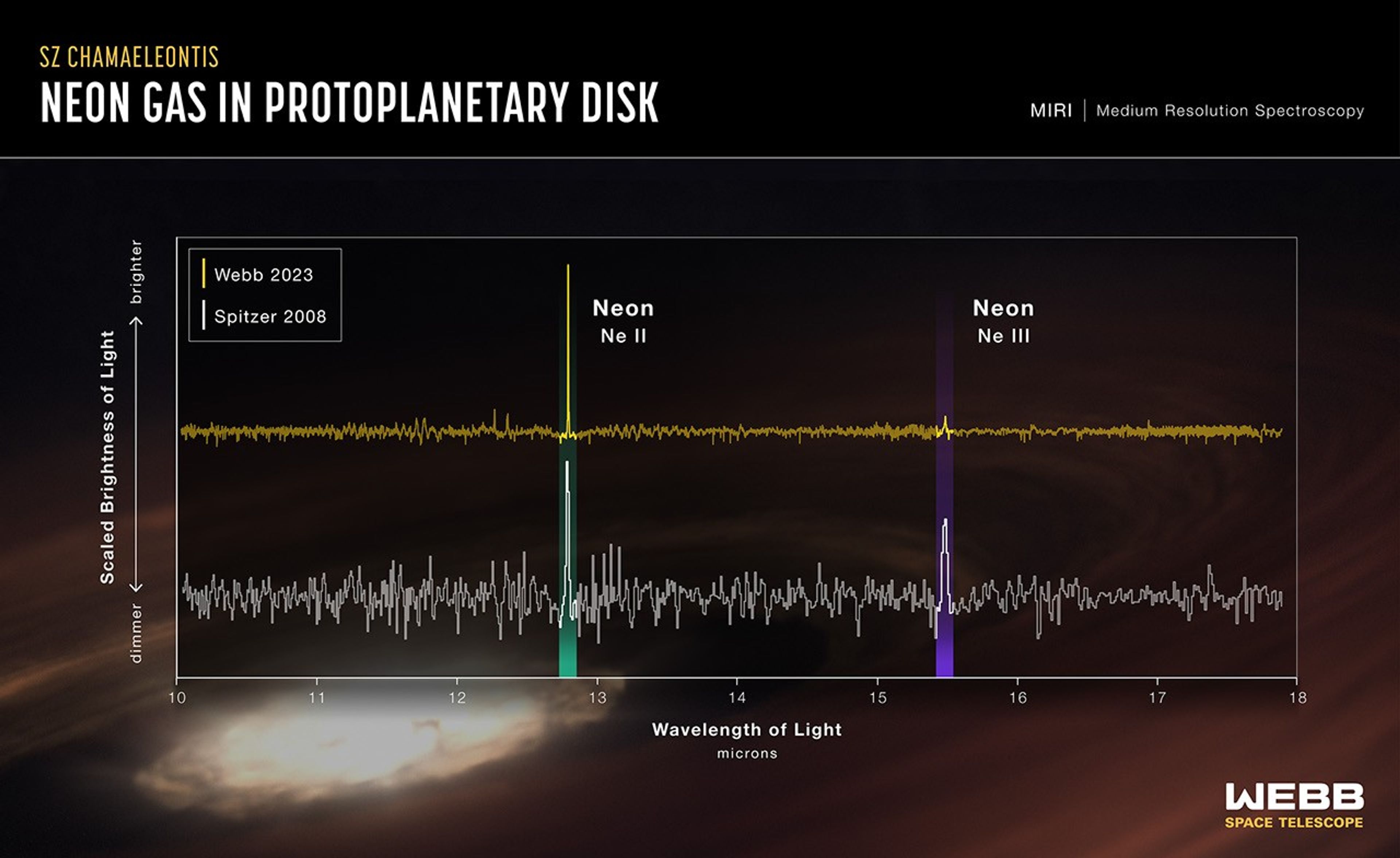
Contrasting data from NASA’s James Webb and Spitzer space telescopes show change in the disk surrounding the star SZ Chamaeleontis (SZ Cha) in just 15 years. In 2008, Spitzer’s detection of significant neon III made SZ Cha an outlier among similar young protoplanetary disks. However, when Webb followed up on SZ Cha in 2023, the ratio of neon II to III was within typical levels.
All of this is significant because protoplanetary disks are the stuff of future planetary systems – and those potential planets are in a race against time. Astronomers use neon as an indicator of the dominant radiation hitting the disk and causing it to evaporate. When extreme ultraviolet light is dominant, there is more neon III. That is the unusual circumstance that Spitzer observed in 2008. Typically, a disk is dominated by X-ray radiation, which evaporates the disk more quickly, leaving planets less time to form.
Researchers think the dramatic differences in neon detections are the result of a wind that, when present, absorbs ultraviolet light and leaves X-rays to pummel the disk. They will continue using Webb to find other examples of variability in disk conditions, working toward a better understanding of how planetary systems develop around Sun-like stars.
Extended Description and Image Alt Text
Extended Description
The vertical Y axis is labeled, Scaled Brightness of Light, with a double-ended arrow pointing toward brighter at the top and dimmer at the bottom. The horizontal X axis is numbered 10 to 18 at regular intervals. Below the numbers are the words Wavelength of Light, microns.
Two squiggly lines are compared, with yellow, the Webb data, shown on top of the Spitzer data. The Webb squiggle has noticeably less vertical noise, and is more detailed horizontally. Two specific spikes in both spectra are highlighted with a vertical colored column. Just before 13 microns on the X axis, a green column highlights a tall vertical spike in both spectra. They are labeled Neon, N E Roman numeral two. Between 15 and 16 microns, a purple column highlights a shorter vertical spike in the Spitzer spectrum, which is contrasted with a very small peak in the Webb spectrum. The Webb peak is not any larger than some of the other peaks in its spectrum. This purple column, and the peaks it highlights, are labeled Neon, N E Roman numeral three. Stylized text in the lower right of the infographic reads Webb Space Telescope.
Image Alt Text
Infographic titled SZ Chamaeleontis, Neon Gas in Protoplanetary Disk. Text at top right reads MIRI, Medium Resolution Spectroscopy. Two spectra lines are compared, labeled in a key as yellow being Webb 2023, and white being Spitzer 2008. Behind the spectra an illustration of a protoplanetary disk shows through, with a very bright center. Two squiggly lines are compared, with yellow, the Webb data, shown on top of the Spitzer data. Just before 13 microns on the X axis, a green column highlights a tall vertical spike in both spectra. They are labeled Neon, N E Roman numeral two. Between 15 and 16 microns, a purple column highlights a shorter vertical spike in the Spitzer spectrum, which is contrasted with a very small peak in the Webb spectrum. This purple column, and the peaks it highlights, are labeled Neon, N E Roman numeral three. See extended description for more.
- Release DateNovember 15, 2023
- Science ReleaseWebb Follows Neon Signs Toward New Thinking on Planet Formation
- CreditIllustration: NASA, ESA, CSA, Ralf Crawford (STScI)
Related Images & Videos
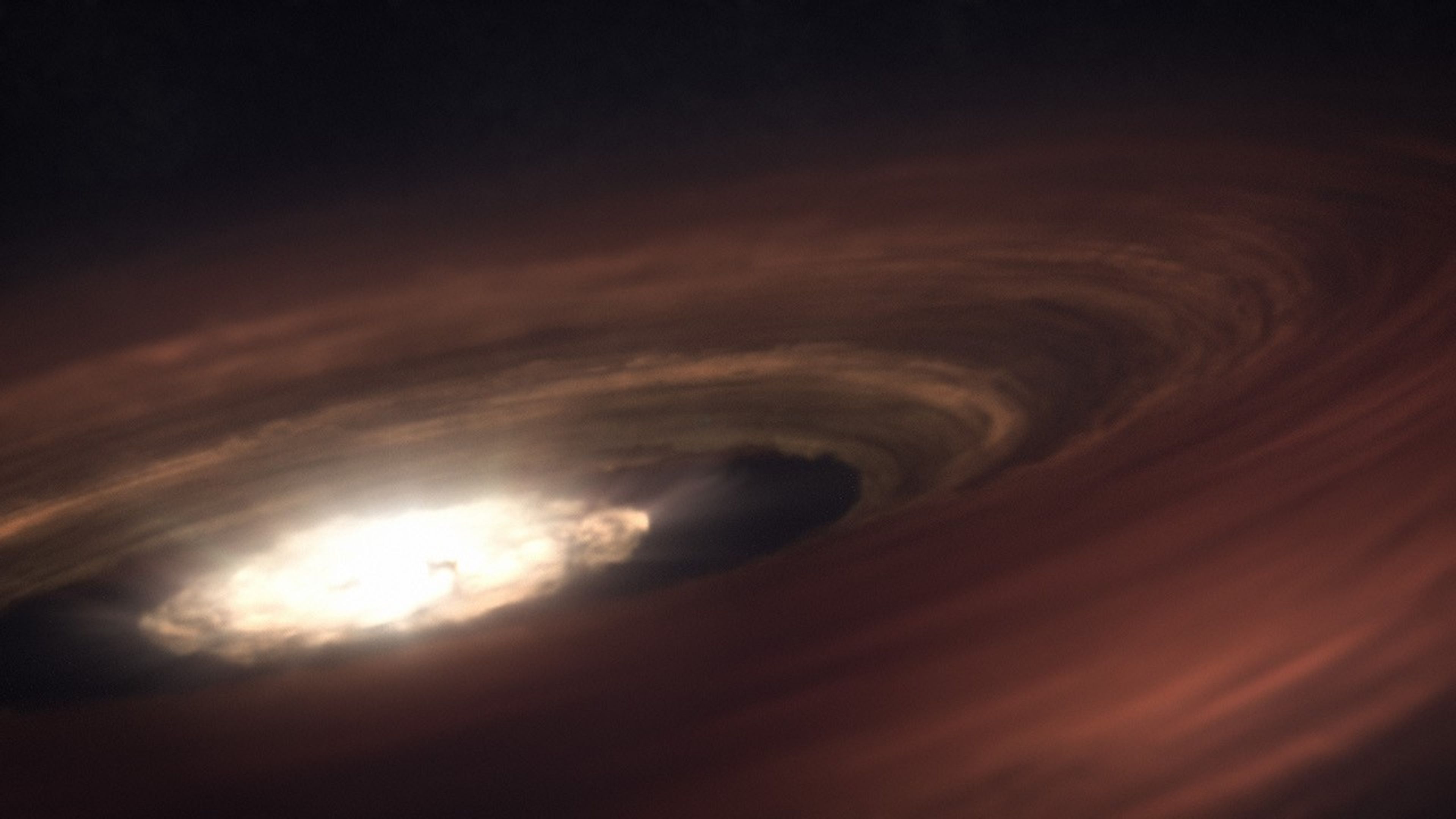
SZ Chamaeleontis (Artist Concept)
In this artist concept, the young star SZ Chamaeleontis (SZ Cha) is surrounded by a disk of dust and gas with the potential to form a planetary system. Once our solar system looked something like this, before planets, moons, and asteroids formed. The raw ingredients, including...
Share
Details
Laura Betz
NASA’s Goddard Space Flight Center
Greenbelt, Maryland
laura.e.betz@nasa.gov
NASA, ESA, CSA, Ralf Crawford (STScI)