



















1 min read
Sextans A PAHs Pull-out (NIRCam and MIRI Image)
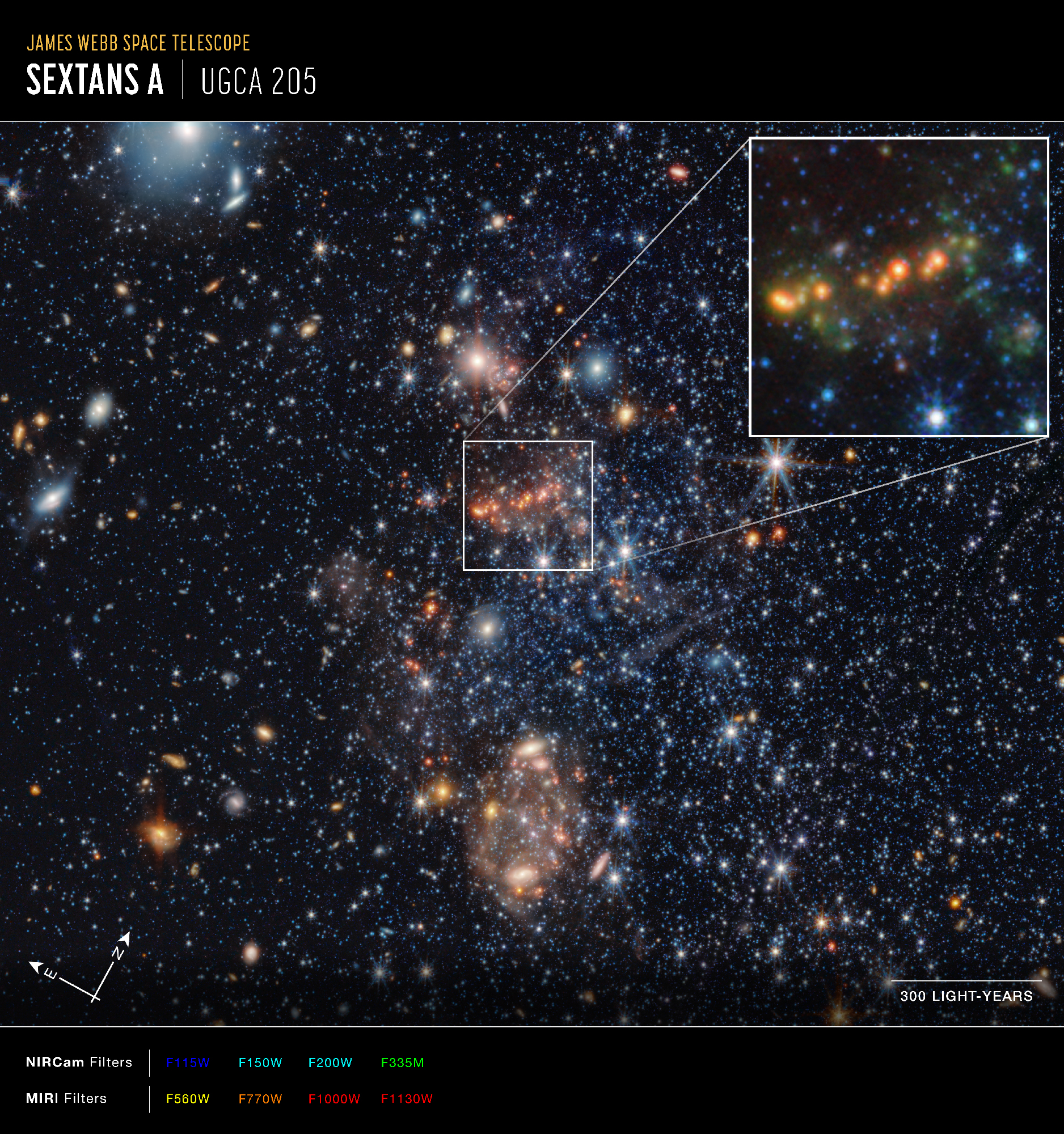
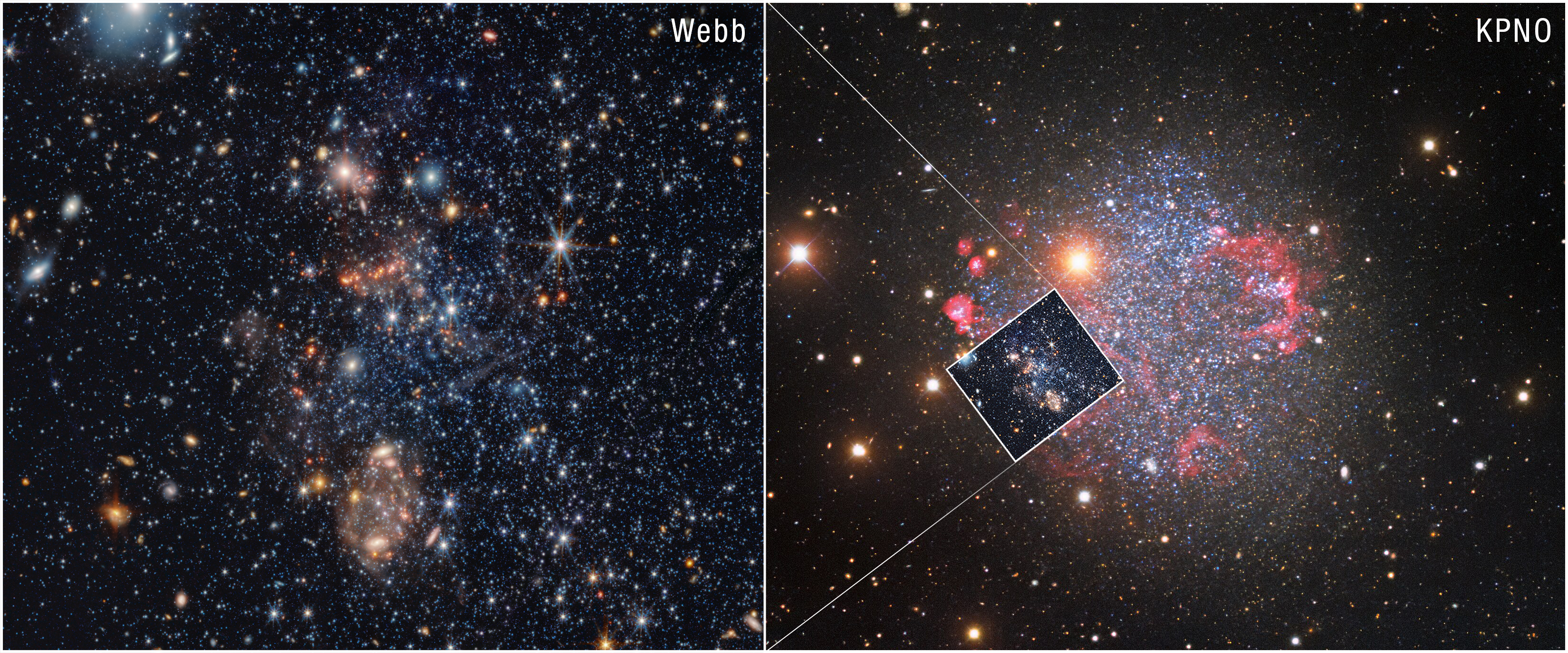
Images from NASA’s James Webb Space Telescope of the dwarf galaxy Sextans A reveal polycyclic aromatic hydrocarbons (PAHs), large carbon-based molecules that can be a signifier of star formation. The inset at the top right zooms in on those PAHs, which are represented in green. In Sextans A, the PAHs are clumpy and relatively small.
Sextans A is a nearby galaxy that is chemically primitive, meaning it has a very low content of metals heavier than helium and hydrogen. It resembles galaxies that filled the early universe, before stars had a chance to enrich the space with ‘metals’ like oxygen and iron. With the new discovery from Webb, Sextans A is now the lowest-metallicity galaxy ever found to contain PAHs.
About the Object
- R.A. PositionR.A. PositionRight ascension – analogous to longitude – is one component of an object's position.10:11:02.11
- Dec. PositionDec. PositionDeclination – analogous to latitude – is one component of an object's position.-04:42:49.55
- ConstellationConstellationOne of 88 recognized regions of the celestial sphere in which the object appears.Sextans
- DistanceDistanceThe physical distance from Earth to the astronomical object. Distances within our solar system are usually measured in Astronomical Units (AU). Distances between stars are usually measured in light-years. Interstellar distances can also be measured in parsecs.About 4.4 million light-years
- DimensionsDimensionsThe physical size of the object or the apparent angle it subtends on the sky.Image is 1.65 arcminutes across (about 2,000 light-years)
About the Data
- Data DescriptionData DescriptionProposal: A description of the observations, their scientific justification, and the links to the data available in the science archive.
Science Team: The astronomers who planned the observations and analyzed the data. "PI" refers to the Principal Investigator.This image was created with Webb data from proposal: 2391 (J. Roman-Duval)
- InstrumentInstrumentThe science instrument used to produce the data.NIRCam, MIRI
- Exposure DatesExposure DatesThe date(s) that the telescope made its observations and the total exposure time.02-04 Jan. 2023, 13 April 2023
- FiltersFiltersThe camera filters that were used in the science observations.NIRCam: F115W, F150W, F200W, F335M MIRI: F560W, F770W, F1000W, F1130W
- Object NameObject NameA name or catalog number that astronomers use to identify an astronomical object.Sextans A, UGCA 205
- Object DescriptionObject DescriptionThe type of astronomical object.Irregular, dwarf galaxy
- Release DateJanuary 6, 2026
- Science ReleaseNASA Webb Finds Early-Universe Analog’s Unexpected Talent for Making Dust
- CreditImage: NASA, ESA, CSA, Elizabeth Tarantino (STScI), Martha Boyer (STScI), Julia Roman-Duval (STScI); Image Processing: Alyssa Pagan (STScI)
Downloads
These images are a composite of separate exposures acquired by the James Webb Space Telescope using the NIRCam and MIRI instruments. Several filters were used to sample specific wavelength ranges. The color results from assigning different hues (colors) to each monochromatic (grayscale) image associated with an individual filter. In this case, the assigned colors are: Blue= F115W, Cyan= F150W+F200W, Green= F335M, Yellow= F560W, Orange: F770W, Red=F1000W+F1130W
Related Images & Videos
Share
Details
Laura Betz
NASA’s Goddard Space Flight Center
Greenbelt, Maryland
laura.e.betz@nasa.gov