



Suggested Searches

1 min read

Trappist-1 System Orbit Comparison
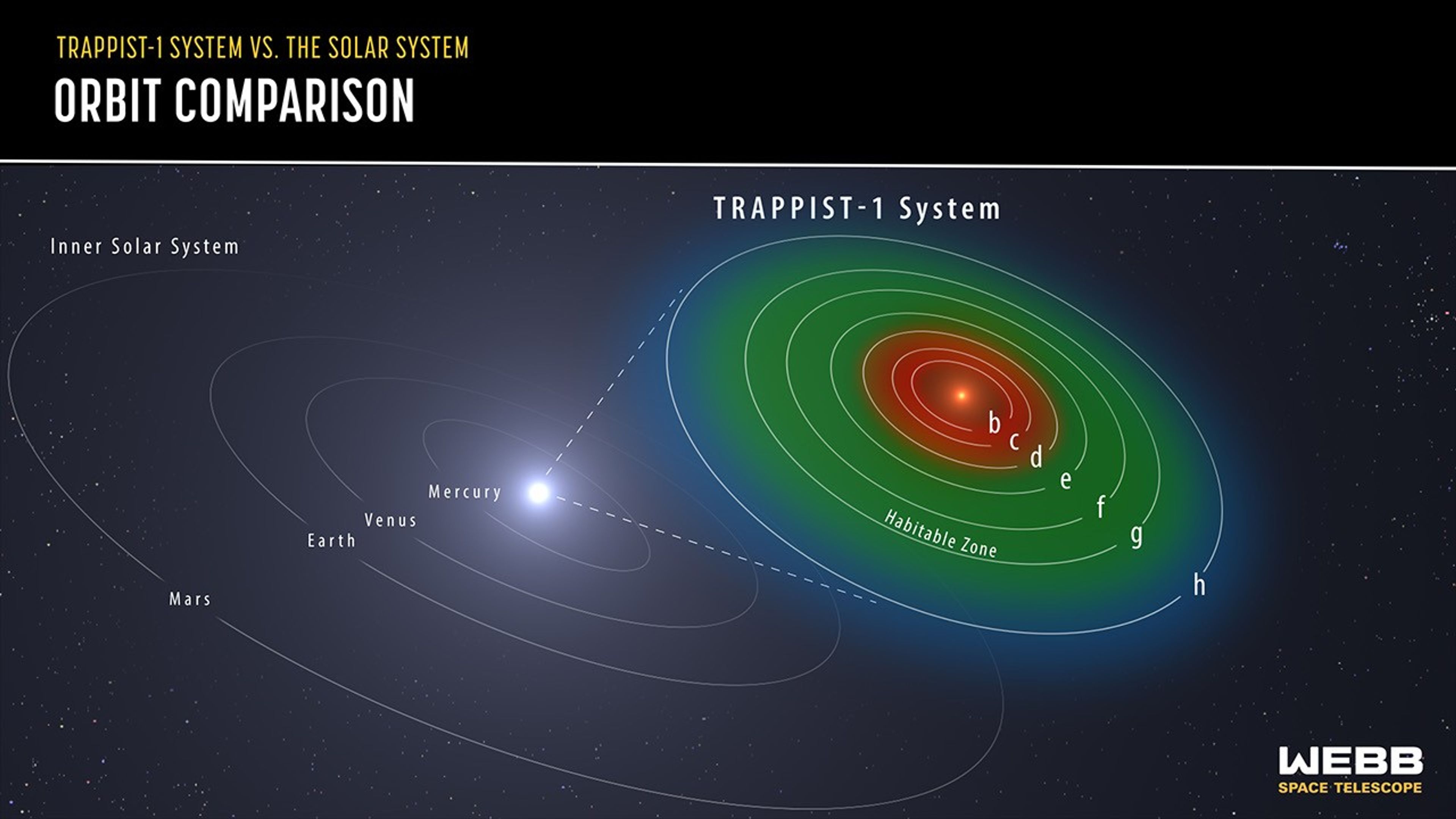
Graphic titled “TRAPPIST-1 System Versus The Solar System, Orbit Comparison.” The inner solar system is at left and labeled “Inner Solar System.” The Sun is depicted as a bright white circle. 4 planets' orbital paths are labeled: Mercury, Venus, Earth, and Mars. 2 lines extend from between the Sun and Mercury to an overlay of the TRAPPIST-1 system at right. 7 rings, representing the orbital paths of the 7 planets, surround the star. They are labeled starting with b, the closest planet to the star, and ending with h, the planet farthest away. Obital areas of planets b, c, and d are shaded red, signifying they are too close to be in the host star’s habitable zone. Orbital areas of planets e, f, and g are green, signifying they are in the area where conditions are just right for liquid water to exist on a planet’s surface. The green area is labeled “Habitable Zone.” Orbital area of planet h is blue to indicate the planet is too far away to be in the host star’s habitable zone.

All seven planets of the TRAPPIST-1 system orbit closer to their host star than Mercury does to the Sun. This diagram compares the orbits of the seven TRAPPIST-1 planets around their star, which are labeled from b to h, to the orbits of the inner solar system planets around the Sun. The orbital areas of TRAPPIST-1 b, c, and d are red to indicate they are too close to be in the host star’s habitable zone. TRAPPIST-1 e, f, and g are in their host star’s habitable zone (in green), the area where the conditions are just right for liquid water to exist on a planet’s surface. The orbital area of planet h is blue to indicate the planet is too far away to be in the host star’s habitable zone.

  • Release Date
    January 15, 2026
  • Credit
    Image: NASA, ESA, CSA, Joseph Olmsted (STScI)

Downloads

  • Full Res (For Display), 3840 × 2160
    jpg (562.92 KB)
  • Full Res (For Print), 3840 × 2160
    tif (12.88 MB)
  • 1920 × 1080
    jpg (233.31 KB)

Share

Details

Last Updated
Jan 15, 2026
Contact
Media

Laura Betz
NASA’s Goddard Space Flight Center
Greenbelt, Maryland
laura.e.betz@nasa.gov