

















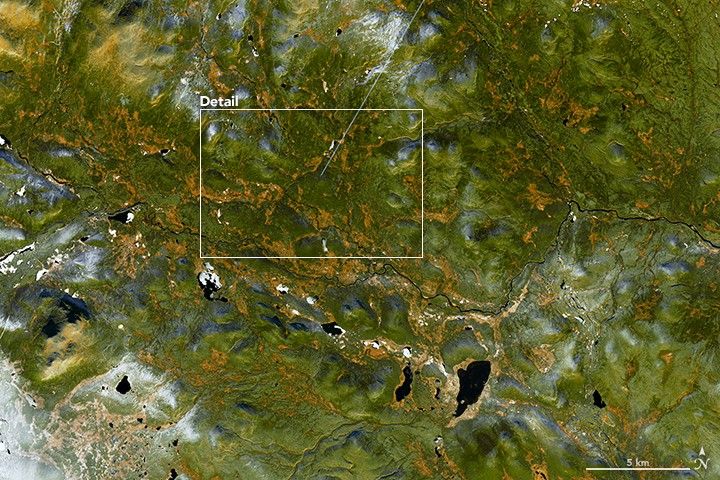

Fall in northern Sweden is a brief but spectacular affair. For a few weeks in October, alpine forests in this remote part of Swedish Lapland turn blazing shades of yellow and orange.
The Operational Land Imager (OLI) on the Landsat 8 satellite captured this image of hilly terrain in northern Lapland on October 10, 2016. Birch forests growing along stream valleys are probably the source of most of the color, though other deciduous shrubs and understory plants surely contribute as well. Some of the hills have a dusting of snow. The southern Sun’s low angle above the horizon draws long, dark shadows across the landscape.
In autumn, the leaves on deciduous trees change colors as they lose chlorophyll, the molecule that plants use to synthesize food. Chlorophyll makes plants appear green because it absorbs red and blue sunlight. It is not a stable compound, and plants have to continuously produce it, a process that requires ample sunlight and warm temperatures. When days shorten and temperatures drop, levels of chlorophyll do as well.
As the green fades, other leaf pigments—carotenoids and anthocyanins—show off their colors. Carotenoids absorb blue-green and blue light, appearing yellow and orange. Anthocyanins absorb blue, blue-green, and green light, appearing red.
In fall displays of color in Scandinavia and northern Europe yellows tends to dominate and reds are rare. In fact, northern Europe has just four tree species that turn red, compared with 89 tree species in North America. In East Asia, the number is 150.
In Lapland, the local name for leaf peeping season is ruska, the time of year when Scandinavians head outdoors to savor nature’s display before the long, dark winter descends.
References & Resources
- Appalachian State University On the Hidden Colors in Leaves: What are the Functions of Those Yellow and Orange Pigments We See in the Fall? Accessed October 21, 2016.
- Appalachian State University Why Is Red Fall Color Nearly Absent in Northern Europe but Prevalent in North America? Accessed October 21, 2016.
- Birchmoth (2015) The mountain birch forest. Accessed October 21, 2016.
- Earth (2009, November 3) Why Leaves Remain Elusive in Europe. Accessed October 21, 2016.
- Lakehead University Sweden Accessed October 21, 2016.
- Royal Swedish Academy of Agriculture and Forestry Forests and Forestry in Sweden. Accessed October 21, 2016.
- Stockholm University Ekolim Study Region Accessed October 21, 2016.
- Swedish Lapland The Eight Seasons of Swedish Lapland. Accessed October 21, 2016.
- The United States National Arboretum (2011, October 6) The Science of Color in Autumn Leaves. Accessed October 21, 2016.
NASA Earth Observatory maps by Joshua Stevens, using Landsat data from the U.S. Geological Survey . Caption by Adam Voiland.