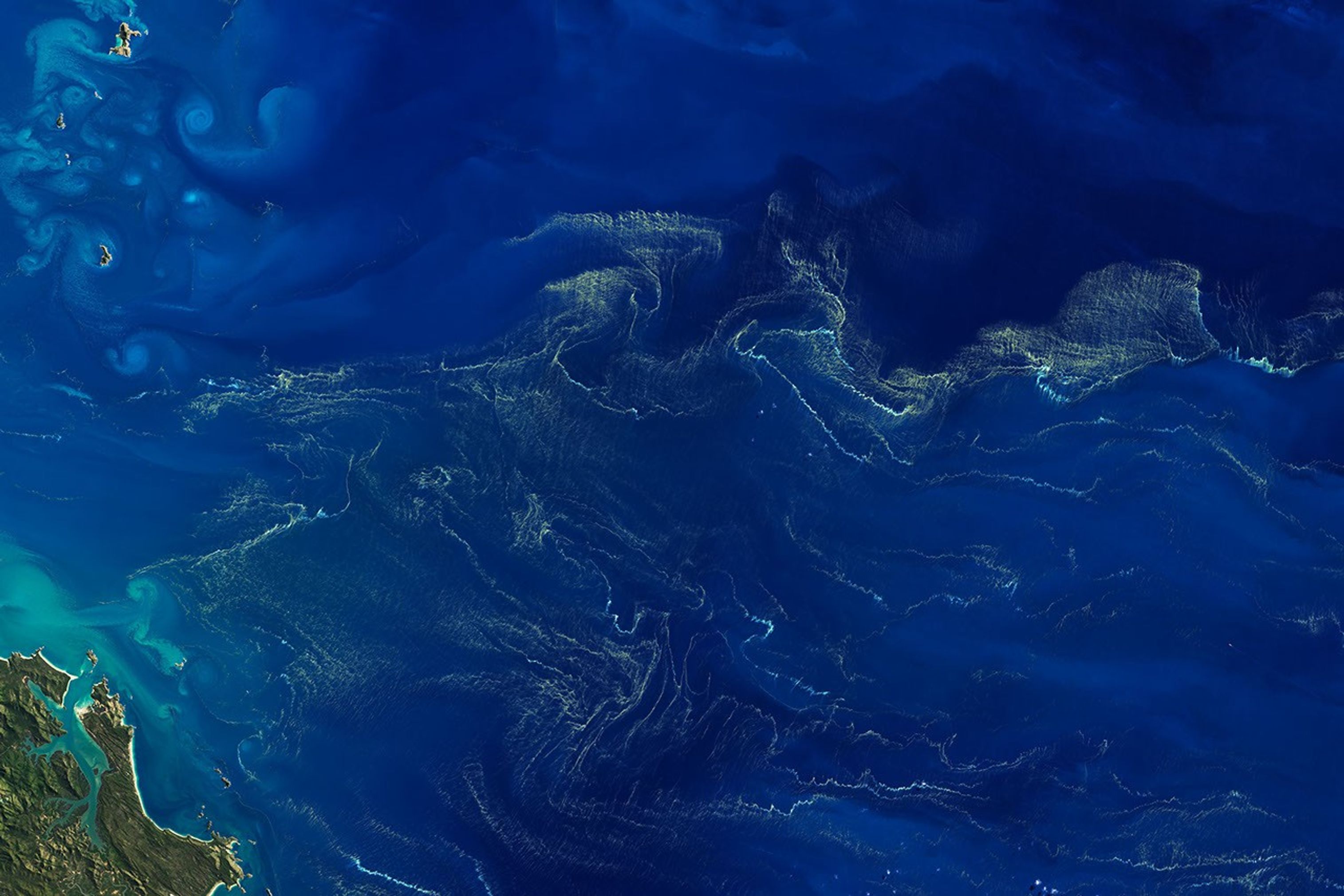





















A bed of sea sawdust. A bundle of chopped hay. A pile of sea scum.
The cyanobacteria Trichodesmium spp. has been given many different descriptions, dating back to its first recorded observation in the 1700s by Captain James Cook. In addition to its distinct appearance, these wispy, microscopic filaments also play an important part in sustaining marine life.
All aquatic organisms depend on nutrients for growth; one of the most important is nitrogen. Trichodesmium plays an important role in the ocean because it supplies large quantities of this necessary element. Trichodesmium belong to a class of bacteria called diazotrophs, which take nitrogen from the atmosphere and convert it to ammonia—a more usable form of nitrogen for photosynthesizing microbes. Research shows Trichodesmium accounts for about 60 to 80 percent of nitrogen fixation in the ocean.
Trichodesmium most commonly bloom—grow rapidly in dense patches—in nutrient-poor tropical and subtropical waters in warmer conditions. They are often seen off the coast of Queensland between August and December when the water warms.
On September 1, 2019, the Operational Land Imager on Landsat 8 captured an image of what appears to be a bloom of Trichodesmium near the Great Barrier Reef off of northeast Australia. Trichodesmium blooms appear yellowish-brown when the bloom is healthy, green when it starts to decay, and white after the pigments decay.
References & Resources
- Atlas Obscura (2017, October 9) A Sea Scum Bloom Off Australia Can Be Seen From Space. Accessed September 13, 2019.
- Boatman, T. G., et al. (2017) A Key Marine Diazotroph in a Changing Ocean: The Interacting Effects of Temperature, CO2 and Light on the Growth of Trichodesmium erythraeum IMS101. PLOS One 12 (1).
- Florida Fish and Wildlife Conservation Commission Learn About Trichodesmium. Accessed September 13, 2019.
- NASA Earth Observatory (2017, October 7) Sea Sawdust off Gladstone.
- NASA Earth Observatory (2016, January 16) âSea Sawdustâ in the Southwest Pacific Ocean.
- University of HawaiâI at Manoa Nitrogen Cycling in the Open Ocean. Accessed September 13, 2019.
NASA Earth Observatory image by Joshua Stevens, using Landsat data from the U.S. Geological Survey. Story by Kasha Patel.