

















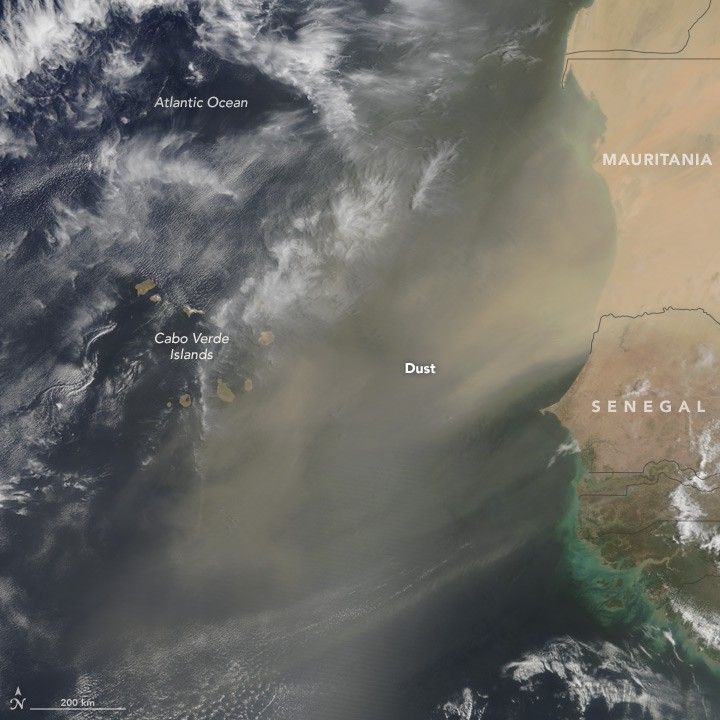
Strong desert winds in mid-May 2017 lofted a huge dust plume from western Africa and carried it over the Atlantic Ocean. At 12:10 Universal Time on May 9, 2017, the Moderate Resolution Imaging Spectroradiometer (MODIS) on NASA’s Terra satellite acquired this natural-color image of airborne sand and other aerosols. The plume stretched southwest to the Cabo Verde (Cape Verde) islands and beyond.
Africa is the world’s largest source of dust to the atmosphere, contributing about 70 percent of the global total. Airborne mineral dust from the world’s deserts delivers nutrients to the land and ocean, and affects the atmosphere and climate.
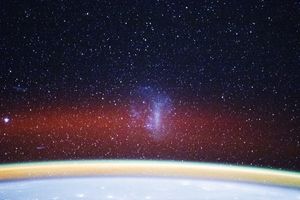
About 30 minutes after MODIS captured its image, astronauts on the International Space Station (ISS) passed over the region. Watch the event unfolding in the video above, acquired with the High Definition Earth Viewing (HDEV) video camera mounted on the ISS. Part of the plume is apparent throughout the duration of the video. By about three minutes in, nearly the entire visible sky area takes on a rusty hue. Footage like this is streamed live from HDEV experiment cameras, which can be viewed here.
References & Resources
- International Space Station (2017, May 10) High Definition Earth Viewing (HDEV). Accessed May 12, 2017.
- Prospero, J. M. et al. (2014, July) Characterizing the annual cycle of African dust transport to the Caribbean Basin and South America and its impact on the environment and air quality. Global Biogeochemical Cycles 28 (7), 757–773.
NASA image by Jeff Schmaltz, LANCE/EOSDIS Rapid Response. Video from the International Space Station High Definition Earth Viewing experiment. Story by Kathryn Hansen.